This resolution expresses the sense of the House of Representatives that U.S. Postal Service employees are frontline essential workers and must be prioritized accordingly for purposes of COVID-19 (i.e., coronavirus disease 2019) vaccine distributions.
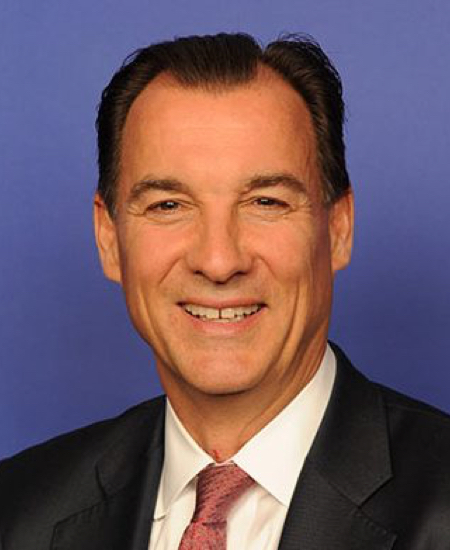
Rep. Thomas R. Suozzi
Sponsored bills
Stop the Attack on Local Taxpayers Act of 2021 or the SALT Act This bill repeals the limitation on the deductibility of state and local taxes during 2018-2025. It also increases from $250 to $1,000 the tax deduction for certain expenses of elementary and secondary school teachers and allows a deduction from gross income (above-the-line) for certain training and uniform expenses of first responders (i.e., individuals who are law enforcement officers, firefighters, paramedics, or emergency medical technicians for at least 1,000 hours during a taxable year). The bill expands individual income tax brackets and increases the top income tax rate for individual taxpayers to 39.6%.
This bill suspends for 2020 the recapture of any overpayment of the tax credit for coverage under a qualified health care plan.
American Family Act of 2021 This bill modifies the child tax credit to (1) make the credit fully refundable, (2) increase the amount of the credit and allow an additional credit for children who are under six years of age, (3) require the amount of the credit to be adjusted annually for inflation, and (4) require the Department of the Treasury to establish a program for making advance payments of the credit on a monthly basis.
This resolution expresses the sense of the House of Representatives that the U.S. Postal Service should continue door delivery for all customers.
Small Business PPE Tax Credit Act This bill allows certain small businesses a tax credit for qualified personal protective equipment expenses, up to $25,000 in a taxable year. The entities eligible for such credit include farms, veterans organizations, and tribal business concerns. The bill defines qualified personal protective equipment expenses to include the cost of equipment for reducing the risk of coronavirus (i.e., the virus that causes COVID-19) transmission, including gloves, medical masks and protective gear, and cleaning supplies.
Gym Mitigation and Survival Act of 2021 or the GYMS Act of 2021 This bill establishes a grant program to provide economic support to eligible fitness facilities in response to the COVID-19 (i.e., coronavirus disease 2019) pandemic. Specifically, the bill authorizes the Small Business Administration to make initial and supplemental grants to privately owned fitness facilities that primarily provide health or fitness services and that do not offer golf, hunting, sailing, or riding facilities. The total amount of grant funds for a recipient may not exceed $25 million, and the recipient must use these funds for payroll costs, rent or mortgage obligations, and other ordinary and necessary business expenses.
Future Advancement of Academic Nursing Act or the FAAN Act This bill authorizes the Health Resources and Services Administration (HRSA) to award grants to nursing schools to increase capacity to respond to public health emergencies and pandemics and otherwise enhance nursing education programs. In awarding these grants, HRSA shall prioritize historically Black colleges and universities and other minority-serving institutions, schools that are located in medically underserved communities, and schools in areas with shortages of health professionals.
Gun Violence Prevention Research Act of 2021 This bill authorizes the Centers for Disease Control and Prevention to conduct or support research on firearms safety or gun violence prevention.
National Climate Emergency Act of 2021 or the Climate Emergency Act of 2021 This bill directs the President to declare a national emergency with respect to climate change. The President, in responding to the emergency, must ensure that the government invests in large scale mitigation and resiliency projects; makes investments that enable a racially and socially just transition to a clean energy economy by ensuring that at least 40% of investments flow to historically disadvantaged communities; avoids solutions that increase inequality or violate human rights; creates jobs that conform to labor standards that provide family sustaining wages and benefits and ensure safe workplaces; prioritizes local and equitable hiring and contracting that creates opportunities for marginalized communities; combats environmental injustice; and reinvests in existing public sector institutions and creates new public sector institutions to strategically mobilize and channel investments at the scale and pace required by the national emergency. The President shall report annually on actions taken in response to the national emergency.