Maddy summaryThis bill requires major internet companies (including social media, streaming services, and app stores) and broadband providers to contribute to the Universal Service Fund, which subsidizes affordable broadband in rural and high-cost areas. It exempts smaller companies that transmit less than 3% of U.S. broadband data or earn under $5 billion annually. The Federal Communications Commission must create a new support mechanism to help rural broadband providers cover costs, while ensuring contributions remain fair and predictable. The bill explicitly states it does not grant the FCC new authority over these companies.
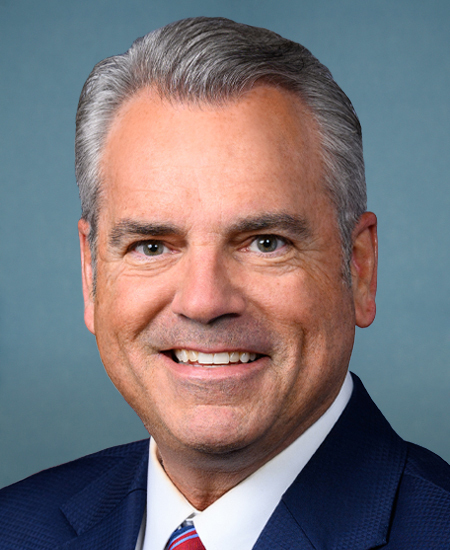
Rep. Mark Alford
Sponsored bills
Maddy summaryThis bill proposes a constitutional amendment that would grant Congress the power to pass laws banning the physical desecration of the U.S. flag (such as burning, trampling, or defacing it). If ratified, it would directly affect individuals who engage in such acts by making them subject to federal criminal penalties under new laws Congress could create. The amendment would add a specific clause to the Constitution stating: "Congress shall have power to prohibit the physical desecration of the flag of the United States." Ratification would require approval by 3/4 of state legislatures within seven years of submission.
Maddy summaryHR 649, the Whole Milk for Healthy Kids Act of 2025, amends the National School Lunch Act to allow schools participating in the program to offer students both organic and non-organic whole milk, in addition to reduced-fat, low-fat, and fat-free options. Key provisions include clarifying that milk fat in whole milk should not count toward saturated fat limits for meal compliance, prohibiting schools from purchasing milk from Chinese state-owned enterprises, and ensuring schools cannot be barred from offering the full range of milk types listed. The bill directly affects public and private schools serving the National School Lunch Program by expanding their milk options for students. It focuses on concrete policy changes to dietary offerings and sourcing restrictions within the school nutrition program.
Maddy summaryHR 1634, the *ThinkDIFFERENTLY About Disability Employment Act*, requires the Small Business Administration (SBA) to partner with the National Council on Disability to improve employment opportunities for people with disabilities. It directs the SBA to assist individuals with disabilities in becoming entrepreneurs or finding jobs at small businesses, while also helping small businesses hire them and address accessibility needs. The SBA must establish memoranda of understanding for these activities, conduct outreach, and submit a detailed report to Congress within two years on progress and future plans. The bill uses existing SBA resources without authorizing new funding, focusing on coordination and reporting to expand employment pathways.
Maddy summaryThis bill requires federal agencies to publicly explain why they cancel small business procurement bids and share plans for reissuing them or using the requirements elsewhere. It directly affects small businesses that prepared bids for cancelled solicitations by mandating agencies to provide written justifications for cancellations and share reissuance timelines. If an agency won't reissue a cancelled bid, the bill requires referring affected small businesses to agency staff who help identify similar future opportunities. All disclosure information must be posted on a central federal website within 180 days of the bill's enactment. The law does not create new funding but sets clear transparency requirements for existing contracting processes.
Maddy summaryHR 3647, the SAFE CROSS Act, requires the Federal Railroad Administration to study AI-enabled sensors at rail crossings. The study, to be completed within one year of the bill's enactment, will examine existing pilot programs, compare costs and benefits against alternatives like grade separations, and identify best practices. Results must be published publicly within 30 days, including recommendations for federal, state, tribal, local governments, and private entities responsible for rail crossing safety. This bill does not implement sensors but directs a review of their potential safety benefits and challenges.
Maddy summaryThis resolution establishes a House select committee to investigate claims about President Biden's cognitive and physical health decline and whether information was concealed from the public. The committee will specifically examine his cancer diagnosis, roles of administration figures (including Vice President Harris and Jill Biden), media coverage of his health, and classified document handling. It cannot pass laws but must issue a final report by December 31, 2025, detailing findings and recommendations. The committee's work is limited to fact-finding through hearings and evidence gathering, not policy-making.
Maddy summaryThis bill prohibits U.S. real estate purchases by individuals, foreign businesses, or agents linked to the governments of China (excluding Taiwan), Russia, North Korea, Iran, Cuba, Venezuela’s Nicolás Maduro, or designated foreign terrorist organizations. It applies to both public and private property across all U.S. states, territories, and possessions, requiring the President to enforce the ban. The law specifically targets foreign government connections rather than all foreign buyers, defining "foreign adversaries" through explicit country and entity listings. This policy change directly restricts real estate transactions involving entities tied to these designated nations.
Maddy summaryHRES 447 is a non-binding House resolution condemning antisemitism and honoring Yaron Lischinsky and Sarah Milgrim, two Israeli Embassy employees killed during a peace-focused panel discussion in 2023. The resolution specifically condemns all forms of antisemitism - including violence, vandalism, and online harassment - and remembers the victims, who were killed by a far-left activist affiliated with the Party for Socialism and Liberation. It calls for enforcing existing hate crime laws and protecting religious freedom, without creating new legislation. This resolution symbolically supports Jewish communities and victims of antisemitic violence but does not alter legal requirements.
Maddy summaryHR 2027, the *Returning SBA to Main Street Act of 2025*, requires the Small Business Administration (SBA) to relocate at least 30% of its Washington, D.C.-based headquarters employees to offices outside the Washington metropolitan area within one year. Relocated employees must have their pay adjusted to local rates and lose full-time telework authorization, though employees with ADA accommodations for telework are exempt. The bill also mandates a 30% reduction in SBA headquarters office space and requires annual reporting to Congress on employee locations, telework status, and ADA accommodations. These changes aim to shift SBA operations toward regional offices while maintaining in-person service access.