This concurrent resolution declares that Congress should not impose any new performance fee, tax, royalty, or other charge relating to the public performance of sound recordings on a local radio station for broadcasting sound recordings over the air, or on any business for such public performance of sound recordings.
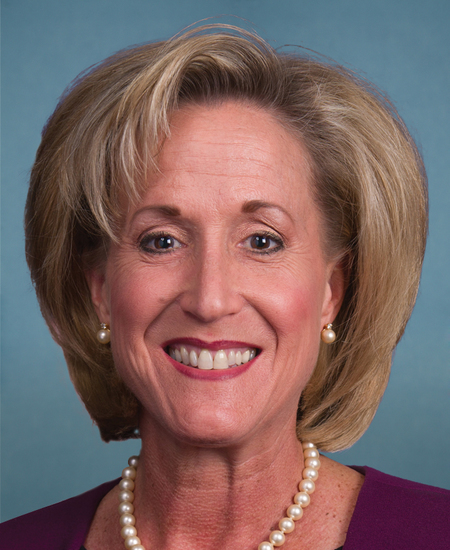
Rep. Ann Wagner
Sponsored bills
Maddy summaryHRES 386 is a symbolic resolution introduced in the U.S. House of Representatives that expresses support for recognizing "National Police Week" each year. The resolution acknowledges law enforcement officers' sacrifices, particularly during the pandemic, and encourages the public to honor their service. As a non-binding statement, this resolution does not create new law or change policy but serves as a formal expression of support for law enforcement officers across the United States.
Uyghur Stop Oppressive Sterilizations Act or the Uyghur SOS Act This bill expands existing visa-blocking sanctions to cover certain high-ranking foreign government officials who are responsible for coercive population control policies, such as forced abortions, with a focus on those responsible for such policies against ethnic minority groups in China. Specifically, the Department of State may not issue a visa to a foreign national who is a head of state, head of government, or cabinet-level minister and responsible for establishing or enforcing such policies if the policies are (1) imposed with the intent to destroy a national, ethnic, racial, or religious group; or (2) targeting ethnic minority groups (e.g., Uyghurs, Kazakhs, or Tibetans) or individuals peacefully expressing internationally-recognized human rights in China. (Currently, these sanctions do not apply to any foreign government officials at these higher ranks.) The State Department must make a public announcement each time sanctions are imposed under this bill. The bill also requires the State Department to provide all appropriate assistance to women who belong to an ethnic minority group in China and who have experienced sexual violence, torture, or coercive population control policies.
Protect and Serve Act of 2021 This bill establishes a new criminal offense for knowingly assaulting a law enforcement officer and causing serious bodily injury (or attempting to do so) in circumstances that affect interstate commerce. It imposes criminal penalties—a prison term, a fine, or both—on a violator.
Fiscal State of the Nation Resolution This concurrent resolution requires the congressional budget committees to conduct an annual joint hearing to receive a presentation from the Comptroller General regarding (1) the Government Accountability Office's audit of the financial statement of the executive branch, and (2) the financial position and condition of the federal government.
Financial Readiness of America's Servicemembers Act of 2021 This bill modifies the financial literacy training program for servicemembers (and spouses of such members) and requires the Federal Retirement Thrift Investment Board to submit a plan to Congress on improving the access of members to certain information about the Thrift Savings Plan.
Stop Foreign Funds in Elections Act This bill prohibits contributions or donations by foreign nationals in connection with state or local ballot initiatives or referenda.
Saving Workers by Eliminating Economic Tampering and Ensuring Reliability Act or the SWEETER Act This bill eliminates certain Department of Agriculture (USDA) sugar subsidy programs. Specifically, the bill eliminates (1) the price support loan program available to processors of domestically grown sugarcane and sugar beets; (2) the sugar marketing allotments and tariff-rate quotas that limit the quantities of domestically produced sugar that processors may sell and the sugar that may be imported under lower tariff rates; and (3) the feedstock flexibility program for bioenergy producers, which operates to avoid loan forfeitures to the USDA's Commodity Credit Corporation by requiring USDA to purchase surplus sugar from domestic processors for resale to bioenergy producers.
Maddy summaryHRES 754 is a non-binding resolution expressing the House of Representatives' opposition to proposed "punitive natural gas taxes" on U.S. businesses, families, and workers. It cites claims that such taxes would raise average energy bills by 17%, reduce GDP by $9 billion, and eliminate 90,000 jobs, while disproportionately harming low-income households. The resolution argues that opposing these taxes supports U.S. energy security, national security, and continued leadership in reducing emissions through domestic natural gas production. As a procedural resolution, it does not create law but formally states the House's position against this policy approach.
Exposing China's Belt and Road Investment in America Act of 2021 This bill requires the Committee on Foreign Investment in the United States to review certain investments made by China in the United States. Specifically, the committee must review any investment by a foreign person that (1) involves the acquisition of real estate in the United States and the establishment of a U.S. business on such real estate, and (2) could result in direct or indirect control of that U.S. business by China. A party to any such investment must submit to the committee a declaration containing basic information regarding the transaction.