Protecting Investors' Personally Identifiable Information Act This bill prohibits the Securities and Exchange Commission (SEC) from requiring a national securities exchange, association, or a member of either to provide a market participant's personally identifiable information to satisfy the reporting requirements of the Consolidated Audit Trail (which tracks market activity). However, this information must be provided to the SEC upon request. The SEC must destroy the information not later than one day after the conclusion of the matter for which this information was required.
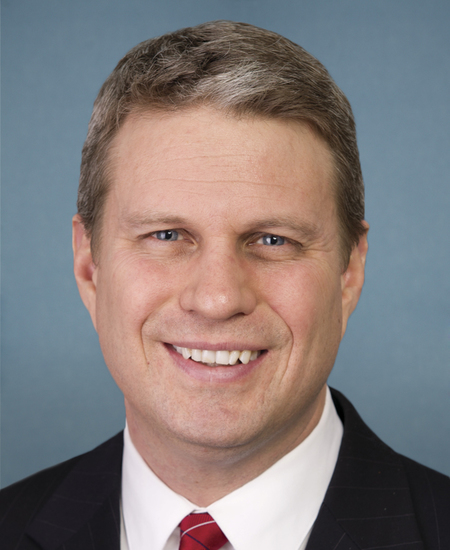
Rep. Bill Huizenga
Sponsored bills
This resolution expresses the sense of the House of Representatives that the Congress should not impose a financial transaction tax on individuals or market intermediaries in connection with trades executed on the National Market System or alternative trading systems.
This bill directs the Speaker of the House and the President pro tempore of the Senate to arrange for the award of three Congressional Gold Medals to the U.S. Capitol Police (USCP) and other law enforcement agencies that protected the U.S. Capitol on January 6, 2021. Following the award of these medals, one medal shall be given to the USCP, one medal shall be given to the Metropolitan Police Department of the District of Columbia, and one medal shall be given to the Smithsonian Institution and displayed with a plaque listing all law enforcement agencies that participated in protecting the Capitol on January 6, 2021.
Global War on Terrorism Memorial Location Act This bill authorizes the establishment of a National Global War on Terrorism Memorial in the area of the National Mall.
Guard Reimbursement for Unhealthy Bites Act or the GRUB Act This bill requires the Department of Defense to pay National Guard members a per diem for each day they performed duty between January 26, 2021, and March 15, 2021, in response to the attacks on January 6, 2021, on the U.S. Capitol building and grounds. The per diem rate must be equal to the proportional meal rate determined by the Defense Travel Management Office for the National Capital Region.
Developing Responsible Individuals for a Vibrant Economy Act or the DRIVE-SAFE Act This bill directs the Department of Transportation to promulgate regulations to implement an apprenticeship program for licensed commercial motor vehicle drivers under the age of 21. Under the program, an apprentice must complete two probationary periods that total 400 hours of on-duty time, of which at least 240 hours must be driving time in a commercial motor vehicle. Additionally, the apprentice must be accompanied in the cab of the commercial motor vehicle by an experienced driver. Further, the bill requires all commercial motor vehicles used in the program for training to be equipped with safety technology such as active braking collision mitigation systems and video event capturing systems. An employer shall not knowingly allow, require, permit, or authorize a driver under the age of 21 to operate a commercial motor vehicle unless the driver is participating in, or has completed, an apprenticeship program that meets the requirements set forth in this bill.
Fair Access to Banking Act This bill restricts certain banks, credit unions, and payment card networks from refusing to do business with a person who is in compliance with the law. Restrictions include prohibiting the use of certain lending programs, initiating the process of terminating an institution's depository insurance, and instituting specified civil penalties.
Death Tax Repeal Act This bill repeals the estate and generation-skipping transfer taxes. It also makes conforming amendments related to the gift tax.
This resolution honors Officers Brian Sicknick and Howard Liebengood of the U.S. Capitol Police, and it commends the bravery and service demonstrated by officers of the U.S. Capitol Police, the Metropolitan Police Department of the District of Columbia, and the other law enforcement agencies and protective entities that assisted in responding to the January 6, 2021, attack on the U.S. Capitol.
Great Lakes Winter Commerce Act of 202 1 This bill directs the U.S. Coast Guard to conduct icebreaking operations in the Great Lakes in accordance with specific performance standards. Specifically, the Coast Guard must keep channels and harbors in the Great Lakes open to navigation not less than 90% of the hours that commercial vessels and ferries attempt to transit ice-covered waterways; in a year in which the Great Lakes are not open to navigation because of ice of a thickness that occurs on average only once every 10 years, keep channels and harbors open to navigation at least 70% of the hours that commercial vessels and ferries attempt to transit ice-covered waterways; and coordinate Great Lakes icebreaking operations with operators of commercial vessels. The bill also directs the Coast Guard to acquire a Great Lakes icebreaker that is at least as capable as Coast Guard Cutter Mackinaw in an accelerated timeframe and award the contract on the basis of contractor qualification and price.