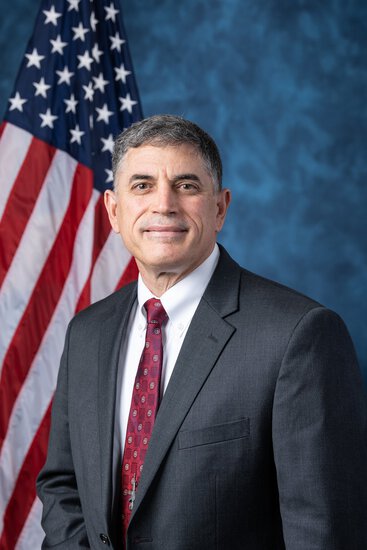
This resolution removes Representative Eric Swalwell from the House Permanent Select Committee on Intelligence.
Rep. Andrew S. Clyde
Sponsored bills
Unauthorized Spending Accountability Act of 2021 This bill establishes a three-year budgetary level reduction schedule for unauthorized programs funded through the annual appropriations process. Under the bill, a budgetary level is an allocation provided to the congressional appropriations committees under Section 302(a) of the Congressional Budget Act of 1974 by a congressional budget resolution or a deeming resolution. The schedule applies to programs included in the Congressional Budget Office's annual report listing programs that are funded through the appropriations process and have an authorization of appropriations that has either expired or will expire during the year. For the first year after a program's authorization has expired, the bill requires the budgetary level to be reduced by 10% of the funds appropriated for the program in the expiring fiscal year. The bill then requires reductions of 15% in the second and third years before terminating the program at the end of the third unauthorized year. Programs that are reauthorized during the three-year period are exempt from the budgetary level reductions if the reauthorization contains a sunset provision limiting the authorization of appropriations period to no more than three years. The bill establishes the Spending and Accountability Commission to review all mandatory spending programs and submit to Congress a legislative proposal to establish an authorization cycle for discretionary spending programs. The commission may recommend legislation to replace the budgetary level reductions required by this bill with reductions in mandatory spending. The commission's reauthorization schedule must limit reauthorizations to three years, include the budgetary level reductions established by this bill, and establish a mechanism for replacing the budgetary level reductions with reductions to mandatory spending programs. The House of Representatives must consider the commission's proposal using specified expedited legislative procedures.
This bill directs the Speaker of the House and the President pro tempore of the Senate to arrange for the award of three Congressional Gold Medals to the U.S. Capitol Police (USCP) and other law enforcement agencies that protect the U.S. Capitol. Following the award of these medals, one medal shall be given to the USCP, one medal shall be given to the Metropolitan Police Department of the District of Columbia, and one medal shall be given to the Smithsonian Institution and displayed with a plaque listing all law enforcement agencies that participate in protecting the Capitol.
Global War on Terrorism Memorial Location Act This bill authorizes the establishment of a National Global War on Terrorism Memorial in the area of the National Mall.
Justice for Victims of Sanctuary Cities Act of 2021 This bill provides a private right of action against state and local jurisdictions with certain policies that limit cooperation with federal immigration enforcement efforts, and contains additional provisions related to such jurisdictions. Currently, such cooperation is generally not required. An individual (or certain relatives of such an individual) who is the victim of any felony for which an alien has been arrested, convicted, or sentenced to a prison term of at least one year may sue a state or local jurisdiction if the jurisdiction failed to comply with (1) certain Department of Homeland Security (DHS) requests related to arresting and detaining aliens, and (2) a DHS request to detain the alien in question or provide a notification about the release of the alien. A jurisdiction that accepts certain federal grants may not assert immunity in such a civil action. A jurisdiction (or employee of a jurisdiction) that complies with certain DHS detainer requests shall be deemed to be acting as an agent of DHS. A complying jurisdiction or employee of the jurisdiction shall not be liable in any lawsuit relating to compliance with such requests. In a lawsuit against an employee of the jurisdiction, the United States shall be substituted in as the defendant, and remedies shall be limited to provisions for bringing tort claims against the federal government.
Protecting the Right to Keep and Bear Arms Act of 2021 This bill prohibits (1) the President or the Department of Health and Human Services from declaring emergencies or disasters for the purpose of imposing gun control; and (2) a federal officer or employee, or person operating under color of federal law, from banning the manufacture, sale, or transfer of firearms or ammunition while acting in support of relief from a major disaster or emergency.
Qualified Immunity Act of 2021 This bill codifies the defense of qualified immunity for law enforcement officers in any case under provisions regarding civil actions for deprivation of rights under color of law. Specifically, a law enforcement officer subject to such an action in his or her individual capacity shall not be found liable if the officer establishes that the right, privilege, or immunity secured by the Constitution or federal law was not clearly established at the time of the deprivation, or that at this time, the state of the law was not sufficiently clear that every reasonable law enforcement officer would have understood that the conduct alleged constituted a violation of the Constitution or federal law; or a court of competent jurisdiction had issued a final decision on the merits holding, without reversal, vacatur, or preemption, that the specific conduct alleged to be unlawful was consistent with the Constitution and federal laws. A law enforcement agency or unit of local government that employed a law enforcement officer subject to such an action shall not be liable if the officer is found not liable and to have been acting within the scope of his or her employment.
No Social Media Accounts for Terrorists or State Sponsors of Terrorism Act of 2021 This bill bars access to certain social media platforms by individuals designated as terrorists or senior officials of a government that is a state sponsor of terrorism. Specifically, the bill requires the President to prohibit providers of social media platforms (i.e., platforms that allow users to generate and share content and that have over 100,000 active users) from making such platforms available to barred individuals or officials. The bill does, however, allow officials to use these platforms solely for legitimate emergency alert purposes. Violations of this prohibition are subject to civil and criminal penalties. In addition, the President may waive the prohibition in the interests of U.S. national security. The Department of the Treasury must report to Congress on (1) the status and impact of the prohibitions of this bill, and (2) efforts to facilitate the free flow of information and access to communications technologies by civil society and democratic activists in Iran, Syria, North Korea, Cuba, and other countries controlled by authoritarian regimes.
Birthright Citizenship Act of 2021 This bill limits birthright citizenship by redefining what it means to be subject to the jurisdiction of the United States. Currently, a person born in the United States and subject to U.S. jurisdiction is entitled to citizenship. Under the bill, a person is subject to U.S. jurisdiction if he or she is born to a parent who is (1) a U.S. citizen or national, (2) a lawful permanent resident residing in the United States, or (3) an alien performing active service in the Armed Forces. The bill does not affect the citizenship or nationality status of any person born before the bill's enactment date.
Hearing Protection Act This bill removes silencers from the definition of firearms for purposes of the National Firearms Act. It also treats persons acquiring or possessing a firearm silencer as meeting any registration and licensing requirements of such Act. The Department of Justice must destroy certain records relating to the registration, transfer, or making of a silencer. The bill also revises the definitions of firearm silencer and firearm muffler under the federal criminal code and includes such items in the 10% excise tax category.