This bill requires all public and charter schools which have students in grades 6-12 to provide free feminine hygiene products in 50% of the bathrooms used by students who can have a menstrual cycle. This bill also requires schools to publish on its website and post in its common areas the locations of the bathrooms where the hygiene products are provided. Finally, this bill provides that each school must consult with its school nurse regarding the products to be provided.
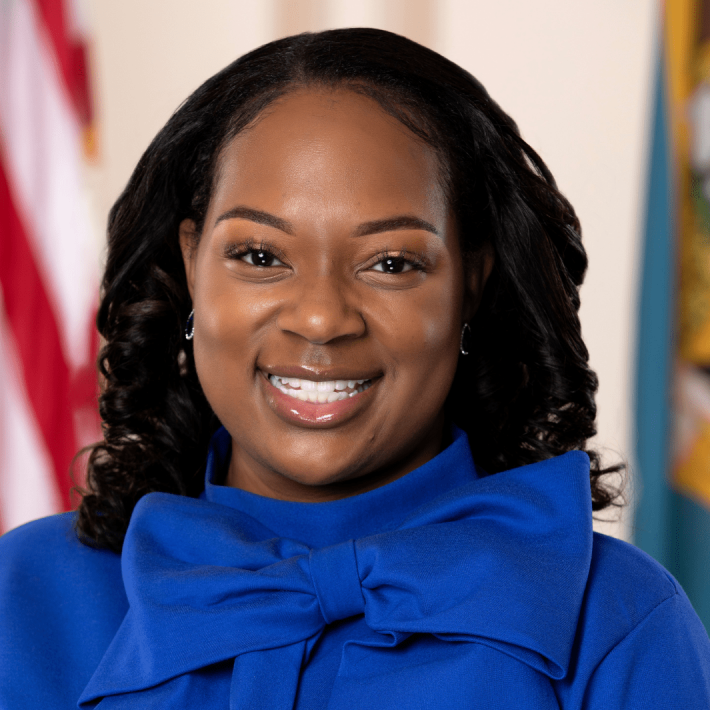
Rep. Rae Moore
Sponsored bills
Delaware, like the rest of the country and the world, has been struggling with the COVID-19 pandemic since March of 2020. The worst outbreaks have occurred in facilities where people live and/or work in tight communal settings – long-term care facilities, prisons, and meat processing plants. There is no real way to prevent an outbreak and the spread of a highly contagious disease inside a prison where inmates share cells, communal recreation and dining spaces, and in some instances reside in large bunk rooms. Furthermore, the COVID-19 pandemic has severely disrupted the operations of the prisons as they struggle with staff shortages due to illness and quarantines, and curtail activities to reduce opportunities for community spread within the prison. This bill seeks to address both the COVID-19 pandemic as well as any future public health emergency that impacts prison operations and conditions by creating a “public health emergency credit” that would automatically be awarded when a public health emergency is declared. Credits would be awarded at the rate of 6 months for every month served during the public health emergency up to a maximum reduction in sentence of 1 year. This has the practical effect of moving forward release dates for inmates whose release would come within the next year regardless of the emergency. This will reduce the prison population in an orderly and fair manner, relieving pressure on staff and creating better conditions for those inmates who remain incarcerated to socially distance and control the spread of infectious disease. By applying additional credit towards sentence completion, this legislation also recognizes that the conditions of confinement during a public health emergency like the current one can be considered significantly more punishing – since visitation, communications, programming, and recreation are all significantly negatively impacted by the emergency conditions and modifications to operations.
This resolution recognizes April 10 through 16, 2021 as "Week of the Young Child" in Delaware.
This Act requires each school district and charter school to establish and implement a curriculum on Black History for students in grades K through 12. This Act incorporates contemporary events into discussions of Black History and the tools of experience.
This House Concurrent Resolution designates March 24, 2021 as "Equal Pay Day" in the State of Delaware.
This Act revises the Fair Housing Act to repeal the exception to discrimination based on source of income that allows a landlord to discriminate against tenants who participate in government-sponsored rental assistance programs. This exemption contributes to a lack of affordable housing in this State. There is currently a severe shortage of affordable housing for extremely low-income households in Delaware, with only 38 affordable rental units available for every 100 extremely low-income households. In addition, studies have shown that people who use government subsidies to move from high-poverty neighborhoods to communities with more opportunity have measurable health improvements and the children in these families earn more in adulthood than children who remain in high-poverty neighborhoods. Nine states and the District of Columbia have fair housing laws that protect against discrimination based on source of income that covers recipients of government subsidies.
This Act, which takes effect on January 1, 2022, clarifies that the Department of Services for Children, Youth and Their Families (DSCYF) has exclusive jurisdiction over a juvenile's care, custody, and control for any juvenile until at least the juvenile’s 18th birthday. Further, this Act stipulates that juveniles found guilty and sentenced for a Superior Court offense shall remain in the custody, care, and control of DSCYF until they turn 18. Juveniles with Superior Court terms of confinement which extend beyond their 18th birthday shall be transferred to the custody of the Department of Correction for the remainder of their sentence after they turn 18. This Act also clarifies that Family Court is permitted to retain jurisdiction in some cases, and Family Court may require DSCYF to provide services and supervision for non-incarcerated persons aged 18-21. Finally, the Act allows individuals charged in Family Court before they turn 18 to be held by DSCYF until they turn 19.
This bill establishes a 2-year residential drinking water purification system pilot program to be administered through the Department of Health and Social Services with funding through the Drinking Water State Revolving Fund.
This bill repeals certain provisions in Title 11 relating to abortion including provisions which treat abortion differently than other medical procedures, and provisions which criminalize women and the sale of medical devices and medicines.
This act restores the $500 senior real property tax credit.