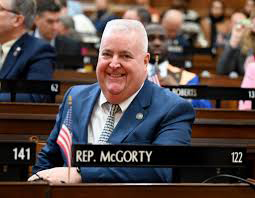
Key legislators
Who's moving education in Connecticut
Showing 4 of 4
bills
All education bills
This bill updates Connecticut's compulsory education laws to allow parents to choose between public school, private school, or home-based equivalent instruction for children aged five to seventeen. It requires parents to formally notify their local school district each year of their chosen educational path and mandates that districts provide information about available educational options. The legislation also raises the age at which students can voluntarily withdraw from school from seventeen to eighteen years old and clarifies definitions for equivalent instruction and nonpublic schools.
SB 298 reallocates state funds across multiple agencies for the 2025-2026 fiscal year. It reduces $3.4 million from Temporary Family Assistance (TANF) funding for the Department of Social Services while appropriating $1.7 million to the Labor Department for unemployment program IT upgrades and $1.7 million to the Department of Education for Adult Education. The bill allocates $1.5 million to five school districts (Newington, Wethersfield, Cromwell, Rocky Hill, Middletown) for high-acuity school-based mental health programs and $750,000 for a teacher residency program operated by the Capitol Region Education Council. These changes directly affect TANF recipients, school districts, mental health providers, and teacher training initiatives.
This bill requires healthcare facilities and schools to cover medical costs and pay full salary for staff injured during work-related assaults or aggressive incidents. It creates a system for reporting patient violence in digital health records (with patient appeal options) and ensures absences due to such incidents don’t count against paid leave. Directly affects healthcare workers, teachers, and school staff who face workplace violence while performing job duties.
HB 5324 repeals several existing education-related mandates in Connecticut. It removes requirements for schools to implement human trafficking training for staff (previously mandated for educators, law enforcement, and healthcare workers), mandates for school composting of organic waste, and a rule allowing school districts to exclude certain insurance losses from budget calculations. The bill directly affects public and nonpublic schools, district administrators, and school personnel who previously had to comply with these specific requirements. This legislation aims to reduce administrative burdens by eliminating these statutory obligations, effective July 1, 2026.