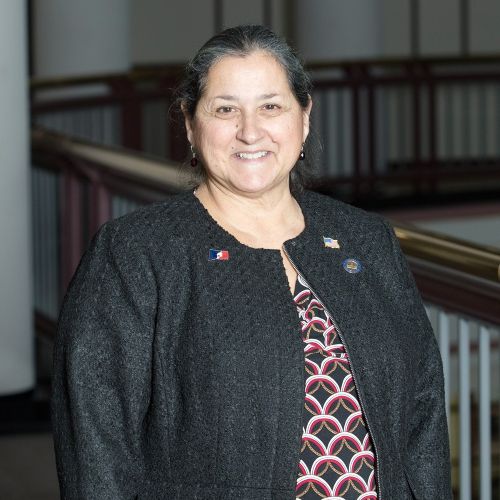
SB 280 makes minor technical revisions to statutes affecting veterans' services in Connecticut. It clarifies staffing requirements for the Office of Advocacy and Assistance, specifying it must have at least 19 staff (including 14 veteran service officers who must be veterans themselves) and 3 clerical personnel. The bill also establishes a dedicated "Hispanic-American Veterans of Connecticut" commemorative account within the General Fund to fund bilingual services for veterans, allowing private donations to support this account. These changes are purely procedural and technical, with no new funding or policy shifts, as stated in the bill's purpose.
HB 5123 authorizes the state to issue up to $20,000 in bonds to fund a cloud-based filing system for Plymouth Town. The funds would be provided as a grant through the Office of Policy and Management to Plymouth's local government. This bill directly affects Plymouth Town by providing targeted financial support for upgrading its document management system. The key mechanism is a state bond authorization specifically for this local government technology project, with no broader policy changes or eligibility criteria beyond the town's need.
HB 5031 allocates $70,010,000 from the General Fund to cover budget shortfalls for the fiscal year ending June 30, 2026, directly affecting state agencies. Key provisions include $14.5 million for the Department of Housing’s homeless services, $5.5 million for mental health personal services, $5.775 million for emergency services, and $6 million for inmate medical services under Corrections. The bill funds ongoing operations and critical programs rather than creating new policies. It is a routine budget adjustment to address existing fiscal gaps, not a new legislative initiative.
HB 5390 establishes a $7 million annual fund to support regional planning councils in Connecticut. Starting July 1, 2026, each council formed under Section 4-124j will receive funding based on a population formula, plus a fixed $200,000 to hire housing planning staff and another $200,000 to fund either a stormwater/flood mitigation coordinator or a waste/recycling coordinator position. The bill clarifies that councils may allocate the second $200,000 to fund both coordinator roles if needed. This directly affects regional councils by providing dedicated funding for specific planning and infrastructure roles.
HB 5028 removes the "Combined Public Benefits Charge" from electricity bills for residential and business customers of electric distribution companies. This bill directly affects all end-use electricity customers in the state by eliminating this specific fee from their monthly bills. The key mechanism shifts the funding source for these public benefits programs from customer bills to the state General Fund. The bill does not change existing public benefits programs but changes how their costs are paid. This is a direct billing change with no impact on program eligibility or service levels.
HB 5013 establishes a registration fee for electric vehicles and plug-in hybrid electric vehicles, and imposes a per-kilowatt-hour tax on electricity purchased at public electric vehicle charging stations. This bill directly affects EV owners through the new registration fee and charging station operators through the electricity tax. Revenue from both the fee and tax must be deposited into the Special Transportation Fund. The legislation aims to generate dedicated funding for transportation infrastructure without specifying how the money will be spent beyond this allocation.
SB 139 increases the state appropriation for the Special Education and Expansion Development Grant by $191 million for the fiscal year ending June 30, 2027. This funding directly supports students with special education needs and helps school districts manage unpredictable costs associated with special education services. The bill amends existing law to boost the grant amount, aiming to stabilize school district budgets and ensure consistent support for these students. It does not alter eligibility or service requirements but provides additional financial resources for existing programs.
SB 370 requires Connecticut's Commissioner of Administrative Services to adjust the hourly pay for adjunct fire instructors at the Connecticut Fire Academy each year starting July 1, 2026. The adjustment must match the percentage increase from the most recent state-wide wage agreement between the state and its employee bargaining coalition, including any cost-of-living adjustments. This directly affects adjunct fire instructors employed by the Connecticut Fire Academy, ensuring their pay rises in line with general state employee compensation changes. The bill takes effect on July 1, 2026, and applies to all subsequent fiscal years.
SB 97 creates a personal income tax credit equal to 25% of the value of food donated by taxpayers during a taxable year. This credit directly affects individuals and businesses that donate food to eligible recipients (such as charities or food banks). The key mechanism is a dollar-for-dollar reduction in tax liability based on the donated food's value, calculated annually. The bill aims to incentivize food donations by making them financially beneficial for donors without altering existing tax rates or creating new requirements for recipients.
SB 101 would create a new statewide property tax on residential properties valued over $3 million. It sets three tax rates based on property value: 0.2% (2 mills) for homes worth $3-5 million, 0.3% (3 mills) for $5-10 million properties, and 0.4% (4 mills) for homes valued at $10 million or more. This tax would apply uniformly across the state to qualifying high-value residential properties, directly affecting owners of such homes. The bill specifies the tax rates but does not detail how the revenue would be allocated.