

The act changes the time frame required to file a certificate of death with the state registrar from 5 days after a death occurs to 72 hours after the funeral director assumes custody of a dead body, stillborn fetus, or dead fetus unless the individual responsible for completing the medical certification for the death certificate is unable to complete the medical certification for the death certificate within the required time frame, additional inquiry into the cause and manner of death is required by current law, or a coroner, a medical examiner, a forensic pathologist, or other qualified individual determines that additional time is required to determine the cause and manner of death, in which case the certificate of death must be completed and signed as soon as practicable. Any individual, other than a family member of the decedent or other individual acting in a non-professional capacity as the funeral director for the decedent, who is required to initiate, complete, respond to, or file a death certificate must use the electronic death registration system (EDRS) used by the department of public health and environment (department) and the state registrar; except that, a physician who is not yet registered to use the EDRS is not required to use it until March 1, 2024, or the date the physician is registered, whichever is earlier. The department is required to ensure that all physicians are registered to use the EDRS on or before March 1, 2024. The physician responsible for completing the medical certification for a death certificate must do so within 72 hours after receipt of an EDRS request unless current law requires additional inquiry into the cause and manner of death. If a death is or may be due to unnatural causes, a physician required to complete a medical certification for a death certificate shall notify the coroner or the medical examiner when current law requires an inquiry or an autopsy to be performed. The act requires the state registrar to provide a monthly report to the department of regulatory agencies (DORA) that identifies any death certificates for which a medical certification was not completed in a timely manner, and DORA is required to promptly provide the report to the Colorado medical board. DORA is also required to report annually to its legislative oversight committees regarding the number of complaints that DORA received and the number of disciplinary actions taken against a licensee. On and after March 1, 2024, the act defines as "unprofessional conduct" for purposes of the "Colorado Medical Practices Act" repeated or willful failure without reasonable cause to comply with the requirements of completing a medical certification for a death certificate in accordance with any applicable deadline. The act generally requires a decedent's established primary care physician to complete the medical certification for the decedent's death certificate if the death appears to be due to natural causes and is determined as such with a reasonable degree of medical certainty, the decedent received medical care from the primary care physician within a year of the death, the death occurred when the decedent was not under the direct care of another physician charged with the decedent's care during the illness or condition that resulted in death, and an inquiry into the death is not required. However, if within a year of the death, the decedent had been treated by a physician other than the decedent's established primary care physician for a chronic condition or terminal illness related to the decedent's death, the death appears to be due to natural causes and is determined as such with a reasonable degree of medical certainty, and an inquiry into the death is not required, that physician is responsible for completing the medical certification for the death certificate. Any deadline in the act by which an individual is required to complete an action relating to a certificate of death or a medical certification for a certificate of death is extended by one day per day of closure if the business or facility at which the individual is employed is actually closed for an entire calendar day that is a weekend day or a legal holiday. APPROVED by Governor May 1, 2023 EFFECTIVE August 7, 2023 NOTE: This act was passed without a safety clause and takes effect 90 days after sine die. (Note: This summary applies to this bill as enacted.)
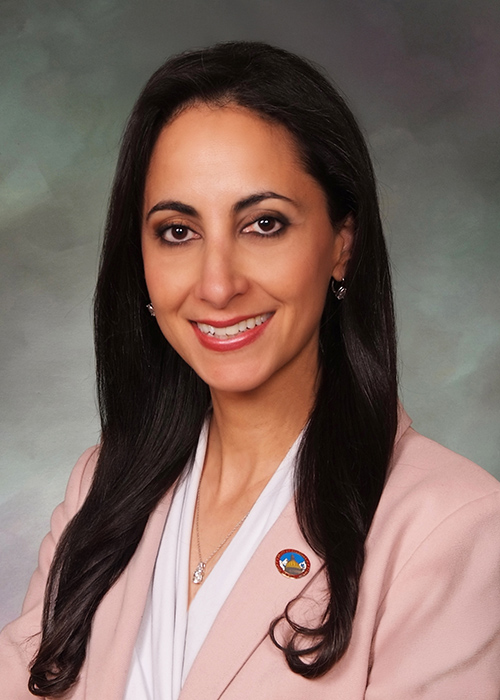
Sen. Iman Jodeh
Sponsored bills
The act requires a person who solicits a fee for filing a document with, or retrieving a public record from, the secretary of state to include specific disclosure language in the solicitation. The person must also include information on where the document can be filed directly with the secretary of state, or where the public record can be retrieved, and the name and physical address of the person who is soliciting. The act also prohibits the use of any form, deadline dates, or other language that makes the document used for solicitation appear to be issued by a state agency or local government or that appears to impose a legal duty on the person being solicited. Violation of these requirements is an unfair or deceptive trade practice. APPROVED by Governor April 11, 2023 EFFECTIVE August 7, 2023 NOTE: This act was passed without a safety clause and takes effect 90 days after sine die. (Note: This summary applies to this bill as enacted.)
The act eliminates the requirement for a person who is lawfully residing in the state, a legal immigrant who is a resident of the state, or a documented individual to refrain from executing an affidavit of support for the purpose of sponsoring a documented individual while the person is receiving public services or medical assistance. County departments responsible for administering benefits programs under the department of health care policy and financing and the department of human services shall identify and review all current county guidance materials that reference a prohibition on sponsorship as a condition of eligibility for benefits and shall remove all such references from verbal and digital communications and from all physical materials currently provided to applicants or beneficiaries. APPROVED by Governor April 11, 2023 EFFECTIVE August 7, 2023 NOTE: This act was passed without a safety clause and takes effect 90 days after sine die. (Note: This summary applies to this bill as enacted.)
Before passage of the act, Colorado law required a motor vehicle or a powersports vehicle manufacturer (manufacturer) to timely compensate a motor vehicle or a powersports vehicle dealer (dealer) for warranty repairs based on the dealer's typical charges for parts and labor if these charges were reasonably consistent with the law governing the setting of these charges. The act repeals the condition that the charges must be reasonably consistent with this law, requiring the manufacturer to pay the charges even if there is a dispute as to the charges. The law governing the setting of these charges is not repealed, so the charges must continue to comply with the law. Before passage of the act, Colorado law governing these charges allowed a manufacturer to challenge the setting of a labor rate or part markup if either was inaccurate or if either was substantially different than the charges of other similarly situated line-make dealers. The act repeals the manufacturer's ability to challenge these charges when the rates are substantially different than the charges of other similarly situated line-make dealers. In order to challenge the setting of a labor rate or part markup as allowed before the passage of the act, the manufacturer was required to provide the dealer a notice that explains why the calculation was subject to contest. The act changes this requirement, requiring instead that the notice must explain why the calculation is materially inaccurate. APPROVED by Governor April 3, 2023 EFFECTIVE August 7, 2023 NOTE: This act was passed without a safety clause and takes effect 90 days after sine die. (Note: This summary applies to this bill as enacted.)
The act creates the Colorado nonprofit security grant program to provide money to qualified nonprofit organizations that are at high risk of a terrorist attack and that applied for, but did not receive, a grant from the federal nonprofit security grant program. Grant recipients may use the money for the following security-related activities: The installation of security equipment on real property owned or leased by the nonprofit organization; Security-related planning, exercises, training, and contracted security personnel; New or existing infrastructure; except that priority must be given to existing infrastructure projects; or Any other approved security enhancements. The act appropriates $500,000 from the general fund to the department of public safety for use by the division of homeland security and emergency management. (Note: This summary applies to this bill as enacted.)
The act provides juvenile court jurisdiction over an unaccompanied child in the custody of the federal office of refugee resettlement who is housed in a facility in Colorado and who has been subjected to parental abuse or neglect. A child may file a petition asking the court to determine that the child is dependent on the court. The petition must: Set forth the facts that bring the child under the court's jurisdiction; State the child's name, age, and country of birth; and Identify the facility where the child is housed in Colorado in the custody of the federal office of refugee resettlement. The petition must not name the child's parent as a respondent. The petition must state clearly that parental rights may not be terminated through the proceedings. The act requires the court to schedule a hearing after the petition is filed. If the court finds at the hearing that the statements in the petition are supported by a preponderance of the evidence, the court shall declare the child dependent on the court. A child declared dependent is eligible for oversight and services by the office of the child protection ombudsman. Upon request, the court may also issue an order establishing the child's eligibility for classification as a special immigrant juvenile under federal law. (Note: This summary applies to this bill as enacted.)
The act allows the state board of human services (state board) to utilize eligibility processes from other public assistance or entitlement programs when promulgating rules for redetermining and verifying eligibility for the Colorado works program (works program). When determining income requirements for the works program, the act requires the department of human services (state department) to use an income conversion ratio for converting weekly and biweekly income to a monthly amount using the lowest ratio or methodology that results in the lowest monthly income amount allowable under federal law. Current law prohibits a person convicted of a drug-related felony offense from being eligible for assistance under the works program unless the person is determined by a county department of human or social services (county department) to have taken action toward rehabilitation. The act removes the ban on eligibility. No later than July 1, 2023, the act requires the state board to promulgate rules establishing statewide standards and procedures that require counties to: Offer an extension beyond the 60-month lifetime maximum for all households that demonstrate good cause, which includes, but is not limited to, an applicant or participant who is a child-only case, the head of a single parent household and has a child under one year of age, or experiencing hardship; and Inform and not penalize any applicant or household that demonstrates good cause for an exemption from work requirements which includes, but is not limited to, an applicant or participant who is the head of a single-parent household and has a child under one year of age or is experiencing hardship. The act requires the state department to annually review and promulgate rules as necessary to update the standard of need to ensure the standard of need is equitable, promotes economic mobility and self-sufficiency, and reflects the current economic status of the state. Current law requires the state department to ensure the amount of a basic cash assistance grant that an applicant or participant receives is equal to or exceeds 102% of the need standard for a participant in a similarly sized household on January 1, 2008. For the state fiscal year commencing July 1, 2022, the act requires the amount of the basic cash assistance grant to equal or exceed 100% of the basic cash assistance in 2021, plus 10%. For the state fiscal year commencing July 1, 2024, and each state fiscal year thereafter, the act requires the amount of the basic cash assistance grant to equal or exceed the amount of basic cash assistance for the previous state fiscal year plus a 2% cost of living adjustment or a cost of living adjustment that is equal to the average of the federal social security administration's cost of living adjustment for that fiscal year plus the previous 2 fiscal years, whichever is greater. On July 1, 2022, the act requires the state treasurer to transfer $21.5 million from the economic recovery and relief cash fund (cash fund) to the Colorado long-term works reserve to cover any increase in basic cash assistance above the amount of basic cash assistance in state fiscal year 2021-22. Beginning in state fiscal year 2023-24, and each state fiscal year thereafter, the act requires the state department to first expend any money remaining that is transferred to the Colorado long-term works reserve from the cash fund. The state department shall then expend money in an amount equal to one-third of the amount necessary to cover any such increase from available "Temporary Assistance for Needy Families" (TANF) funds, and an amount equal to two-thirds of the amount necessary to cover any such increase that the general assembly appropriates to the state department from the state general fund or any other available fund. If the total statewide county TANF reserve falls below 15% of the county block grant amount, the act requires the general assembly to appropriate money from the Colorado long-term works reserve to the county block grant until the balance of the total statewide TANF reserve exceeds 15% or until the Colorado long-term works reserve falls below 25% of the state block grant amount. If the Colorado long-term works reserve falls below 25%, of the state block grant amount and the total statewide county TANF reserve exceeds 15% of the county block grant amount, the act requires counties to fund the TANF program from available TANF funds until the total statewide county TANF reserve falls below 15% of the county block grant amount. The act strongly encourages a county department to contact each participant using each method of communication provided by the participant in order to conduct exit and follow-up interviews upon case closure. The act expands the purpose of the exit and follow-up interviews to include evaluating the participant's experience with the works program, how well the program met the participant's needs and assisted the participant in meeting the participant's goals, and informing the state department of any changes to rules that are needed to improve the participant's experience. Beginning January 2023, and each January thereafter, the state department is required to submit a report to the general assembly on the effectiveness of the works program. Current law requires the state board to promulgate rules that require a percentage reduction in the basic cash assistance grant upon the imposition of a sanction affecting the grant, with the percentage to be specified in the rules but not to be less than 25%. The act requires the percentage not to exceed one dollar. The act requires the works allocation committee to review, at least quarterly, the balance of the Colorado long-term works reserve, the balance of the total statewide county TANF reserve, and the amount of basic cash assistance grants provided to participants to monitor whether the reserves will fall below specified amounts. The act authorizes a county department that is projected to exhaust all money available in the county's TANF reserve and faces a local or statewide natural disaster or other emergency to request money from the county block grant support fund. No later than September 30, 2022, the act requires the state department to develop an outreach and engagement plan to promote access to the works program for eligible persons. The act appropriates: $3,500,00 from the economic recovery and relief cash fund to the department of human services for use by the office of economic security; $9,849,303 from the Colorado long-term works reserve to the department of human services; and $1,066,400 to the office of the governor for use by the office of information technology.(Note: This summary applies to this bill as enacted.)
The act directs the division of housing in the department of local affairs (division) to award a grant to a local government in the Denver metropolitan area or a community partner in conjunction with a local government in order to build or acquire, and then facilitate, a regional navigation campus to respond to and prevent homelessness. The act requires the division, in collaboration with the department of human services and the behavioral health administration in the department of human services, to establish application requirements, review applications, select a grant recipient, and ensure the grant is only awarded after a fair and rigorous open competition among eligible applicants. The act creates the regional navigation campus cash fund (cash fund) and requires the state treasurer to transfer $50 million from the economic recovery and relief cash fund to the regional navigation campus cash fund on July 1, 2022. For the 2022-23 state fiscal year, the act appropriates $44,557 to the department of human services for use by the behavioral health administration from the funds transferred to the cash fund. (Note: This summary applies to this bill as enacted.)
The act creates the epilepsy awareness license plate for motor vehicles. The department of revenue must designate a nonprofit organization to qualify applicants for issuance of the license plate. The organization must: Be headquartered in Colorado; Have been in existence for at least 5 years; Be a nonprofit organization; Provide education to the public about epilepsy; Offer programs for youth and adults with epilepsy; and Fund services and support for those affected by epilepsy. An applicant qualifies for issuance of the license plate if the applicant makes a donation to the organization and pays all required taxes and fees. In addition to the standard motor vehicle fees, the applicant must pay 2 one-time fees of $25 for issuance of the license plate. One fee is credited to the highway users tax fund and the other to the licensing services cash fund. For the 2022-23 state fiscal year, $29,671 is appropriated for use by the division of motor vehicles in the department of revenue (department) to implement the act, of which amount $3,168 is reappropriated to the office of the governor for use by the office of information technology to provide information technology services for the department. (Note: This summary applies to this bill as enacted.)
House Bill 21-1198 established health-care billing requirements for indigent patients beginning June 1, 2022. The act changes the beginning date to September 1, 2022. (Note: This summary applies to this bill as enacted.)