This resolution honors Officers Brian Sicknick and Howard Liebengood of the U.S. Capitol Police, and it commends the bravery and service demonstrated by officers of the U.S. Capitol Police, the Metropolitan Police Department of the District of Columbia, and the other law enforcement agencies and protective entities that assisted in responding to the January 6, 2021, attack on the U.S. Capitol.
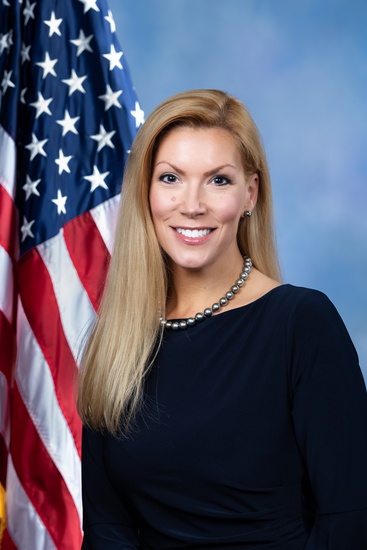
Rep. Beth Van Duyne
Sponsored bills
Protecting the Right to Keep and Bear Arms Act of 2021 This bill prohibits (1) the President or the Department of Health and Human Services from declaring emergencies or disasters for the purpose of imposing gun control; and (2) a federal officer or employee, or person operating under color of federal law, from banning the manufacture, sale, or transfer of firearms or ammunition while acting in support of relief from a major disaster or emergency.
Qualified Immunity Act of 2021 This bill codifies the defense of qualified immunity for law enforcement officers in any case under provisions regarding civil actions for deprivation of rights under color of law. Specifically, a law enforcement officer subject to such an action in his or her individual capacity shall not be found liable if the officer establishes that the right, privilege, or immunity secured by the Constitution or federal law was not clearly established at the time of the deprivation, or that at this time, the state of the law was not sufficiently clear that every reasonable law enforcement officer would have understood that the conduct alleged constituted a violation of the Constitution or federal law; or a court of competent jurisdiction had issued a final decision on the merits holding, without reversal, vacatur, or preemption, that the specific conduct alleged to be unlawful was consistent with the Constitution and federal laws. A law enforcement agency or unit of local government that employed a law enforcement officer subject to such an action shall not be liable if the officer is found not liable and to have been acting within the scope of his or her employment.
Thin Blue Line Act This bill expands the list of statutory aggravating factors in death penalty determinations to also include killing or targeting a law enforcement officer, firefighter, or other first responder.
Concealed Carry Reciprocity Act This bill establishes a federal statutory framework to regulate the carry or possession of concealed firearms across state lines. Specifically, an individual who is eligible to carry a concealed firearm in one state may carry or possess a concealed handgun (other than a machine gun or destructive device) in another state that allows its residents to carry concealed firearms. It sets forth requirements for the lawful concealed carry across state lines. The bill preempts most state and local laws related to concealed carry and establishes a private right of action for a person adversely affected by interference with a concealed-carry right established by this bill.
PPP Flexibility for Farmers and Ranchers Act This bill expands eligibility for agricultural producers under the Paycheck Protection Program, established to support small businesses in response to COVID-19 (i.e., coronavirus disease 2019), to include certain agricultural producers organized as partnerships. Currently, only certain agricultural producers that are sole proprietorships, independent contractors, or self-employed individuals may receive support under the program.
Patient Access to Higher Quality Health Care Act of 2021 This bill repeals provisions under the Stark law (i.e., the Physician Self-Referral Law) that limit, for purposes of Medicare participation, self-referrals by newly constructed or expanded physician-owned hospitals.
Telehealth Modernization Act This bill modifies requirements relating to coverage of telehealth services under Medicare. Specifically, the bill extends certain flexibilities that were initially authorized during the public health emergency relating to COVID-19 (i.e., coronavirus disease 2019). Among other things, the bill allows (1) rural health clinics and federally qualified health centers to serve as the distant site (i.e., the location of the health care practitioner); (2) the home of a beneficiary to serve as the originating site (i.e., the location of the beneficiary) for all services (rather than for only certain services); and (3) all types of practitioners to furnish telehealth services, as determined by the Centers for Medicare & Medicaid Services.
Main Street Tax Certainty Act This bill makes permanent the tax deduction for qualified business income. (Under current law, the deduction expires after December 31, 2025.) Qualified business income is defined as the net amount of qualified items of income, gain, deduction and loss with respect to any trade or business, excluding capital gains or losses, dividends, interest income, or income earned outside the U.S.
New Markets Tax Credit Extension Act of 2021 This bill makes the new markets tax credit permanent. It also modifies the credit to (1) provide for an inflation adjustment to the limitation amount for the credit after 2021, and (2) allow an offset against the alternative minimum tax for the credit (determined with respect to qualified equity investments initially made after 2020).