Fostering and Realizing Electrification by Encouraging Zero Emission Refrigeration Trucks Act of 2021 or the FREEZER Trucks Act of 2021 This bill requires the Environmental Protection Agency to establish a pilot program to award grants, rebates, or low-cost revolving loans for electrifying or retiring diesel-powered transport refrigeration units in certain heavy-duty vehicles (e.g., commercial trucks).
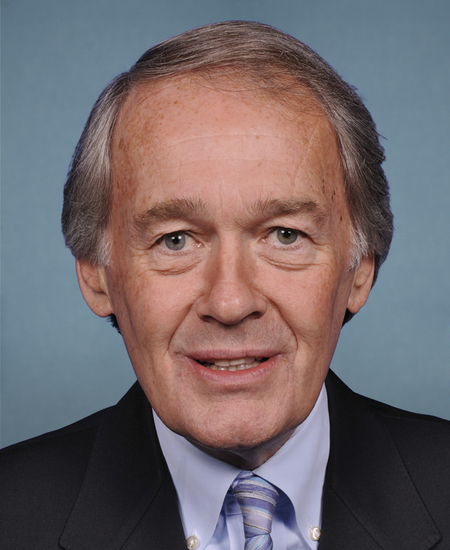
Sen. Edward J. Markey
Sponsored bills
Generating Resilient, Environmentally Exceptional National Streets Act or the GREEN Streets Act This bill establishes national goals to reduce carbon dioxide and other greenhouse gas emissions and improve the resilience of the transportation system. Specifically, the bill directs the Department of Transportation (DOT) to establish minimum standards for states to decrease greenhouse gas emissions and per capita vehicle miles traveled (VMTs) on the National Highway System; DOT to establish measures for states to assess and reduce carbon dioxide; states and metropolitan planning organizations (MPOs) to consider projects and strategies that reduce carbon dioxide and other greenhouse gas emissions and decrease per capita VMT's; states and MPOs to publish an analysis of the impact on per capita VMTs and mobile source greenhouse gas emissions for each project that adds new lanes or otherwise increases traffic capacity and costs more than $25 million; states that are out of compliance with the per capita VMT standards or carbon dioxide or greenhouse gas emission measures to dedicate federal highway funding to achieve compliance; and DOT to establish national transit access standards and performance measures for transit accessibility, transit stop distance, and transit mode share.
New Deal for New Americans Act of 2021 This bill provides assistance to immigrants and addresses issues related to naturalization. The bill establishes the National Office of New Americans to (1) welcome and support immigrants, (2) promote and support immigrant integration, and (3) promote the pursuit of U.S. citizenship among immigrants. The bill also establishes grant programs for eligible entities that provide (1) legal services for immigrants, (2) English language education that focuses on integrating students into society, and (3) workforce development training that supports the economic integration of immigrants. The bill also reauthorizes the Citizenship and Integration Grant Program within U.S. Citizenship and Immigration Services (USCIS). USCIS shall establish a nonprofit entity to spur innovation in the expansion of citizenship preparation programs and to support assistance for immigrants seeking permanent resident status or citizenship. The bill also requires the Department of Homeland Security to (1) report to Congress before increasing fees for immigration adjudication and naturalization services above the levels of such fees on January 1, 2019, and (2) waive or reduce certain immigration-related fees for low-income aliens. The bill also (1) waives the English proficiency requirement for the naturalization of certain permanent residents, (2) repeals the public charge ground for deportation, (3) requires states to provide for automatic voter registration to qualifying new citizens unless that individual declines, and (4) sets a floor of 125,000 to the maximum number of refugees who may be admitted into the United States each year.
Complete Streets Act of 2021 This bill directs each state to establish a competitive program to provide technical assistance and grants for the design and construction of complete streets to make transit routes safer and more accessible. Specifically, the bill directs the Department of Transportation (DOT) to establish benchmarks and guidance by which states can implement complete streets programs and eligible entities can carry out complete streets policies and principles; eligible entities seeking technical assistance or funds for a complete streets program to adopt policies using complete streets principles that are approved by the state or metropolitan planning organizations (MPOs) with jurisdiction over such entites; states and MPOs to certify that their complete street policies meet the minimum requirements set out by DOT; states to set aside 5% of their federal highway money to implement a complete streets program; and states and MPOs to adopt design standards for federal surface transportation projects that provide for the safe and adequate accommodation of all users of the surface transportation network, including motorized and non-motorized users, in all phases of project planning, development, and operation.
Enhancing the Strength and Capacity of America's Primary Evacuation routes Act or the ESCAPE Act This bill directs the Department of Transportation (DOT) to provide assistance for projects that strengthen and protect mass evacuation routes. Specifically, DOT must (1) establish criteria for states, tribal and local governments, and other entities to identify mass evacuation routes; (2) establish a competitive grant program to provide grants for resilience projects that strengthen and protect evacuation routes that are essential for providing and supporting mass evacuations caused by emergency events; and (3) provide grants to resilience projects that ensure the ability of the evacuation route to provide safe passage during a mass evacuation and reduce the risk of damage to evacuation routes as a result of future emergency events.
Iran Diplomacy Act of 2021 This bill outlines U.S. policy with respect to Iran and the Joint Comprehensive Plan of Action (JCPOA), commonly known as the Iran nuclear deal. Specifically, the bill states that the United States and Iran should promptly return to full compliance with their commitments under the JCPOA. Further, the bill encourages the United States to lead international efforts to advance diplomatic measures that promote U.S., regional, and international security.
International Human Rights Defense Act of 2021 This bill establishes in the Department of State a permanent Special Envoy for the Human Rights of LGBTQI (lesbian, gay, bisexual, transgender, queer, or intersex) Peoples who shall serve as the principal State Department advisor regarding human rights for LGBTQI people and represent the United States in diplomatic matters relevant to the human rights of LGBTQI people. The special envoy shall periodically provide Congress with a U.S. global strategy to prevent and respond to criminalization, discrimination, and violence against LGBTQI people. The State Department and the U.S. Agency for International Development may provide assistance to prevent and respond to such activities against LGBTQI people. The bill also requires that annual country reports on human rights practices include information on criminalization, discrimination, and violence based on sexual orientation and gender identity.
Protecting Moms and Babies Against Climate Change Act This bill establishes grants and directs other activities to address health risks associated with climate change, particularly for members of racial and ethnic minority groups, pregnant or postpartum individuals, and children younger than age three. Specifically, the Department of Health and Human Services (HHS) must establish a program to award grants to partnerships of community-based organizations and other entities to identify and address climate-change-related risks to these individuals at a county level. HHS must also establish a program to award grants to health professional schools and training programs to integrate training on identifying risks associated with climate change for patients, with a focus on those intending to become pregnant, in curricula and continuing education programs. In addition, the National Institutes of Health (NIH) must establish the Consortium on Birth and Climate Change Research. The consortium must coordinate research on climate-change-related risks conducted and supported by various NIH institutes and offices. The Centers for Disease Control and Prevention must also develop a strategy to identify areas where there is a high risk of adverse maternal and infant health outcomes due to climate change.
Living Donor Protection Act of 2021 This bill prohibits certain insurance carriers from discriminating against, and provides other protections for, living organ donors. Specifically, carriers may not deny, cancel, or otherwise impose conditions on policies for life insurance, disability insurance, or long-term care insurance based on an individual's status as a living organ donor. The bill also expressly specifies that recovery from organ-donation surgery constitutes a serious health condition that entitles eligible employees to job-protected medical leave. In addition, the Department of Health and Human Services must update educational materials on live organ donation to include information about the benefits of live organ donation and about access to insurance for living organ donors.
Duty To Report Act This bill requires political committees, candidates for federal office, and other individuals to report to the Federal Election Commission (FEC) and the Federal Bureau of Investigation (FBI) any offers of prohibited contributions, including offers of nonpublic information regarding other candidates, by foreign nationals. Specifically, political committees and candidates must report to the FEC within 24 hours any (1) offers of prohibited contributions from foreign nationals, and (2) meetings with foreign governments or their agents. In addition, the bill requires political committees, candidates, immediate family members of candidates, and individuals affiliated with a campaign (e.g., employees and independent contractors) to report to the FBI within 24 hours any offers of prohibited contributions from foreign nationals. Further, the bill establishes a new criminal offense for knowingly and willfully failing to comply with this reporting requirement. A violator is subject to criminal penalties—a fine, a prison term of up to two years, or both. Such reported information may not be used to enforce certain immigration provisions related to the removal of undocumented aliens.