

Maddy summaryThis bill establishes federal rules for college student athletes, primarily affecting institutions of higher education and the National Collegiate Athletic Association. It guarantees that student athletes have five consecutive years of eligibility to compete in intercollegiate sports, regardless of injuries or other circumstances. The legislation also sets new transfer portal regulations, requiring athletes to sit out one academic year after transferring except for their first transfer, and mandates that schools honor financial aid commitments when students move to new institutions. Additionally, the bill prevents states from passing laws that conflict with these federal provisions or restrict student athlete rights under the new rules.
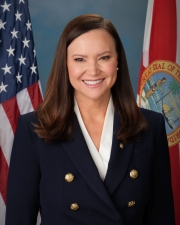
Sen. Ashley Moody
Sponsored bills
Maddy summaryS 921, titled "Tyler’s Law," requires the U.S. Department of Health and Human Services to study how often hospital emergency departments test for fentanyl during overdose cases, along with the costs, benefits, privacy impacts, and effects on patient-clinician relationships. The study must examine current testing frequency, associated costs, and how fentanyl testing might influence patient privacy and care. Within six months of completing the study, the Secretary must issue guidance on whether hospitals should routinely test for fentanyl, how to inform clinicians about testing protocols, and how such testing might affect future overdose risks and health outcomes. This bill directly affects hospitals with emergency departments and patients experiencing overdoses, but it does not mandate testing - it only mandates a study and subsequent guidance.
Maddy summaryThis resolution designates March 21, 2026, as "National Women in Agriculture Day" to recognize the contributions of women in the agricultural sector. The bill directly affects women working in farming, research, education, and related industries by formally acknowledging their roles as producers, leaders, and mentors. It highlights that women represent over one-third of U.S. agricultural producers and generated $222 billion in agricultural sales in 2022. The designation encourages citizens to celebrate and support women in agriculture during National Ag Week, which coincides with the date. This is a commemorative measure rather than a policy change that alters laws or programs.
Maddy summaryThis bill, the Conscience Protection Act of 2025, strengthens protections for healthcare providers and organizations that refuse to participate in certain medical procedures (including abortion, assisted suicide, and sterilization) based on religious, moral, or ethical beliefs. It creates a private right of action allowing affected entities to seek legal remedies when their conscience rights are violated, addressing a gap in current law where victims could not defend their rights in court. The bill amends the Public Health Service Act to prohibit discrimination against such healthcare entities and establishes clearer enforcement mechanisms through the Department of Health and Human Services, including administrative investigations and civil actions. It directly affects healthcare providers, hospitals, insurers, and other health-related organizations operating under federal funding. The bill aims to address inconsistent enforcement of existing conscience protections like the Weldon Amendment, which has been challenged in cases such as California's abortion coverage mandate.
Maddy summaryThe VSAFE Act of 2025 creates a new "Veterans Scam and Fraud Evasion Officer" within the Department of Veterans Affairs to combat fraud targeting veterans. This position serves as the central point of contact for veterans, families, and caregivers, responsible for developing fraud prevention communication, training VA staff, promoting the VSAFE Fraud Hotline and website, and coordinating with agencies like the IRS and DOJ. The bill requires the officer to monitor fraud metrics, establish consistent guidance for identifying and reporting scams, and consult with veterans' organizations. It does not authorize new full-time staff and includes a minor extension of a pension payment deadline (Section 3).
Maddy summaryThis bill, titled the Land Grant Research Prioritization Act of 2026, amends existing federal agricultural law to establish specific research and extension grant priorities for land-grant universities. It directs funding toward four main areas: advanced mechanized harvesting technologies, particularly for specialty crops; artificial intelligence applications in agriculture to improve specialty crop production; methods for managing and eradicating invasive plant and animal species; and aquaculture techniques for valuable aquatic species. The legislation allows the Secretary of Agriculture to prioritize grants in these areas when awarding funding to land-grant institutions for research and extension projects.
Maddy summaryThis bill amends the Higher Education Act to recognize home-schooled students as high school graduates for federal student aid eligibility. It changes the definition in Section 484(d) to state that a student completing secondary education in a home school setting treated as a home or private school under state law is considered a high school graduate. This directly affects home-schooled students seeking federal financial aid for college. The key provision is a new definition that removes prior barriers to eligibility based on educational setting, aligning federal recognition with state-level home school classifications.
Maddy summaryThe SHARKED Act of 2025 establishes a 7-year task force under the Commerce Secretary to address shark interactions with fishing operations and humans. The task force, including fishery council representatives, shark behavior researchers, and state agencies, will identify research priorities (like causes of increased shark interactions and non-lethal deterrents), develop management strategies, and create educational materials for fishermen. It amends the Magnuson-Stevens Act to fund specific shark depredation research projects focused on reducing harmful interactions. The bill directly affects coastal fisheries managers, researchers, and fishing communities by directing coordinated action on shark-human interactions, without altering existing protections under the Endangered Species Act.
Maddy summaryThis bill, known as the TAP Promotion Act, would allow representatives from recognized veterans service organizations to join presentations that inform service members about benefits they can access after leaving the military. These presentations are part of the Transition Assistance Program, which helps veterans prepare for civilian life, and the law requires that they be standardized and approved by the Department of Veterans Affairs before being used. The bill also mandates that the presentations include information on how veterans service organizations can help with filing benefit claims, while prohibiting any effort to encourage members to join a specific organization. Additionally, the Department of Veterans Affairs must submit an annual report to Congress detailing which organizations participated in these sessions and how many service members attended.
Maddy summaryS 3922, the Traditional Cigar Manufacturing and Small Business Jobs Preservation Act of 2026, exempts specific types of cigars from most FDA regulations under the Federal Food, Drug, and Cosmetic Act. It directly affects traditional cigar manufacturers who produce cigars meeting strict criteria: 100% tobacco leaf construction (no filters or non-tobacco parts), weighing at least 6 pounds per 1,000 cigars, and made by hand or with limited machinery. The bill defines "traditional large and premium cigars" to exclude cigarettes and little cigars while ensuring these products are not subject to new FDA rules. This change aims to preserve jobs in the small business cigar manufacturing sector by reducing regulatory burden. The bill does not alter existing rules for other tobacco products.