

End the Border Crisis Now Act This bill imposes additional restrictions on asylum eligibility. Under this bill, an alien must be lawfully admitted into the United States to apply for asylum. (Currently, an alien may apply for asylum upon being physically present or arriving in the United States, subject to certain restrictions.) In addition, if an alien was in a qualifying third country (generally one where the alien's life or freedom would not be threatened on account of certain characteristics) during the 180 days before being admitted into the United States, the alien may not apply for asylum unless the alien proves that (1) the alien applied for and was denied asylum or equivalent status in that third country, or (2) the conditions in the alien's country of nationality have significantly worsened since the alien was in the third country.
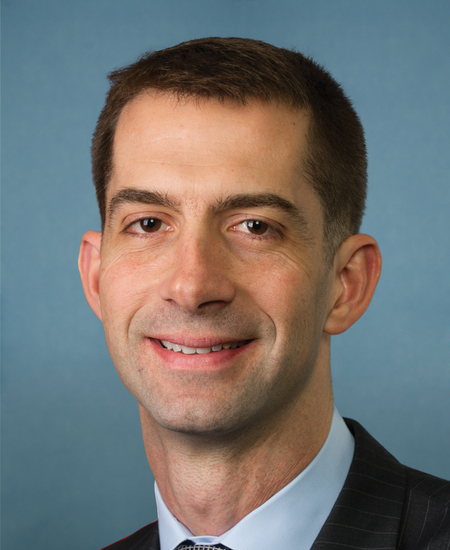
Sen. Tom Cotton
Sponsored bills
This resolution urges the European Parliament to enact legislation that allows electronic service providers to continue using certain technologies to detect child sexual exploitation.
Combating Racist Training in the Military Act of 2021 This bill prohibits the Armed Forces and academic institutions of the Department of Defense from promoting specified anti-American and racist theories (e.g., that any race is inherently superior or inferior to any other race). Specifically, the bill prohibits including anti-American and racist theories or materials in curricula, reading lists, seminars, workshops, trainings, or other educational or professional settings in a manner that could appear as sponsorship, approval, or endorsement; contracting with, hiring, or otherwise engaging speakers, consultants, diversity trainers, and other persons for the purpose of advocating anti-American and racist theories; compelling members of the Armed Forces to affirm or profess belief in anti-American and racist theories; and segregating members of the Armed Forces by race in any setting, including educational and training sessions.
Keep China Out of Solar Energy Act of 2021 This bill prohibits federal procurement of solar panels manufactured or assembled in China. Specifically, the bill directs the Office of Management and Budget (OMB) to develop standards and guidelines for executive agencies to prohibit (1) federal funds from being awarded for the procurement of solar panels that are manufactured or assembled by any entity domiciled in China or subject to influence or control by the government of China or the Chinese Communist Party, and (2) the use of government-issued purchase cards to purchase solar panels that are manufactured or assembled by any such entity. The Federal Acquisition Regulatory Council shall amend the Federal Acquisition Regulation to implement the prohibition with respect to federal contracts and subcontracts. The bill sets forth provisions regarding waivers, quarterly reports by the OMB to Congress, and a report by the Government Accountability Office. The OMB shall seek to enter into a contract with a federally funded research and development center under which the center will study (1) the current and future domestic market of solar panel production, (2) the ability of the solar panel domestic market to keep pace with technological advancements across the industry, and (3) the current global supply chain and workforce involved with solar panel production.
Stopping Overdoses of Fentanyl Analogues Act This bill adds five fentanyl analogues and the entire category of fentanyl-related substances to schedule I of the Controlled Substances Act. A schedule I controlled substance is a drug, substance, or chemical that has a high potential for abuse; has no currently accepted medical value; and is subject to regulatory controls and administrative, civil, and criminal penalties under the Controlled Substances Act.
Cormorant Relief Act This bill provides statutory authority for certain regulations that allow for the taking of double-crested cormorants (birds) to protect fish at aquaculture facilities and to protect public resources (e.g., fish, wildlife, plants, and their habitats).
This resolution expresses the sense that the current influx of migrants at the southern land border constitutes a crisis.
Reassurance On Commitments Act of 2021 or the ROC Act This bill prohibits using funds made available to the Department of State for FY2022 to implement or enforce any policy that restricts representatives of Taiwan (such as members of Taiwan's armed forces or representatives of its government) or the Taipei Economic and Cultural Representative Office from displaying symbols of Taiwan's sovereignty for official purposes.
Protecting Seniors Access to Health Care Act This bill modifies funding and eligibility for various benefits and programs, including several established under COVID-19 relief laws. With respect to funding, the bill provides supplemental funding for the Public Health and Social Services Emergency Fund to reimburse certain health care providers for expenses or lost revenue attributed to COVID-19; and rescinds certain unobligated funds that were provided to the Department of the Treasury for payments to state, tribal, and territorial governments to mitigate fiscal impacts of COVID-19. The bill also applies certain modified payment limits to certain rural health clinics that enrolled in, or applied to enroll in, Medicare in calendar year 2020. Furthermore, the bill prohibits individuals who were unlawfully present in the United States on March, 11, 2021, from receiving premium subsidies in the event they lose employer-sponsored health insurance due to involuntary termination or a reduction in hours, or direct payments provided to certain taxpayers to mitigate financial hardship during the COVID-19 emergency. The bill also prohibits individuals who were incarcerated on that date from receiving the direct payments.
This bill retroactively eliminates the waiting period for Social Security Disability Insurance (SSDI) benefits for certain individuals with amyotrophic lateral sclerosis (ALS). Commonly known as Lou Gehrig's Disease, ALS is a progressive neurodegenerative disease that affects nerve cells in the brain and spinal cord. Under current law, most SSDI recipients must wait five months after becoming disabled before their benefit payments may begin. The ALS Disability Insurance Access Act of 2019 eliminated the waiting period for individuals with ALS but only covers individuals who apply for benefits after the date of enactment (December 20, 2020). As a result, individuals with ALS who applied for SSDI benefits in the five months before that date are still subject to the waiting period. This bill eliminates the waiting period for those individuals.