

For the People Act of 2021 This bill addresses voter access, election integrity and security, campaign finance, and ethics for the three branches of government. Specifically, the bill expands voter registration (e.g., automatic and same-day registration) and voting access (e.g., vote-by-mail and early voting). It also limits removing voters from voter rolls. The bill requires states to establish independent redistricting commissions to carry out congressional redistricting. Additionally, the bill sets forth provisions related to election security, including sharing intelligence information with state election officials, supporting states in securing their election systems, developing a national strategy to protect U.S. democratic institutions, establishing in the legislative branch the National Commission to Protect United States Democratic Institutions, and other provisions to improve the cybersecurity of election systems. Further, the bill addresses campaign finance, including by expanding the prohibition on campaign spending by foreign nationals, requiring additional disclosure of campaign-related fundraising and spending, requiring additional disclaimers regarding certain political advertising, and establishing an alternative campaign funding system for certain federal offices. The bill addresses ethics in all three branches of government, including by requiring a code of conduct for Supreme Court Justices, prohibiting Members of the House from serving on the board of a for-profit entity, and establishing additional conflict-of-interest and ethics provisions for federal employees and the White House. The bill requires the President, the Vice President, and certain candidates for those offices to disclose 10 years of tax returns.
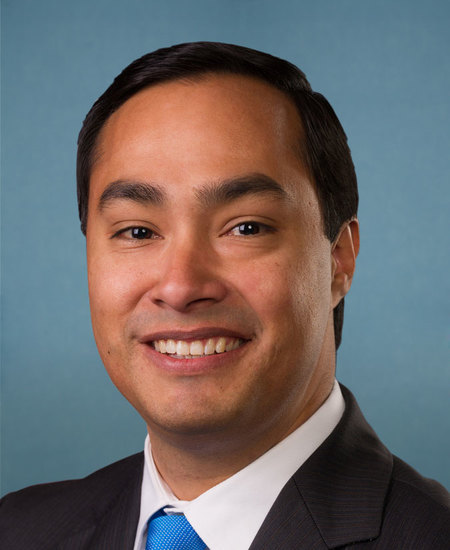
Rep. Joaquin Castro
Sponsored bills
Abortion is Health Care Everywhere Act of 2021 This bill authorizes the use of certain foreign assistance funds to provide comprehensive reproductive health care services in developing countries, including abortion services, training, and equipment.
George Floyd Justice in Policing Act of 2021 This bill addresses a wide range of policies and issues regarding policing practices and law enforcement accountability. It increases accountability for law enforcement misconduct, restricts the use of certain policing practices, enhances transparency and data collection, and establishes best practices and training requirements. The bill enhances existing enforcement mechanisms to remedy violations by law enforcement. Among other things, it does the following: lowers the criminal intent standard—from willful to knowing or reckless—to convict a law enforcement officer for misconduct in a federal prosecution, limits qualified immunity as a defense to liability in a private civil action against a law enforcement officer, and grants administrative subpoena power to the Department of Justice (DOJ) in pattern-or-practice investigations. It establishes a framework to prevent and remedy racial profiling by law enforcement at the federal, state, and local levels. It also limits the unnecessary use of force and restricts the use of no-knock warrants, chokeholds, and carotid holds. The bill creates a national registry—the National Police Misconduct Registry—to compile data on complaints and records of police misconduct. It also establishes new reporting requirements, including on the use of force, officer misconduct, and routine policing practices (e.g., stops and searches). Finally, it directs DOJ to create uniform accreditation standards for law enforcement agencies and requires law enforcement officers to complete training on racial profiling, implicit bias, and the duty to intervene when another officer uses excessive force.
This resolution supports the goals of a feminist foreign policy (i.e., a foreign policy that requires analysis of and challenges to power structures and inequalities that are based on systems of discrimination), and it supports the adoption of policies that promote gender equity and women's participation in public life.
Girls' Leadership, Engagement, Agency, and Development Act of 2021 or the Girls LEAD Act This bill directs the Department of State and the U.S. Agency for International Development (USAID) to jointly report to Congress a strategy to strengthen the participation of adolescents, particularly girls, in democracy, human rights, and governance. The State Department and the USAID shall (1) implement activities to achieve this goal, including activities to increase adolescent girls' civic and political knowledge and skills and address barriers to political participation; and (2) prioritize foreign assistance funding for democracy, human rights, and governance programs toward achieving the goals in this bill.
Provides for the relief of Alirio Palacios Gamez, Hilda Veronica Ramirez Mendez, and Jayro Ivan Juarez Ramirez.
Jakelin Caal Death in Custody Reporting Act of 2021 This bill requires an investigation and reports for each death of an alien in Department of Homeland Security or Department of Health and Human Services custody. Within 24 hours of such a death, the relevant department shall provide to Congress a publicly available report containing (1) the name, gender, race, ethnicity, and age of the deceased; (2) the date, time, and location of the death; and (3) the circumstances surrounding the death. The relevant department shall conduct an investigation within 30 days of the death of an alien in its custody, including an analysis of (1) the root cause of the death, and (2) any policy or systemic changes that could reduce the possibility of such a death in the future. The results of such an investigation shall be reported to Congress and made publicly available on the internet.
Correcting Hurtful and Alienating Names in Government Expression (CHANGE) Act This bill prohibits any executive agency from using the term alien to refer to an individual who is not a U.S. citizen or national, or i llegal alien to refer to such an individual who is unlawfully present in the United States or lacks lawful immigration status. This prohibition does not apply when quoting certain texts. The bill (1) establishes a uniform definition for the term foreign national when used in acts of Congress and agencies; (2) replaces alien with foreign national in federal government documents, including statutes and regulations; and (3) replaces illegal alien with undocumented foreign national in such documents. Under the bill, a foreign national is any individual other than an individual (1) who is a citizen of the United States; or (2) though not a citizen of the United States, who owes permanent allegiance to the United States.
This joint resolution proposes a constitutional amendment authorizing Congress and the states to set reasonable limits on the raising and spending of money by candidates and others to influence elections. The amendment grants Congress and the states the power to implement and enforce this amendment by legislation. They are allowed to distinguish between natural persons and corporations or other artificial entities created by law, including by prohibiting such entities from spending money to influence elections.
This resolution impeaches President Donald John Trump for high crimes and misdemeanors. Specifically, the resolution sets forth two articles of impeachment. The first article states that President Trump abused the powers of the presidency by attempting to unlawfully overturn the results of Georgia's presidential election. The article specifies that President Trump, on a recorded call, repeatedly asked the Secretary of State of Georgia to overturn the verified results of the election and threatened consequences for a failure to do so. The second article states that President Trump abused the powers of the presidency by inciting violence and orchestrating an attempted coup. The article specifies that, on January 6, 2021, President Trump incited a crowd of supporters to attack the Capitol while Congress was in session to certify the results of the election. The article further specifies that, after those supporters had violently breached the Capitol, President Trump made a statement repeating his false claims of election fraud and expressing affection for the supporters. Both articles state that, by such conduct, President Trump warrants impeachment and trial, removal from office, and disqualification from holding U.S. office.