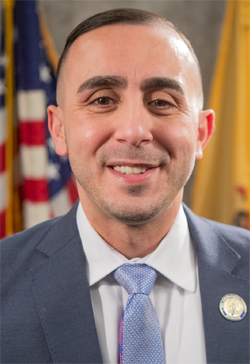
This bill changes how New Jersey courts handle sentencing for people with drug or alcohol dependency who commit certain crimes. It allows courts to place eligible individuals on "special probation" instead of prison time, requiring them to complete licensed substance use treatment (including medication-assisted treatment) and undergo regular drug/alcohol testing. To qualify, offenders must have committed their current crime while under the influence or to support their addiction, not possess firearms, have no prior convictions for violent offenses (like murder or sexual assault), and be assessed as needing treatment. The bill directly affects drug/alcohol dependent offenders convicted of specific non-violent crimes who would otherwise face mandatory prison sentences, and it modifies court procedures for approving treatment-based probation.
This bill protects inmates in New Jersey state correctional facilities who report sexual abuse, harassment, or violence by staff. It requires the Corrections Commissioner to create a confidential, fee-free system for inmates to file complaints anonymously, with language access and clear information about reporting options. The bill prohibits staff from retaliating against reporting inmates through transfers, job changes, or other punitive actions, and mandates victim advocate support. It criminalizes both retaliation against inmates and staff failing to report abuse, punishable as a fourth-degree crime with up to 18 months in prison or a $10,000 fine.
This bill makes a fifth or subsequent drunk driving conviction a third-degree crime in New Jersey, punishable by up to $15,000 in fines or 5 years in prison. It requires a 10-year driver's license suspension for these offenses, increasing to 20 years if the offense occurs near schools (on school property, within 1,000 feet, or at an unmarked school crossing with juveniles present). Offenders must complete alcohol education and treatment programs or face a mandatory two-day jail term and extended license suspension. The law applies to all fifth or subsequent DUI convictions occurring after its effective date.
This bill requires New Jersey's Department of Corrections to establish minimum cell size standards for state prison housing. It mandates at least 35 square feet of usable space per person in single-occupancy cells and 25 square feet per person in shared cells, with a minimum ceiling height of eight feet. These standards must meet or exceed those set by the American Correctional Association. The law directly affects all state prison inmates by setting concrete habitability requirements for their living conditions. It was introduced to the Assembly Public Safety Committee in January 2026.
This bill requires New Jersey's Department of Labor and Workforce Development (DOLWD) to identify and publicly post on its website employment opportunities with minimal entry barriers for people returning to work after incarceration. It directly affects formerly incarcerated individuals who face employment challenges like employer stigma and lack of educational opportunities. The key mechanism is DOLWD's ongoing duty to list jobs that have low barriers to entry and high demand. The bill aims to improve reintegration into the workforce by making accessible job listings available to this population, without specifying how employers will be engaged or how success will be measured.
This bill amends New Jersey's theft statute to set a specific $25,000 value threshold for motor vehicle theft to be classified as a second-degree crime. Currently, most thefts exceeding $75,000 are second-degree, but this change ensures motor vehicles valued at $25,000 or more automatically qualify as second-degree offenses (punishable by up to 10 years in prison), while vehicles under $25,000 remain third-degree theft. It directly affects individuals who steal motor vehicles worth $25,000 or more, raising the severity of penalties for higher-value auto thefts. The bill maintains the existing structure but clarifies the lower threshold specifically for motor vehicles.
This bill upgrades motor vehicle theft to a first-degree crime if, during the theft, the vehicle is operated in a way that creates a risk of injury to people or damage to property. It directly affects individuals who steal vehicles and drive recklessly while doing so, such as through high-speed chases or dangerous maneuvers. The key provision increases penalties to up to 20 years in prison or a $200,000 fine for this specific reckless conduct. The law takes effect immediately upon enactment.
New Jersey's A 2136 creates new criminal penalties for unlicensed marijuana sales and purchases. It makes it a third-degree crime (up to 5 years in prison or $15,000 fine) for owners of unlicensed businesses that manufacture, distribute, or dispense marijuana, and a second-degree crime (up to 10 years or $150,000 fine) for leaders of multi-location illegal networks. The bill also imposes a misdemeanor charge (up to 6 months or $1,000 fine) for knowingly buying marijuana from unlicensed businesses. Enforcement allows state police and the Attorney General to shut down violating businesses and seize illegally sold marijuana. This bill supplements existing law (CREAMMA) by adding specific penalties for unlicensed commercial activity, not personal use.
This bill changes sentencing for human trafficking convictions in New Jersey. It makes human trafficking crimes (including labor exploitation and sexual trafficking of adults or children) punishable as first-degree offenses, requiring a minimum 20-year prison sentence with no parole eligibility for 20 years. Convicted traffickers must also pay restitution to victims based on New Jersey's prevailing wage laws, and fines collected will fund a survivor assistance program. The law directly affects traffickers convicted under these provisions, increasing penalties and ensuring victims receive financial compensation.
This bill requires New Jersey's Commissioner of Corrections to submit quarterly reports to legislative leaders detailing the operation of residential community release programs (including halfway houses). The reports must include specific data on reimbursement rates, inmate demographics by offense type (violent vs. non-violent), escape/abscondment rates, safety incidents, and measures to prevent violence. It also mandates an annual analysis of each program's effectiveness, with a focus on recidivism rates, and recommendations for improvement. The bill directly affects correctional programs and the state legislature, which will use the data to monitor program performance.