Maddy summaryThe EBOLA Act requires the President to rejoin the World Health Organization within 30 days of enactment and immediately coordinate with that body to address an ongoing Ebola outbreak in Central and Eastern Africa. The legislation authorizes necessary funding to cover U.S. membership fees and financial obligations, as well as voluntary contributions to support international disease response efforts. By mandating this rapid re-entry into the global health agency, the bill aims to enhance the nation's ability to monitor emerging infectious diseases and prevent the spread of the virus to American soil.

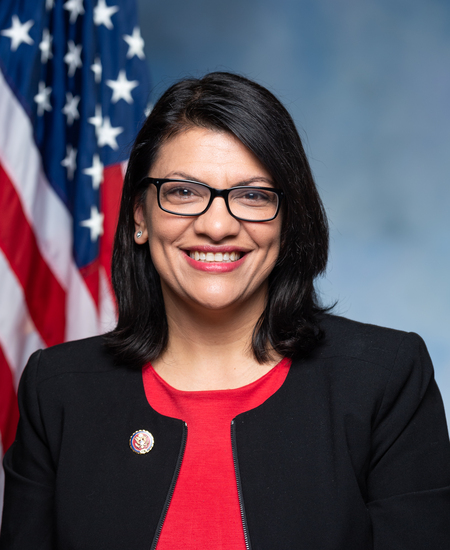
Rep. Rashida Tlaib
Sponsored bills
Maddy summaryThe Thirty-Two Hour Workweek Act amends the Fair Labor Standards Act to establish a new standard for overtime pay, requiring employers to pay time-and-a-half for hours worked beyond thirty-two hours per week. The bill also introduces daily overtime rules that mandate premium pay for workdays exceeding eight or twelve hours. To allow businesses to adjust, the law phases in the weekly overtime threshold over four years, starting at thirty-eight hours and decreasing by two hours each year until it reaches thirty-two. Employers are prohibited from reducing an employee's total compensation or benefits as a result of these new coverage requirements.
Maddy summaryThe El Salvador TPS Act of 2026 requires the Secretary of Homeland Security to grant Temporary Protected Status (TPS) to individuals from El Salvador. This designation would remain in effect until a date 18 months after September 9, 2026. The bill directly affects eligible residents of El Salvador by providing them with legal protection and work authorization during this specified period.
Maddy summaryThe Access to School Supplies Act of 2026 establishes a five-year pilot program that provides competitive grants to up to ten local school districts serving high-poverty schools. These funds are intended to help districts purchase books, supplies, and other materials for students and instructional staff at no cost. The legislation authorizes $100 million annually from fiscal years 2027 through 2031 and requires recipients to submit annual reports detailing how the money was spent and which schools benefited. A small portion of the total funding is reserved for outlying areas and Bureau of Indian Education schools, while the program sunsets on September 30, 2031.
Maddy summaryThe Protecting Our Widows and Widowers in Retirement Act would amend the Social Security Act to increase monthly benefits for surviving spouses of deceased workers who were part of two-income households. Under the new rules, a fully insured widow or widower could receive 75 percent of the combined total of their own retirement or disability benefit and the deceased spouse's primary insurance amount, rather than just the deceased spouse's benefit alone. The bill includes a cap on this increased payment based on a hypothetical high-earner's maximum benefit to limit costs. Additionally, the legislation ensures that these higher Social Security payments do not reduce eligibility for Supplemental Security Income by treating the income as if it were at pre-amendment levels. These changes would apply to benefits paid for months after December 2026.
Maddy summaryThe No Homeless Detention Centers Act prohibits recipients of federal housing funds from forcing homeless individuals to live in government facilities or requiring them to perform labor in exchange for shelter. The bill also bans local and state authorities from punishing people for engaging in basic life-sustaining activities, such as sleeping or resting, on public property. These restrictions apply to actions taken by law enforcement officers or private contractors acting under federal authority. By tying these prohibitions to federal funding, the legislation aims to prevent the use of criminal penalties or involuntary confinement to address homelessness.
Maddy summaryThe Public Transit Mental Health Awareness Act requires public transit agencies that receive federal assistance to display information about the national suicide prevention hotline in areas visible to passengers. This information must state that the service is free, confidential, and available around the clock. Agencies can meet this requirement by placing the notice on all their vehicles or in all their transit facilities, provided it does not block existing revenue-generating advertising space. The law includes a provision allowing agencies to remain compliant if they make reasonable efforts to restore displays that are damaged or removed, with the mandate taking effect one year after enactment.
Maddy summaryThe HEIRS Act of 2025 establishes two grant programs to help homeowners with "heirs' property" - residential land held by multiple heirs without clear title due to intestacy. It provides $30 million annually (2026-2036) to states/local governments that adopt the Uniform Partition of Heirs Property Act, funding title documentation, legal fees, and estate planning. An additional $10 million annually (2026-2030) supports HUD-approved housing counselors and legal services to assist low- and moderate-income minority homeowners in clearing title and retaining homes. The bill requires grantees to prioritize neighborhoods with high concentrations of affected residents and includes mandatory education about heirs' property risks and solutions.
Maddy summaryThe High School Voter Empowerment Act of 2026 requires all public high schools in the United States to be designated as voter registration agencies under federal law. Schools must conduct at least one voter registration drive each academic year, with a specific goal of registering eligible students who are at least 17 years old and enrolled in American Government or Economics classes. To support these efforts, the Department of Education would establish a grant program that reimburses schools for the reasonable costs associated with running these drives. Additionally, state election officials may provide voting machines to schools upon request for use in student council elections.
Maddy summaryThe Hands Off Our Great Lakes Act prohibits the President and federal officials from changing the official names of Lake Superior, Lake Michigan, Lake Huron, Lake Erie, or Lake Ontario. The bill specifically nullifies Executive Order 14422, which had renamed Lake Ontario to Lake America, and bans any further attempts to alter these geographic names through similar executive actions. Additionally, it forbids the use of federal funds to implement or enforce the revoked order or any comparable measures.