This bill designates the facility of the United States Postal Service located at 1706 South Burnside Avenue in Gonzales, Louisiana, as the "Cpl. Lawrence Brown Post Office Building".

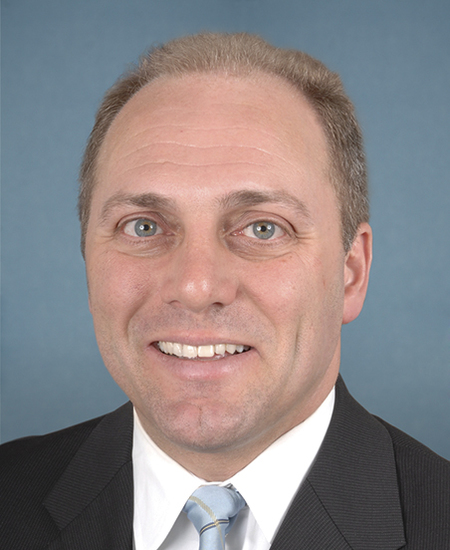
Rep. Steve Scalise
Sponsored bills
Maddy summaryThis bill (HR 6963) names the Department of Veterans Affairs community-based outpatient clinic in Lafayette, Louisiana, as the "Rodney C. Hamilton Sr. VA Clinic." It honors Rodney C. Hamilton Sr., a Korean War veteran who received the Purple Heart, served on Lafayette's city council, and helped establish the clinic that opened in 2016. The bill changes the clinic's official name to recognize his contributions to veterans' care and community service. This is a ceremonial designation with no impact on clinic operations or services.
Safeguard American Voter Eligibility Act or the SAVE America Act This bill requires individuals to provide documentary proof of U.S. citizenship when registering to vote, and requires photo identification to vote, in federal elections. Specifically, the bill prohibits states from accepting and processing an application to register to vote in a federal election unless the applicant presents documentary proof of U.S. citizenship. The bill specifies what documents are considered acceptable proof of U.S. citizenship, such as identification that complies with the REAL ID Act of 2005 that indicates U.S. citizenship. Further, the bill (1) prohibits states from registering an individual to vote in a federal election unless, at the time the individual applies to register to vote, the individual provides documentary proof of U.S. citizenship; and (2) requires states to establish an alternative process to demonstrate U.S. citizenship. Each state must take affirmative steps on an ongoing basis to ensure that only U.S. citizens are registered to vote, which shall include establishing a program to identify individuals who are not U.S. citizens using information supplied by certain sources. Additionally, states must remove noncitizens from their official lists of eligible voters. The bill (1) provides for a private right of action for certain violations, and (2) establishes criminal penalties for certain offenses. Individuals voting in federal elections must present an eligible photo identification document. An individual who votes by absentee ballot must submit a copy of their identification document with both the request for, and the submission of, the absentee ballot.
Maddy summaryHCONRES 58 is a symbolic congressional resolution denouncing socialism in all its forms. It does not create new laws or affect any policies, as it is a non-binding statement of opinion. The resolution cites historical events and quotes from Founding Fathers to argue that socialism leads to authoritarianism and economic harm, referencing examples like the Soviet Union and Venezuela. It formally "denounces" socialism and opposes implementing socialist policies in the U.S., but has no legal effect on citizens or government actions. This is a procedural resolution, not a policy measure.
Maddy summaryHRES 719 is a House resolution honoring Charles "Charlie" James Kirk, the founder of Turning Point USA who was assassinated on September 10, 2025. The resolution condemns his assassination and all political violence, extends condolences to his family, and calls on Americans to reject violence while promoting civil discourse. It specifically recognizes Kirk's legacy as a defender of constitutional principles and his role in inspiring youth through free speech and faith-based civic engagement. As a commemorative resolution, it does not enact policy changes but formally expresses the House's stance on honoring his life and legacy.
Rescissions Act of 2025 This act rescinds specified unobligated funds that were provided to the Department of State, the U.S. Agency for International Development (USAID), various independent and related agencies, and the Corporation for Public Broadcasting. The rescissions were proposed by the President under procedures included in the Congressional Budget and Impoundment Control Act of 1974. Under current law, the President may propose rescissions to Congress using specified procedures, and the rescissions must be enacted into law to take effect. Specifically, the act rescinds funds that were provided to the State Department or the President for Contributions to International Organizations; Contributions for International Peacekeeping Activities; Global Health Programs (excluding funds for programs addressing HIV/AIDS, tuberculosis, malaria, nutrition, or maternal and child health); Migration and Refugee Assistance; the Complex Crises Fund; the Democracy Fund; the Economic Support Fund (excluding funds for assistance to Jordan, Egypt, or the Countering PRC Influence Fund); Contributions to the Clean Technology Fund; International Organization and Programs; Development Assistance (excluding funds for Feed the Future Innovation Labs, the Countering PRC Influence Fund, or commodity-based food aid); Assistance for Europe, Eurasia, and Central Asia; International Disaster Assistance (excluding funds for commodity-based food aid); and Transition Initiatives. The act also rescinds funds that were provided for USAID Operating Expenses, the Inter-American Foundation, the U.S. African Development Foundation, the U.S. Institute of Peace, and the Corporation for Public Broadcasting.
Maddy summaryHR 21, the Born-Alive Abortion Survivors Protection Act, requires medical staff at abortion facilities to provide the same immediate care and hospital admission to any infant born alive during an abortion as they would for any newborn. It mandates reporting failures to provide this care to law enforcement and imposes penalties of up to 5 years in prison for violations, with harsher penalties for intentional killing. The bill also allows women who undergo abortions to sue for civil damages, including triple the abortion cost, and provides for attorney fees. It defines "abortion" to exclude procedures performed after viability to preserve a live birth. This law directly affects healthcare providers at abortion facilities and creates new federal legal obligations for them.
Maddy summaryHR 82, the Social Security Fairness Act of 2023, repeals two provisions that reduce Social Security benefits for certain government workers. It eliminates the Government Pension Offset (GPO), which cuts spousal or survivor benefits for people with pensions from jobs not covered by Social Security (like federal or state government roles), and the Windfall Elimination Provision (WEP), which lowers retirement benefits for those with similar pensions. The law takes effect for benefits paid after December 2023, requiring the Social Security Administration to adjust benefit calculations to remove these reductions. This change directly affects public-sector employees who previously had their Social Security benefits reduced due to their government pensions.
Maddy summary# Summary of Proposed Legislation This comprehensive legislative proposal contains multiple sections addressing election integrity, campaign finance reform, cybersecurity, census operations, and related government functions. Key provisions include: 1. **Campaign Finance Reforms**: - Increased thresholds for political committee reporting requirements - Repeal of requirements for political committees to report donor identification - Exemption of uncompensated internet communications from contribution/expenditure treatment - Protection of donor privacy for tax-exempt organizations through the "Speech Privacy Act of 2023" 2. **Election Security**: - Establishment of a process for testing and monitoring cybersecurity vulnerabilities in election equipment - Requirements for the Secretary of Homeland Security to notify state officials about election cybersecurity incidents - Exclusive authority for the Election Assistance Commission regarding guidelines for voting system certification 3. **Census and Redistricting**: - Establishment of a permanent Census Monitoring Board with bipartisan composition to review census operations - Clarification of state authority over congressional redistricting maps - Provisions regarding the Speaker of the House's authority to join civil actions related to apportionment 4. **Other Key Provisions**: - Termination of the Disinformation Governance Board and prohibition on funding similar entities - Amendments to the Federal Election Campaign Act to increase reporting thresholds and exempt certain communications - Various technical corrections to existing campaign finance law The legislation appears to focus on enhancing election security, reducing regulatory burdens on political organizations, protecting donor privacy, and strengthening oversight of census operations while maintaining constitutional boundaries between federal and state authority.
Maddy summaryThis resolution informs the Senate that the House of Representatives has assembled a quorum and elected Mike Johnson of Louisiana as Speaker and Kevin McCumber of Illinois as Clerk. It serves as a routine procedural step to establish the leadership structure for the 119th Congress at the start of the new session. The resolution does not enact any policy changes or affect public laws, but formally confirms the House's organizational setup. This is a standard, non-controversial action required by congressional procedure.