Maddy summaryThis bill increases penalties for impersonating a police officer in Minnesota. It upgrades the base offense to a felony (up to 2 years in jail or $4,000 fine) and creates a new crime for impersonating while carrying a firearm (up to 10 years in jail or $20,000 fine). The bill also requires anyone pretending to be a law enforcement officer to identify themselves when asked and imposes harsher penalties if they commit other crimes while impersonating an officer (e.g., a misdemeanor becomes a gross misdemeanor). It directly affects individuals who falsely pose as police officers, including those using fake uniforms, vehicle markings, or equipment to mimic law enforcement.

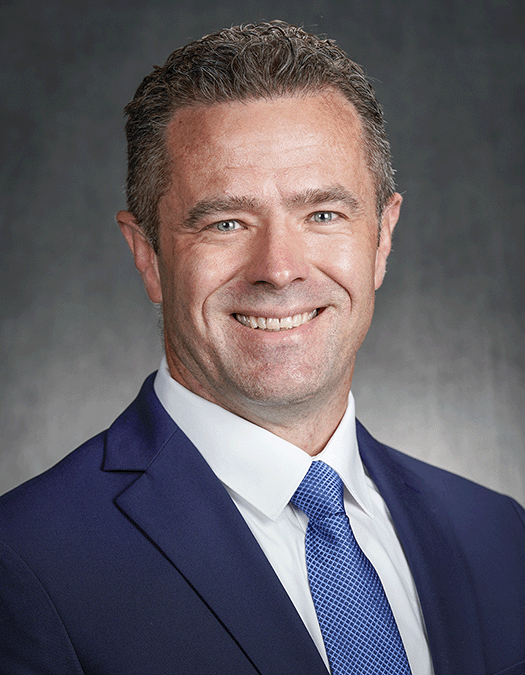
Rep. Pete Johnson
Sponsored bills
Maddy summaryHF 3467 allows Minnesota's Commissioner of Veterans Affairs to redirect agency resources toward specific veterans' initiatives, including addressing food insecurity, homelessness, and suicide prevention. The bill requires the commissioner to submit an annual report by October 15 to the governor and relevant legislative committees, detailing resources used and the critical issues supported in the previous year. This legislation directly affects veterans by enabling targeted support for urgent needs through state agency resources. It creates a formal mechanism for tracking how funds and resources are allocated to veterans' programs. The bill is currently in its initial legislative stage, having been introduced on February 19, 2026.
Maddy summarySF 3958 modifies the annual reporting deadline for Minnesota's disaster assistance contingency fund. The bill changes the requirement from submitting a report by January 15 to January 31 each year, detailing state disaster fund spending from the previous calendar year. This report must be submitted to the chairs and ranking members of the House Ways and Means and Senate Finance Committees. The change only affects the timing of the report; it does not alter how funds are used or who receives assistance under the disaster fund. The bill focuses solely on adjusting the reporting schedule for state agencies managing disaster relief funds.
Maddy summaryThis bill establishes a price ceiling for specific prescription drugs in Minnesota that are subject to federal Medicare drug price negotiations. It requires drug manufacturers to stop accepting payments higher than the federal "maximum fair price" for these medications, while also ensuring pharmacies receive at least that amount or the national average cost, whichever is higher. To enforce these rules, the law prohibits manufacturers from removing drugs from the market to evade price limits unless they provide advance notice, and it mandates that health plans and pharmacy benefit managers share detailed financial data with the state's Prescription Drug Affordability Board. The provisions will take effect on January 1, 2027, impacting drug manufacturers, health insurance plans, pharmacy benefit managers, and pharmacies operating in the state.
Maddy summaryHF 3393 creates supplemental unemployment benefits for workers in the iron ore mining industry and related explosive manufacturing firms that supply them. It provides additional benefits to employees laid off between January 15 and March 15, 2026, due to a 50%+ workforce reduction at their employer. Eligible workers must have exhausted regular unemployment benefits and meet standard eligibility requirements, receiving up to 26 weeks of supplemental payments matching their regular weekly benefit amount. The bill applies retroactively to January 15, 2026, and excludes those receiving federal Trade Readjustment Allowance benefits.
Maddy summaryHF 2354 strengthens Minnesota's response to Medicaid fraud by expanding the Attorney General's authority to subpoena records from entities like phone companies, financial institutions, and healthcare providers. It establishes criminal penalties for submitting false Medicaid claims, including fines up to $100,000 and up to 20 years in prison for fraud exceeding $35,000, with lesser penalties for smaller amounts. The bill directly affects Medicaid providers and individuals who submit fraudulent claims for medical assistance funds. Key mechanisms include new subpoena powers for investigations and tiered penalties based on the value of the fraudulent claims. The law amends existing statutes (256B.12, 609.467) and repeals outdated provisions.
Maddy summaryThis bill directs state funds to conduct a study on building nuclear power plants in Minnesota, focusing on factors like technology, regulations, and community impact. The study will examine small modular reactors, waste management, economic benefits, and safety concerns, and must be completed by June 2027. The results will be shared with state lawmakers to inform future energy policy decisions.
Maddy summaryHF 1082 establishes the Minnesota Victims of Crime Account, funded by increased fees/penalties from criminal cases and additional general fund transfers. It appropriates specific funds for fiscal years 2026-2027 to provide grants to organizations that received crime victim service grants in 2024. These grants must support direct services for victims of sexual assault, domestic violence, child abuse, and general crime - including client assistance, housing supports, culturally responsive programming, and prevention efforts like restorative justice. The bill requires services to prioritize underserved communities and reflect Minnesota’s diversity, with up to 10% of funds allowed for grant administration.
Maddy summarySF 856 creates an independent Office of the Inspector General (OIG) in Minnesota to oversee state agencies and programs. The OIG will conduct audits and investigations into fraud, waste, and abuse of public funds, report findings publicly, and make recommendations for improvement. It requires the OIG to operate separately from executive agencies, with a qualified director appointed by an advisory council, and mandates annual public reports. The bill appropriates funding for the OIG and takes effect January 1, 2026. This directly affects all state agencies, programs, and entities receiving public funds by subjecting them to independent oversight.
Maddy summaryHF 4980 modifies how Minnesota calculates and distributes compensatory education funding for school buildings in fiscal years 2027 and 2028. The bill changes the revenue formula to be based on the number of compensatory pupils rather than a fixed allowance per pupil and introduces a minimum funding floor for the 2027 school year. It also increases the percentage of funds school districts can reallocate to specific sites from 20 percent to 40 percent for these two years. Finally, the legislation appropriates money from the general fund to the commissioner of education to support these changes.