

Maddy summaryThis bill repeals existing affirmative action requirements for state agencies in Minnesota, removing the mandate for the state to establish specific goals and programs to increase the employment of members of protected groups. While the legislation eliminates these targeted initiatives, it retains the policy that state hiring and performance evaluations must be based on merit and free from discrimination based on race, gender, disability, or other protected characteristics. The law also keeps in place a requirement for agency managers to receive training on identifying and mitigating bias in the hiring and evaluation processes. Ultimately, the bill shifts the state's approach from proactive affirmative action plans to a focus on equal opportunity and nondiscrimination without setting numerical targets for diverse representation.
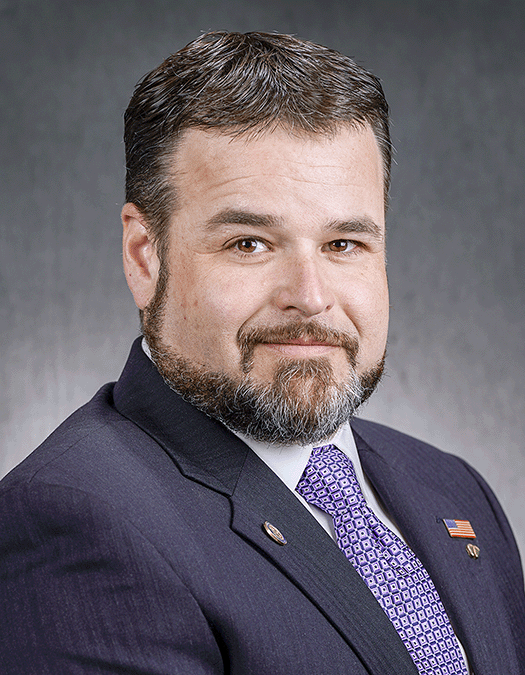
Rep. Josh Heintzeman
Sponsored bills
Maddy summaryThis bill temporarily suspends the state motor fuels tax in Minnesota for a specific period in 2026, directly affecting drivers, fuel retailers, and businesses that purchase gasoline and diesel. Under the legislation, the tax rate is set to zero cents per gallon or per thousand cubic feet for all fuel types during the designated timeframe, which begins shortly after the bill is enacted and ends in early September 2026. To offset the lost revenue from this suspension, the state will transfer money from its general fund to the Department of Transportation to cover the costs that would have been collected from fuel taxes. The bill also allocates a one-time appropriation to the Department of Revenue to cover the administrative expenses required to implement this temporary tax pause.
Maddy summaryThis bill strengthens Minnesota's regulations on the handling of infectious or pathological waste by requiring immediate notification when such waste is mistakenly sent to unapproved facilities, mandating unannounced inspections of waste generators, and establishing significant financial penalties for violations. Facilities that receive infectious waste must report the incident to state officials with details about the waste and its source, while generators must conduct annual internal audits to ensure compliance with management plans. Penalties for unlawful transport start at $200,000 for a first offense and increase to up to $2 million for subsequent violations, with half of collected fines directed to the facility that received the waste. The legislation also allocates $50,000 to create training materials for proper waste management and disposal practices.
Maddy summaryHF 1327 amends Minnesota's definition of "all-terrain vehicle" (ATV) by increasing the maximum allowable dry weight from 2,000 pounds to 3,000 pounds. The bill clarifies that ATVs must have three to six low-pressure or non-pneumatic tires and a width of 65 inches or less, while explicitly excluding electric-assisted bicycles, golf carts, mini-trucks, dune buggies, and vehicles designed for specific commercial uses like farming or logging. This change directly affects ATV operators, manufacturers, and law enforcement by expanding the weight threshold for vehicles classified as ATVs under state law. The policy adjustment updates regulatory definitions without altering enforcement requirements or creating new restrictions.
Maddy summaryThis bill requires Minnesota counties and cities to lose state funding if they reject development projects that would have increased their local property tax base. Under the law, the state Department of Revenue would calculate a penalty equal to the lost tax growth and cut the affected government's financial aid for the following year. Local officials must report the details of denied projects to the state by July 1, and the funding penalty continues until the jurisdiction's tax capacity grows enough to offset the lost value. The measure is designed to financially discourage local governments from blocking projects that expand the tax base, with an effective date of June 30, 2027.
Maddy summaryThis bill appropriates $1,925,000 from Minnesota's general fund to support the operations of five public television stations in Greater Minnesota for fiscal year 2026. The funding is distributed as specific grants to Pioneer PBS, Lakeland PBS, KSMQ, PBS North, and Prairie Public television, with amounts ranging from $200,000 to $650,000 for each station. The legislation takes effect the day after it is officially enacted and directs the commissioner of administration to manage the distribution of these funds.
Maddy summaryThis bill requires the state to grant a one-year extension without penalty to timber permit holders who request it before their current permit expires, provided they are not delinquent on payments or have active trespass violations. The law also mandates that permits for timber requiring frozen ground access must have a minimum term of four years, ending on May 31 of the fifth year, to ensure safe working conditions during winter. Additionally, the bill updates requirements for sale lists to include specific assessments on whether frozen ground access is needed for certain tracts of land. These changes directly affect current and future timber operators in Minnesota by altering how long they can legally harvest state timber and how sale information is presented.
Maddy summaryThis bill authorizes the Minnesota state government to issue bonds and allocate funds for capital projects on state-owned forest lands. It directly affects the Department of Natural Resources by providing financial resources for forest management activities such as reforestation, planting native trees, and site preparation on over 50 designated state forests. The legislation defines key terms like "reforestation" and "state forest land" to establish clear guidelines for how the appropriated funds will be used. By enabling bond issuance, the bill allows the state to finance large-scale forestry infrastructure improvements without immediately drawing from the general fund.
Maddy summaryHF 482 establishes "Choose Life" special license plates for Minnesota motor vehicle owners. To obtain these plates, applicants must pay a $25 initial fee and $25 annual contribution to a dedicated "Choose Life account," in addition to standard registration fees. Funds collected are deposited into this account and distributed by Choose Life Minnesota, Inc., to non-profit agencies within each county that assist pregnant women making adoption plans - excluding any agencies involved in abortion services or charging fees for services. The bill also specifies plate design requirements (featuring the "Choose Life" logo and inscription) and limits administrative costs for the program to 15% of funds. The program becomes effective January 1, 2026.
Maddy summaryThis bill directs the Minnesota Legislature to formally request that the U.S. Congress convene a constitutional convention specifically to propose amendments limiting terms for members of the House of Representatives and Senate. The resolution states that Minnesota's application should be grouped with similar requests from other states to collectively reach the two-thirds threshold required to trigger such a convention. It designates the Secretary of State to send copies of this request to federal officials and state legislators across the country to encourage cooperation. The measure aims to reduce the influence of special interests and allow elected officials to focus more on policy rather than reelection by establishing term limits for federal legislators.