Maddy summaryThis bill increases penalties for impersonating a police officer in Minnesota. It upgrades the base offense to a felony (up to 2 years in jail or $4,000 fine) and creates a new crime for impersonating while carrying a firearm (up to 10 years in jail or $20,000 fine). The bill also requires anyone pretending to be a law enforcement officer to identify themselves when asked and imposes harsher penalties if they commit other crimes while impersonating an officer (e.g., a misdemeanor becomes a gross misdemeanor). It directly affects individuals who falsely pose as police officers, including those using fake uniforms, vehicle markings, or equipment to mimic law enforcement.

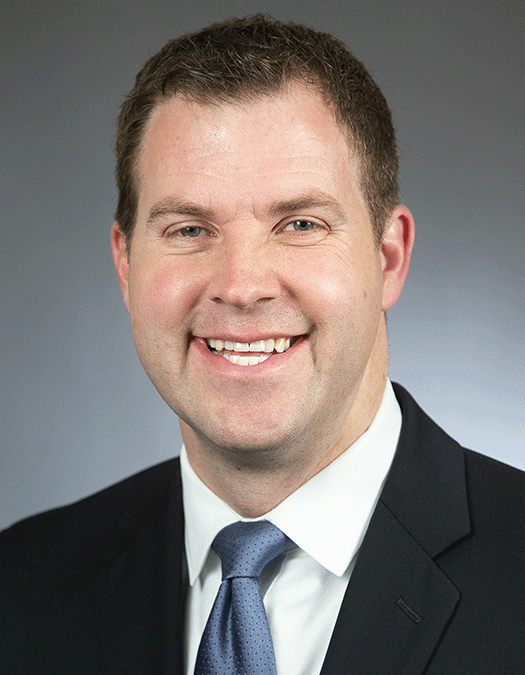
Rep. Jamie Long
Sponsored bills
Maddy summaryHF 5149 restricts law enforcement from making civil immigration arrests at court facilities and surrounding areas to protect individuals attending legal proceedings. The bill defines 'civil arrest' as taking someone into custody for immigration violations and explicitly prohibits this action within courthouses, parking lots, and nearby sidewalks. It also establishes protections for court companions, such as family members and advocates, by extending these arrest restrictions to anyone accompanying a person to court. Additionally, the legislation modifies laws related to concealing identity and expands investigations into police use of force.
Maddy summaryThis bill introduces new regulations in Minnesota to restrict the ownership and sale of semiautomatic military-style assault weapons and large-capacity magazines, while also banning the sale of binary trigger systems. It expands criminal penalties for possessing dangerous weapons in schools and for negligently storing firearms, and it specifically criminalizes the manufacture and sale of untraceable "ghost guns." Additionally, the legislation strengthens the state's extreme risk protection order system, requires law enforcement to report firearm discharges more comprehensively, and allocates funding to support public awareness campaigns and mental health services.
Maddy summaryThis bill creates a new Greenhouse Gas Pollution Superfund in Minnesota to address climate change impacts. It establishes a program that requires fossil fuel companies responsible for over one billion metric tons of emissions between 1995 and 2026 to pay into a dedicated account. The collected funds will be used to finance climate change adaptation projects for state, local, and Tribal governments, as well as for disadvantaged communities. The bill defines specific terms like "responsible party" and "covered greenhouse gas emissions" to determine which companies must contribute and what types of projects can receive funding.
Maddy summaryThis bill appropriates $10 million in state bond proceeds to fund the expansion and renovation of St. David's Center at 1130 Nicollet Mall in Minneapolis. The funds will support early childhood education, children's mental health services, pediatric therapy, and family support programs aimed at improving educational and health outcomes for children and families in Hennepin County. The state will issue bonds up to $10 million to cover these costs, with the project required to use the funds for specific services outlined in the bill. The appropriation is available until the facility project is completed.
Maddy summaryThis bill establishes the Minnesota Business Recovery Loan Program to provide financial assistance to businesses that have suffered revenue losses exceeding 30% due to staffing shortages or disruptions caused by increased immigration enforcement activities. The program allocates $100 million in one-time funding, with $18 million designated for zero-interest loans to businesses in greater Minnesota and $82 million for zero-interest loans to businesses in the seven-county metropolitan area through nonprofit lenders. To qualify, businesses must be Minnesota-based, in good standing, and demonstrate that their revenue decline stems from immigration-related events between the bill's enactment and December 1, 2025. Loan amounts vary by business size and location, ranging from $25,000 to $200,000, and funds must be used exclusively for business operations within Minnesota rather than debt repayment or real estate investment.
Maddy summaryThis bill authorizes the issuance of up to $75 million in state bonds to fund capital improvements for bus rapid transit projects in Minnesota. The money will be distributed to the Metropolitan Council, which is responsible for acquiring property, designing routes, and constructing arterial bus rapid transit systems. The council must decide how to allocate these funds based on specific criteria such as project readiness, expected ridership, and alignment with existing transportation plans. Once the bonds are sold, the resulting revenue will be used to pay for construction costs, utility relocation, and the equipping of facilities for these transit projects.
Maddy summaryThis bill repeals previous tax exemptions that allowed certain preferred seats and amenities at athletic events to be sold without sales tax. It also provides funding for safe harbor shelter and housing grants to support individuals experiencing homelessness. By removing the exemptions, the legislation ensures that these specific stadium seats and related amenities are now subject to standard sales tax like other retail items. The funding provision aims to allocate state money directly to organizations assisting with shelter and housing needs.
Maddy summaryHF 3802 amends Minnesota's energy certificate of need exemptions, removing the requirement for certain energy projects to seek state approval. The bill specifically exempts projects like wind/solar facilities (including repowering projects that don't exceed capacity limits), transmission line upgrades (e.g., converting to natural gas or increasing efficiency by ≤10%), and energy storage systems from the standard review process. It also clarifies exemptions for small transmission lines (≤1 mile) and upgrades using existing rights-of-way. These changes directly affect energy developers and utilities building or modifying infrastructure, streamlining approval for projects that align with existing state energy policies. The bill focuses on updating technical definitions and scope rather than creating new regulatory requirements.
Maddy summaryThis bill (HF 3556) is a naming resolution that commemorates Melissa Hortman by designating Minnesota's community solar garden program as the "Melissa Hortman Community Solar Garden Program." It does not change any program rules, funding, or operations - it only adds a short title to Minnesota Statutes section 216B.1641. The bill directly honors Melissa Hortman, a former state legislator, through this naming. It is procedural and has no policy impact beyond the name change.