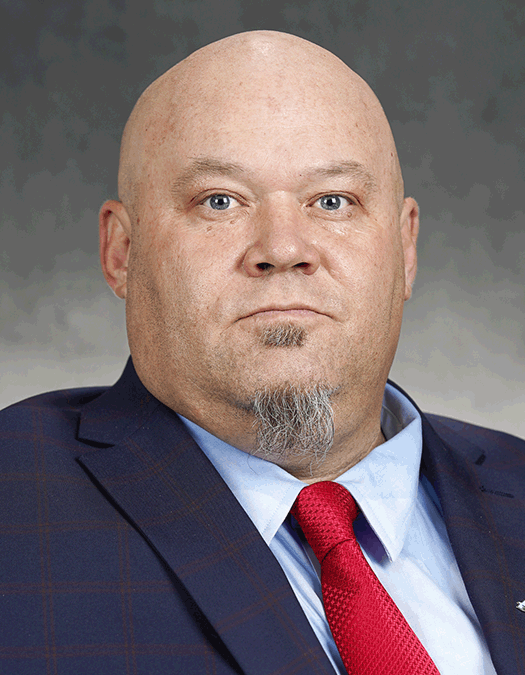
Maddy summaryHF 1849 proposes a constitutional amendment to limit Minnesota's governor and lieutenant governor to two terms each. If approved by voters in 2026, the amendment would change the state constitution to state that no person may be elected more than twice to either office. The amendment requires a statewide vote at the 2026 general election with a specific ballot question asking voters to approve term limits beginning in 2030. This change would affect all future governors and lieutenant governors, but would not apply to terms served before 2030.

Sponsored bills
Maddy summaryThis bill proposes adding a new section to the Minnesota Constitution that explicitly states a preborn child has a right to life. It defines a preborn child as a living human fetus from fertilization until live birth and requires voter approval at the 2026 general election for the amendment to take effect in 2027. The text includes specific language ensuring that medical treatment to save a pregnant person's life or the removal of a nonviable or deceased fetus remains allowed.
Maddy summaryThis bill temporarily suspends the state motor fuels tax in Minnesota for a specific period in 2026, directly affecting drivers, fuel retailers, and businesses that purchase gasoline and diesel. Under the legislation, the tax rate is set to zero cents per gallon or per thousand cubic feet for all fuel types during the designated timeframe, which begins shortly after the bill is enacted and ends in early September 2026. To offset the lost revenue from this suspension, the state will transfer money from its general fund to the Department of Transportation to cover the costs that would have been collected from fuel taxes. The bill also allocates a one-time appropriation to the Department of Revenue to cover the administrative expenses required to implement this temporary tax pause.
Maddy summaryThis bill establishes a "Parent's Bill of Rights" in Minnesota to protect the authority of parents over their minor children's upbringing, education, and healthcare. It mandates that government entities and schools cannot interfere with parental decisions regarding education methods, moral training, medical consent, and the privacy of school and medical records. The law also requires written parental consent before biometric scans, DNA collection, or recording a child, with specific exceptions for emergencies or legitimate security needs. Additionally, it prohibits employees from pressuring children to hide information from parents or from discriminating against parents who exercise these rights.
Maddy summaryThis bill creates a new process allowing individuals subject to civil commitment orders in Minnesota to request that those orders be cancelled if they were issued due to mistakes or false information. It applies to cases involving orders issued on or after January 1, 2015, and requires the court to cancel the order if the person proves the error by a preponderance of the evidence. The legislation also permits appeals of these cancellation decisions and is scheduled to take effect on August 1, 2026.
Maddy summaryThis bill expands the legal definition of a "disorderly house" in Minnesota to include commercial establishments where high-risk sexual activities occur habitually, provided the owner or manager knows about them. The legislation specifically defines "high-risk sexual conduct" as activities likely to spread diseases through bodily fluid exchange, such as anonymous sex or sex with multiple partners. While the law already covers places involved in prostitution, gambling, or drug sales, this change adds a new category targeting venues facilitating unsafe sexual behavior. The new provisions will take effect on August 1, 2026, and apply to crimes committed on or after that date.
Maddy summaryThis bill creates a new tax subtraction for Minnesota individual income tax that reduces taxable income for taxpayers aged 65 and older. It applies to both single filers and married couples filing jointly, where the subtraction covers income received by any spouse who has reached age 65 during the tax year. The provision defines "income" broadly to include amounts included in adjusted gross income or required to be added back under existing tax rules. The bill would take effect for taxable years beginning after December 31, 2025, meaning it would apply to tax returns filed in 2026 and later.
Maddy summaryThis bill establishes the SAVE Minnesota Act, which requires voters to present a specific photo identification card to register to vote and to cast their ballots. To obtain this new voter identification card, applicants must provide proof of their U.S. citizenship and may receive certain vital records, such as birth certificates, without a fee. The legislation also creates a new voter identification card program, modifies existing driver's license requirements, and sets up a process for handling provisional ballots. Additionally, the bill includes funding provisions to support the administration of these new election procedures and establishes a children's trust fund.
Maddy summaryThis bill is a House resolution that formally impeaches Minnesota Governor Timothy J. Walz for alleged corrupt conduct in office. It directly affects the Governor by charging him with four specific articles of misconduct, including concealing fraud in state programs, obstructing oversight investigations, prioritizing political narratives over transparency, and failing to enforce laws protecting public funds. If adopted by the House, the resolution would immediately suspend the Governor's duties while the Senate conducts a trial to determine whether he should be removed from office. The bill also requires the Speaker of the House to serve formal notice of the charges to the Governor and directs the Chief Clerk to send copies of the resolution to relevant state officials.
Maddy summaryThis bill establishes a one-time special property tax refund for Minnesota property owners who paid taxes in 2026. It directly affects owners of specific property types, including residential homes, apartments, farms, and forests, by allowing them to apply for a share of a $4 billion fund. To receive money, owners must submit an application to the Department of Revenue between July 15 and September 15, 2026, and the refunds will be distributed by December 31, 2026. The legislation appropriates $4 billion from the state's general fund to finance these payments, with each eligible owner receiving a portion based on their individual tax contribution relative to the total taxes paid by all applicants.