

Maddy summaryThis bill modifies eligibility requirements for private detective and protective agent licenses in Minnesota by updating definitions for applicants, license holders, and specific roles like Minnesota managers and proprietary employers. It requires that key individuals within corporate or partnership applicants meet licensing qualifications and be actively involved in daily management and supervision of licensed activities. The legislation also establishes a Board of Private Detective and Protective Agent Services with members representing licensed professionals and the public to oversee licensing applications and investigations. These changes aim to clarify who qualifies for licensure and strengthen oversight of security-related businesses operating in the state.
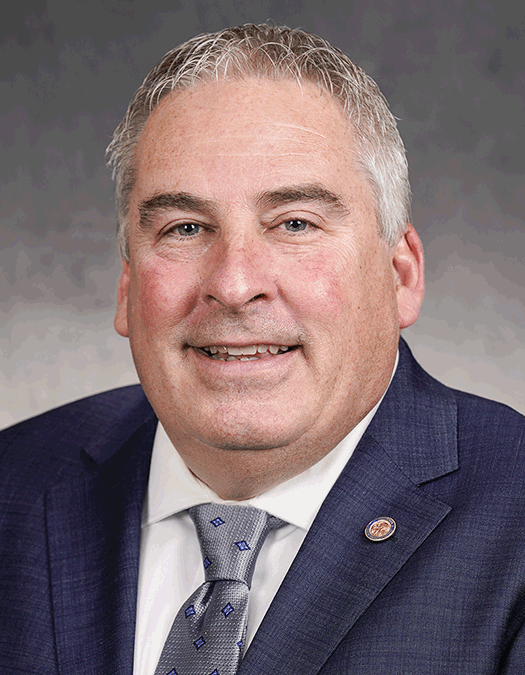
Rep. Jeff Witte
Sponsored bills
Maddy summaryThis bill amends Minnesota's organized retail theft law to explicitly include gift card fraud as a form of retail theft. It defines "retail merchandise" to cover all gift cards (both physical and digital) and specifies that the "value" of stolen gift cards includes their full face value. Retailers and law enforcement will now have a clearer legal framework for prosecuting gift card fraud under existing organized retail theft statutes. The change takes effect August 1, 2025.
Maddy summaryHF 1410 amends Minnesota's Peace Officers Discipline Procedures Act to explicitly include local correctional officers under the existing disciplinary framework. The bill changes definitions in Minnesota Statutes to clarify that "correctional officer" means someone employed in a security role at a local correctional or detention facility, and specifies that the discipline procedures apply to these local facilities. This means local correctional officers will now be covered by the same disciplinary processes that currently apply to state and municipal peace officers. The change ensures consistency in how disciplinary actions are handled for all security personnel working in correctional settings across Minnesota.
Maddy summaryHF 3489 establishes new safety rules for school field trips in Minnesota, requiring that school staff, contractors, or volunteers never be alone with students during any field trip (including overnight trips), effective July 1, 2026. The bill also adds "grooming" (defined under Minnesota Statute 609.352) as a specific criminal offense that automatically triggers license revocation for educators without a hearing if convicted. Additionally, it mandates school districts to report certain educator terminations or suspensions related to misconduct to licensing boards within 10 days. This bill directly affects school staff, school districts, and educator licensing boards by changing field trip protocols, expanding automatic license revocation grounds, and requiring new reporting procedures.
Maddy summaryThis bill expands how Minnesota cities and counties can use local affordable housing aid by adding emergency rental assistance and support for financially distressed properties to the list of eligible projects. It also updates the timeline for spending these funds, requiring that aid be committed to projects within three years and fully spent within four years, with a specific exception allowing more time for construction and shelter facility projects. Additionally, the legislation mandates that new multi-unit buildings funded by this aid include a minimum percentage of accessible and sensory-accessible units to better serve people with disabilities. These changes apply to aid payments made in calendar year 2027 and later, aiming to provide greater flexibility and broader coverage for local housing initiatives.
Maddy summaryHF 1849 proposes a constitutional amendment to limit Minnesota's governor and lieutenant governor to two terms each. If approved by voters in 2026, the amendment would change the state constitution to state that no person may be elected more than twice to either office. The amendment requires a statewide vote at the 2026 general election with a specific ballot question asking voters to approve term limits beginning in 2030. This change would affect all future governors and lieutenant governors, but would not apply to terms served before 2030.
Maddy summaryThis bill updates election procedures for Minnesota school districts that span multiple counties, specifically regarding special elections. It requires these districts to establish at least one polling place in each county where over 5,000 registered voters live, based on the most recent general election data. Additionally, the bill mandates that voters receive detailed notices by mail at least 14 days before the election, including information about the election date, location, and financial details regarding the cost and savings of using combined polling places. The notices must also be posted on the school district's website, though exceptions apply for certain election dates or mail-only ballots.
Maddy summaryThis bill updates Minnesota's tax laws to align with recent federal changes regarding how businesses can deduct research and development expenses. It directly affects Minnesota businesses by allowing them to claim these deductions under state law in the same way they are treated under federal rules. The legislation amends existing tax statutes to include specific federal provisions about expensing research expenditures and ensures the state's rules match federal timelines for these changes.
Maddy summarySF 3868 prohibits the placement or operation of virtual currency kiosks (physical machines for buying/selling cryptocurrency) within Minnesota. It directly affects businesses that operate such kiosks by banning their activity statewide. The bill creates a new legal provision (Minnesota Statutes § 53B.691) explicitly stating this prohibition and repeals all existing statutes (53B.69-53B.75) that previously defined virtual currency kiosk operations and related terms. This represents a complete ban on physical cryptocurrency kiosks in Minnesota, replacing the prior regulatory framework.
Maddy summaryHF 4949 establishes a new state program to provide financial reimbursement for hosting major sports and events in Minnesota. The bill defines eligible events to include high-profile competitions such as the Super Bowl, NCAA championships, World Cup matches, and various All-Star games. Funding is intended for local organizing committees that successfully attract these events to the state, with money drawn from a newly created account in the state treasury. The legislation also requires the commissioner of revenue to submit reports regarding the program's operations.