Maddy summaryThis bill permits tow trucks in Minnesota to display portable variable message signs while performing emergency services on or near highways. It directly affects tow truck operators by allowing them to use these signs (e.g., to display warnings like "STOP" or "ACCIDENT AHEAD") during emergency responses, as long as the signs meet Minnesota's traffic control device standards. The key provision amends traffic regulations to explicitly authorize this use during emergency service, supplementing existing requirements for flashing red and amber lights. The bill does not change general towing operations but adds a safety tool for emergency scenarios. It is a procedural change to traffic equipment rules, not a broad policy shift.

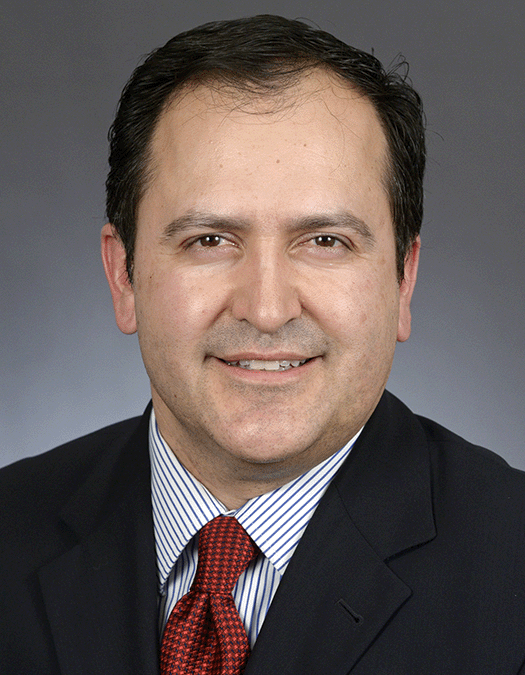
Rep. Jon Koznick
Sponsored bills
Maddy summaryThis Minnesota bill requires large social media platforms to implement specific protections for children under 18, including restrictions on addictive design features like infinite scrolling, autoplay videos, and personalized feeds. The law applies to platforms that earn at least $1 billion in annual advertising revenue and defines "addictive interface features" in detail, such as push notifications and metrics showing likes or follower counts. Parents of children under 15 must receive clear notifications about their child's online activity, and platforms must provide tools for parents to manage their child's account settings. The bill also establishes enforcement mechanisms and sets up a new chapter in Minnesota statutes to govern these requirements.
Maddy summaryHF 2438 is a funding bill that allocates $4.88 billion for Minnesota's Department of Transportation (DOT) in fiscal year 2026 and $3.96 billion in 2027. It specifies funding sources including the trunk highway fund ($3.43 billion for 2026), airports fund ($28 million annually), and county/municipal state-aid highway funds. The bill directs funds toward existing programs like airport development, aviation support services, and Civil Air Patrol, with no new policy changes. It affects state agencies managing transportation infrastructure, airports, and highway systems, not individual citizens or businesses. This is a routine budget appropriation, not a policy bill.
Maddy summaryThis bill modifies Minnesota State Patrol compensation requirements by updating how salary surveys are conducted and how certain expenses are reimbursed. It requires the legislative auditor to perform a compensation and benefits survey every odd-numbered year for police departments in cities with over 25,000 residents in metropolitan counties, first-class cities, and the State Patrol. The survey must include base salary, overtime wages, premium pay, and all benefits like insurance and retirement contributions, with results reported to relevant legislative committees. Additionally, the bill clarifies that salary adjustments for supervisory ranks must be proportionate to those made for patrol troopers based on survey findings. The legislation also updates the definition of patrol troopers to include lieutenants and removes the 2030 survey deadline, extending the requirement to every odd-numbered year thereafter.
Maddy summaryHF 1724 establishes legal definitions and regulatory exemptions for direct primary care service agreements in Minnesota. The bill clarifies that these agreements - where patients pay a direct fee for primary care services (like check-ups and chronic disease management) instead of using insurance - are not considered insurance or health plans under Minnesota law. This means primary care providers (such as physicians or nurse practitioners) offering these agreements do not need insurance licenses or comply with insurance regulations (chapters 60A, 62A, 62C, 62D, or 62N). The bill directly affects primary care providers seeking to offer subscription-based care and patients choosing this alternative to traditional insurance.
Maddy summaryHF 3785 clarifies definitions and requirements for electric-powered vehicles in Minnesota, specifically targeting devices often called "E-Motos" (high-speed electric cycles not classified as standard e-bikes). It requires sellers of these vehicles to hold a dealer license, mandates registration for certain electric motorcycles and motorized bicycles, and explicitly prohibits vehicles not defined in Minnesota law from operating on public roads. The bill updates statutes to distinguish E-Motos from e-bikes (which are unaffected) and clarifies that off-highway motorcycles used on trails may include some electric devices. This directly affects sellers of electric-powered vehicles and riders using these devices on Minnesota roads.
Maddy summaryThis bill temporarily suspends the state motor fuels tax in Minnesota for a specific period in 2026, directly affecting drivers, fuel retailers, and businesses that purchase gasoline and diesel. Under the legislation, the tax rate is set to zero cents per gallon or per thousand cubic feet for all fuel types during the designated timeframe, which begins shortly after the bill is enacted and ends in early September 2026. To offset the lost revenue from this suspension, the state will transfer money from its general fund to the Department of Transportation to cover the costs that would have been collected from fuel taxes. The bill also allocates a one-time appropriation to the Department of Revenue to cover the administrative expenses required to implement this temporary tax pause.
Maddy summaryHF 3490 authorizes Minnesota to participate in a federal tax credit program by establishing rules for scholarship-granting organizations (SGOs). These SGOs must be 501(c)(3) nonprofits that spend at least 90% of funds on student scholarships, verify household income, prioritize returning students/siblings, and avoid targeting specific students. Organizations must report annually to the Minnesota Department of Education, which will post a public list of approved SGOs. The bill clarifies it does not grant schools additional control over nonpublic schools or their students.
Maddy summaryThis bill updates election procedures for Minnesota school districts that span multiple counties, specifically regarding special elections. It requires these districts to establish at least one polling place in each county where over 5,000 registered voters live, based on the most recent general election data. Additionally, the bill mandates that voters receive detailed notices by mail at least 14 days before the election, including information about the election date, location, and financial details regarding the cost and savings of using combined polling places. The notices must also be posted on the school district's website, though exceptions apply for certain election dates or mail-only ballots.
Maddy summaryThis bill appropriates $80,000 for the Civil Air Patrol in each of fiscal years 2026 and 2027, funded from the state airports fund and administered by the commissioner of transportation. It directly affects the Civil Air Patrol organization in Minnesota by providing dedicated state funding for its operations. The bill contains no policy changes or new requirements - only a specific funding allocation. As a procedural appropriation, it does not alter existing programs or create new obligations.