Maddy summaryThis bill increases penalties for impersonating a police officer in Minnesota. It upgrades the base offense to a felony (up to 2 years in jail or $4,000 fine) and creates a new crime for impersonating while carrying a firearm (up to 10 years in jail or $20,000 fine). The bill also requires anyone pretending to be a law enforcement officer to identify themselves when asked and imposes harsher penalties if they commit other crimes while impersonating an officer (e.g., a misdemeanor becomes a gross misdemeanor). It directly affects individuals who falsely pose as police officers, including those using fake uniforms, vehicle markings, or equipment to mimic law enforcement.

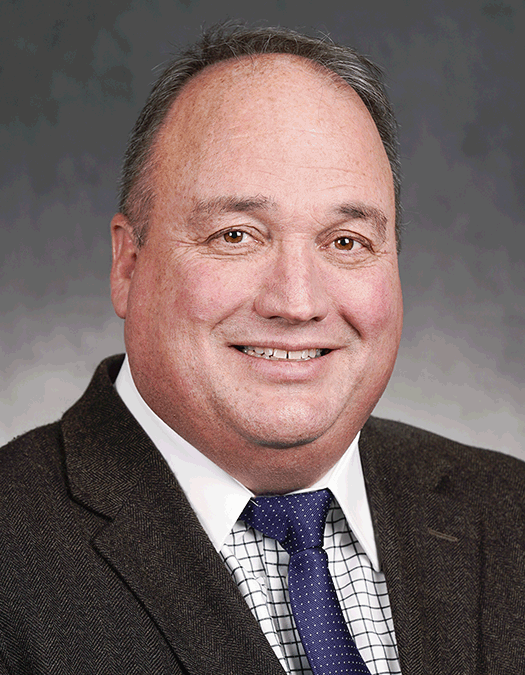
Rep. John Huot
Sponsored bills
Maddy summaryHF 3521 amends Minnesota's hospital construction moratorium to allow specific exceptions for new beds or facility expansions that would otherwise be restricted. It directly affects hospitals in targeted locations, including up to 35 new psychiatric beds in Rice County, 31 new beds in Beltrami County, and 20 new beds in Carver County, among other specified projects. Key provisions include exemptions for facilities meeting criteria like serving over 70% out-of-state patients (Rice County) or consolidating pediatric services without net bed increases. The bill also permits a new 300-bed hospital in Maple Grove if approved by the city council. These exceptions apply only to projects that meet all defined conditions without increasing overall state bed capacity.
Maddy summaryThis bill requires Minnesota's real estate appraiser commissioner to use the Appraisal Foundation's Voluntary Disciplinary Sanction Matrix as the standard when imposing discipline on appraisers. It directly affects licensed real estate appraisers in Minnesota and the commissioner who enforces disciplinary actions. The key provision mandates that the commissioner follow this matrix by default, but allows case-by-case deviations only when specific mitigating circumstances are present. The bill establishes a standardized framework for disciplinary decisions without altering existing penalties or creating new requirements for appraisers.
Maddy summaryThis bill requires public cemeteries in Minnesota to allow individuals to be buried according to the rites of their recognized religion, including green burials. It mandates that these burial practices comply with existing state environmental laws and sets a limit of 300 green burial plots per acre over 100 years, with exceptions for religions that require higher density. The legislation also amends current cemetery statutes to formally include green burials as a permitted option for public cemeteries.
Maddy summaryThis bill authorizes the Metropolitan Council to sell transit-related merchandise, food, and beverages at retail locations, online, and within transit stations in seven specific Minnesota counties. The legislation allows the council to partner with private entities to help market and manage these sales. Any money earned from these sales must be used to fund improvements for the region's transportation capital projects.
Maddy summaryThis bill modifies how Minnesota calculates registration taxes for passenger automobiles and hearses, directly affecting vehicle owners and dealers. It establishes a new tax rate of 1.575 percent based on the manufacturer's suggested retail price for vehicles registered on or after November 16, 2020, while maintaining a slightly lower rate for older registrations. The legislation introduces a tiered tax devaluation schedule that reduces the taxable value of a vehicle by a specific percentage each year it remains in use, with the reduction amount varying depending on the vehicle's price range. Additionally, the bill clarifies that the tax calculation excludes the cost of optional accessories and destination charges, except for pre-2020 registrations.
Maddy summaryThis bill amends Minnesota statutes to update pension contribution rates and annuity calculation formulas for teachers in the state's retirement systems. It establishes specific employer contribution percentages for certain districts like Minneapolis and Duluth while adjusting the rates for other districts. Additionally, the legislation modifies how retirement annuities are computed based on years of service, distinguishing between different periods of employment and membership types. These changes directly affect teachers and school districts in Minnesota by altering the financial terms of their retirement benefits.
Maddy summaryHF 3658 modifies Minnesota's process for extreme risk protection orders (ERPOs), which are temporary court orders preventing individuals deemed a threat from accessing firearms. The bill expands who can file petitions - including law enforcement agencies, family/household members, and guardians - while clarifying definitions of "family or household members" and requiring specific evidence in petitions. Key changes include waiving court filing fees, mandating mental health professionals to report firearm-related suicide risks to law enforcement, and requiring courts to notify law enforcement and update background checks within 24 hours of issuing an order. These changes aim to streamline access to ERPOs for at-risk individuals and improve enforcement coordination.
Maddy summaryThis bill requires health insurance plans in Minnesota to cover cancer screenings for breast, colorectal, prostate, cervical, and lung cancers in accordance with current American Cancer Society guidelines. The law mandates that these plans provide coverage for all recommended examinations and follow-up tests without imposing any cost-sharing requirements, such as co-pays, deductibles, or coinsurance. Effective January 1, 2027, the provisions will apply to any health plan that is offered, issued, or renewed on or after that date.
Maddy summaryThis bill allows the Minnesota Historical Society to enter into contracts with counties, municipalities, or local historical societies to manage and operate state historic sites. The key provision permits these contracted organizations to keep admission fees collected at the sites and receive grants-in-aid for operational and maintenance costs. This change expands the types of entities that can directly manage state historic sites beyond the current restrictions. The bill takes effect immediately upon final enactment.