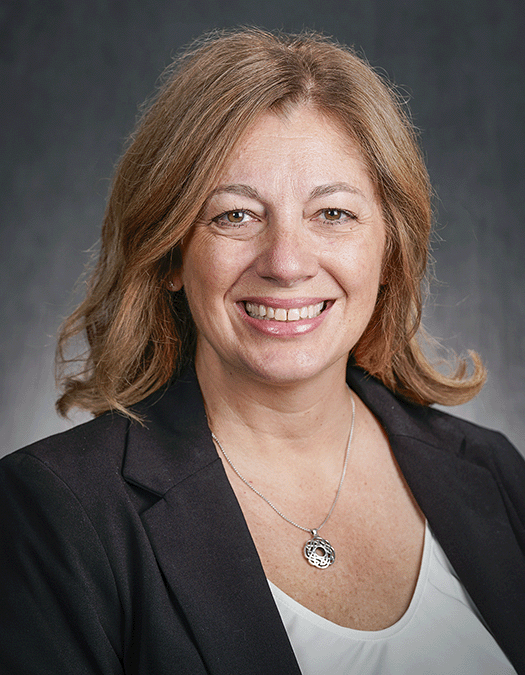
Photo of Julie Greene
D Minnesota House · District 50A On the 2026 ballot

Rep. Julie Greene

Compare
Total votes
463
all sessions
Attendance
100%
1 missed
Higher than 77% of chamber peers
With party
98%
of cast votes
Near the chamber average
Bipartisan score
1%
crosses aisle rarely
Near the chamber average
Sponsored
174
bills & resolutions
Near the chamber average
Committees
3
assignments
174 bills and resolutions

Sponsored bills

Total
174
Primary
29
Co-sponsor
145
This page
174
matching current filters
Co-sponsor HF 3404
Signed into law · Minnesota House · Co-sponsor
Criminal penalty for impersonating a peace officer increased, crime of impersonating a peace officer while possessing a firearm established, enhanced penalties established, persons presenting as peace officers required to fulfill duty to identify, and criminal penalties established.

Maddy summaryThis bill increases penalties for impersonating a police officer in Minnesota. It upgrades the base offense to a felony (up to 2 years in jail or $4,000 fine) and creates a new crime for impersonating while carrying a firearm (up to 10 years in jail or $20,000 fine). The bill also requires anyone pretending to be a law enforcement officer to identify themselves when asked and imposes harsher penalties if they commit other crimes while impersonating an officer (e.g., a misdemeanor becomes a gross misdemeanor). It directly affects individuals who falsely pose as police officers, including those using fake uniforms, vehicle markings, or equipment to mimic law enforcement.

Signed into law Aug 1, 2026 1 co-sponsor
Co-sponsor HF 4138
Signed into law · Minnesota House · Co-sponsor
Social media platform requirements established relating to accounts for minors, and enforcement mechanisms established for regulations on child social media accounts.

Maddy summaryThis Minnesota bill requires large social media platforms to implement specific protections for children under 18, including restrictions on addictive design features like infinite scrolling, autoplay videos, and personalized feeds. The law applies to platforms that earn at least $1 billion in annual advertising revenue and defines "addictive interface features" in detail, such as push notifications and metrics showing likes or follower counts. Parents of children under 15 must receive clear notifications about their child's online activity, and platforms must provide tools for parents to manage their child's account settings. The bill also establishes enforcement mechanisms and sets up a new chapter in Minnesota statutes to govern these requirements.

Signed into law Jul 1, 2026 1 co-sponsor
Co-sponsor HF 3900
Signed into law · Minnesota House · Co-sponsor
Permanent school fund investment, management, and distribution policy modified; and constitutional amendment proposed.

Maddy summaryThis bill proposes a constitutional amendment to modify how Minnesota's permanent school fund is invested, managed, and distributed to school districts. The key change would require the fund to be managed as a perpetual resource that preserves its purchasing power over time while providing annual distributions to support schools without raising individual taxes. The amendment establishes a board of investment led by the governor, state auditor, secretary of state, and attorney general, and prohibits the use of state funds to underwrite municipal securities. If approved by voters in 2026, the new policy would take effect on July 1, 2027, with specific rules for calculating distributable amounts and handling investment gains and losses.

Signed into law May 26, 2026 1 co-sponsor
Co-sponsor HF 5149
In committee · Minnesota House · Co-sponsor
Law enforcement access to sensitive locations restricted, civil remedies established, concealing identity crime modified, scope of use of force investigations expanded, access to certain information limited.

Maddy summaryHF 5149 restricts law enforcement from making civil immigration arrests at court facilities and surrounding areas to protect individuals attending legal proceedings. The bill defines 'civil arrest' as taking someone into custody for immigration violations and explicitly prohibits this action within courthouses, parking lots, and nearby sidewalks. It also establishes protections for court companions, such as family members and advocates, by extending these arrest restrictions to anyone accompanying a person to court. Additionally, the legislation modifies laws related to concealing identity and expands investigations into police use of force.

In committee May 17, 2026 1 co-sponsor
Co-sponsor HF 5140
In committee · Minnesota House · Co-sponsor
Ownership, possession, and sale of semiautomatic military-style assault weapons and large-capacity magazines regulated; provisions for possessing dangerous weapons in schools, negligently storing firearms, and reporting on law enforcement firearms discharge modified; ghost guns criminalized; other gun safety provisions modified; and money appropriated.

Maddy summaryThis bill introduces new regulations in Minnesota to restrict the ownership and sale of semiautomatic military-style assault weapons and large-capacity magazines, while also banning the sale of binary trigger systems. It expands criminal penalties for possessing dangerous weapons in schools and for negligently storing firearms, and it specifically criminalizes the manufacture and sale of untraceable "ghost guns." Additionally, the legislation strengthens the state's extreme risk protection order system, requires law enforcement to report firearm discharges more comprehensively, and allocates funding to support public awareness campaigns and mental health services.

In committee May 14, 2026 1 co-sponsor
Co-sponsor HF 4017
Passed · Minnesota House · Co-sponsor
Unlawful shipment of infectious or pathological waste study required, and money appropriated.

Maddy summaryThis bill strengthens Minnesota's regulations on the handling of infectious or pathological waste by requiring immediate notification when such waste is mistakenly sent to unapproved facilities, mandating unannounced inspections of waste generators, and establishing significant financial penalties for violations. Facilities that receive infectious waste must report the incident to state officials with details about the waste and its source, while generators must conduct annual internal audits to ensure compliance with management plans. Penalties for unlawful transport start at $200,000 for a first offense and increase to up to $2 million for subsequent violations, with half of collected fines directed to the facility that received the waste. The legislation also allocates $50,000 to create training materials for proper waste management and disposal practices.

Passed May 13, 2026 1 co-sponsor
Co-sponsor HF 3176
In committee · Minnesota House · Co-sponsor
Rail corridor service analysis required for passenger rail service to Fargo and Kansas City, commissioner of transportation required to apply for federal passenger rail corridor identification and development programming, and money appropriated.

Maddy summaryThis bill requires Minnesota's commissioner of transportation to apply for federal funding to develop two new passenger rail routes: one from St. Paul to Fargo, North Dakota, and another from St. Paul to Kansas City, Missouri (with stops in Northfield, Albert Lea, and Des Moines, Iowa). It appropriates $1 million in fiscal year 2026 for planning, application costs, and state matching funds to secure federal grants for these routes. The funding covers activities like environmental analysis, cost estimates, and service development planning under the federal Corridor Identification and Development Program. The bill directly affects Minnesota's transportation agency and communities along the proposed rail corridors. The $1 million is a one-time allocation available until June 2028 for Minnesota's share of project costs.

In committee May 13, 2026 1 co-sponsor
Co-sponsor HF 244
In committee · Minnesota House · Co-sponsor
Minneapolis; child and family services facility expansion and renovation funding provided, bonds issued, and money appropriated.

Maddy summaryThis bill appropriates $10 million in state bond proceeds to fund the expansion and renovation of St. David's Center at 1130 Nicollet Mall in Minneapolis. The funds will support early childhood education, children's mental health services, pediatric therapy, and family support programs aimed at improving educational and health outcomes for children and families in Hennepin County. The state will issue bonds up to $10 million to cover these costs, with the project required to use the funds for specific services outlined in the bill. The appropriation is available until the facility project is completed.

In committee May 12, 2026 1 co-sponsor
Primary HF 5128
In committee · Minnesota House · Lead sponsor
Minnesota Vision of a Learner established, working group created, report required, and money appropriated.

Maddy summaryThis bill establishes a "Minnesota Vision of a Learner" to define the knowledge and skills students need to succeed after high school, affecting public schools, charter schools, and the broader education community. It creates a working group that must include diverse stakeholders such as students, parents, teachers, business leaders, and tribal representatives to develop this vision through public input. The group is required to submit a report by January 15, 2028, and the resulting vision will be posted on various state department websites, though local districts retain the choice to adopt, adapt, or ignore it. Additionally, the bill updates rules for developing academic standards in core subjects to ensure they are clear, measurable, and organized as coherent learning progressions. These changes take effect on July 1, 2026, and include funding for the working group members.

In committee May 11, 2026 0 co-sponsors
Co-sponsor HF 3624
In committee · Minnesota House · Co-sponsor
Food shelf programs funding provided, and money appropriated.

Maddy summaryHF 3624 appropriates $5,392,000 from the general fund for Minnesota's food shelf programs in fiscal year 2027. The funding, added to the base allocation, supports existing food shelf operations under Minnesota Statutes section 142F.14, administered by the state agency for children, youth, and families. This bill directly affects community food shelves that provide emergency food assistance to Minnesotans in need, without changing program eligibility or creating new requirements. The measure focuses solely on providing dedicated state funding for current food shelf services.

In committee May 7, 2026 1 co-sponsor
Showing 1 to 10 of 174 bills
1 2 3 18 Next