Maddy summarySF 3887 allows watershed districts, watershed management organizations, and towns with over 100 employees to self-insure for employee health benefits like long-term disability (but not life insurance). The bill requires self-insurance plans to meet legal benefit standards and be certified by the Department of Commerce before use. It also mandates that employers consult with employee representatives before adopting or dissolving self-insurance plans and provides options for employees to enroll in external insurance at their own expense. This expands existing self-insurance options previously limited to cities and counties.

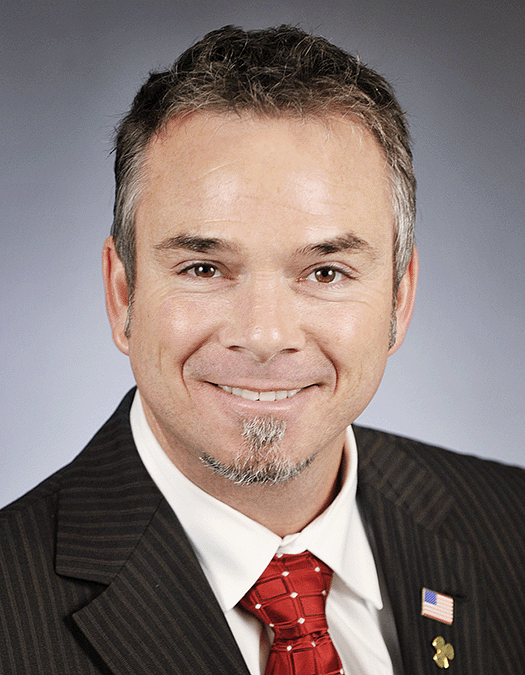
Rep. Joe McDonald
Sponsored bills
Maddy summaryThis bill modifies Minnesota's gambling laws by increasing the maximum cash prize for paddle tickets from $70 to $200 and raising the maximum ticket price from $2 to $5. It directly affects gambling organizations that sell paddle tickets, which are a type of lottery game. The changes are made to Minnesota Statutes 2024, section 349.211, subdivision 2b, which governs paddlewheel prizes.
Maddy summaryThis bill modifies prize and ticket limits for paddlewheel gambling in Minnesota. It directly affects organizations that operate paddlewheel games by changing the maximum cash prize to $70 and setting a merchandise prize limit at $200 fair market value. The legislation also increases the maximum ticket price from $2 to $5. These changes update Minnesota Statutes 349.211, subdivision 2b to reflect the new gambling regulations.
Maddy summaryHF 1724 establishes legal definitions and regulatory exemptions for direct primary care service agreements in Minnesota. The bill clarifies that these agreements - where patients pay a direct fee for primary care services (like check-ups and chronic disease management) instead of using insurance - are not considered insurance or health plans under Minnesota law. This means primary care providers (such as physicians or nurse practitioners) offering these agreements do not need insurance licenses or comply with insurance regulations (chapters 60A, 62A, 62C, 62D, or 62N). The bill directly affects primary care providers seeking to offer subscription-based care and patients choosing this alternative to traditional insurance.
Maddy summaryThis bill proposes adding a new section to the Minnesota Constitution that explicitly states a preborn child has a right to life. It defines a preborn child as a living human fetus from fertilization until live birth and requires voter approval at the 2026 general election for the amendment to take effect in 2027. The text includes specific language ensuring that medical treatment to save a pregnant person's life or the removal of a nonviable or deceased fetus remains allowed.
Maddy summaryThis bill temporarily suspends the state motor fuels tax in Minnesota for a specific period in 2026, directly affecting drivers, fuel retailers, and businesses that purchase gasoline and diesel. Under the legislation, the tax rate is set to zero cents per gallon or per thousand cubic feet for all fuel types during the designated timeframe, which begins shortly after the bill is enacted and ends in early September 2026. To offset the lost revenue from this suspension, the state will transfer money from its general fund to the Department of Transportation to cover the costs that would have been collected from fuel taxes. The bill also allocates a one-time appropriation to the Department of Revenue to cover the administrative expenses required to implement this temporary tax pause.
Maddy summaryHF 3490 authorizes Minnesota to participate in a federal tax credit program by establishing rules for scholarship-granting organizations (SGOs). These SGOs must be 501(c)(3) nonprofits that spend at least 90% of funds on student scholarships, verify household income, prioritize returning students/siblings, and avoid targeting specific students. Organizations must report annually to the Minnesota Department of Education, which will post a public list of approved SGOs. The bill clarifies it does not grant schools additional control over nonpublic schools or their students.
Maddy summaryThis bill requires Minnesota voter registration forms to include any new requirements mandated by federal law, such as asking voters to provide proof of citizenship. It directs the Secretary of State to ensure all election officials comply with federal election rules and to distribute $5 million in state funds to counties based on their 2024 voter turnout to help cover costs associated with these new federal mandates. The legislation also mandates that the Secretary of State submit annual reports to the legislature confirming that the state and local officials are meeting these federal obligations.
Maddy summaryHF 3129 requires Minnesota's Commissioner of Labor and Industry to adopt new safety rules for window cleaning and adult changing facilities under the State Building Code. Specifically, it mandates rules for window cleaning safety features in new buildings and existing buildings undergoing renovations (if current features are unsafe and renovations allow for new safety provisions), and requires adult-size changing facilities in new construction. These rules directly affect building owners, developers, and construction companies who must comply with the updated code. The bill amends Minnesota Statutes section 326B.106, adding new subsections (m) for window safety and (n) for changing facilities.
Maddy summaryThis bill makes it a felony to force or coerce a pregnant minor under 18 into seeking or obtaining an abortion, defining coercion broadly to include threats, isolation, financial pressure, and exploiting vulnerabilities. It requires hospitals and other facilities to screen and report suspected cases of human trafficking involving minors. Additionally, the law adds wrongful death as a cause of action for deaths resulting from abortions and mandates the creation of specific rules by the state health commissioner.