Maddy summaryThis bill modifies Minnesota law to allow county commissioners to enter into agreements with other government units for services that those units are authorized to provide themselves, even if the county does not currently have the specific power to perform that service. The legislation also mandates that county sheriffs must sign agreements with federal agencies to carry out authorized federal functions without needing prior approval from the county board. By creating these exceptions to the usual requirement that all parties in an agreement must share common powers, the bill expands the ability of local governments to collaborate on service delivery and fulfill federal mandates.

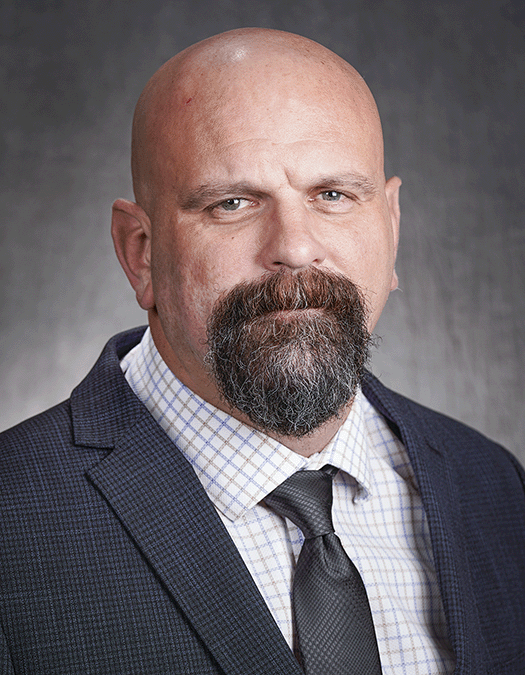
Rep. Terry Stier
Sponsored bills
Maddy summaryThis bill creates a new 100% tax on money obtained through fraud by individuals or organizations, regardless of whether they have already paid fines or restitution. It applies to those convicted by a court, those identified by the state revenue commissioner as having committed fraud, and anyone paid to help facilitate such fraudulent activities. The revenue collected from this tax must be used exclusively to provide relief for state income or property taxes. The law takes effect retroactively for fraud cases determined after December 31, 2019.
Maddy summaryThis bill, known as the Minnesota Public Safety Radio Communications Funding and Interoperability Act, removes the requirement for Minnesota counties to pay for the expansion and maintenance of the ARMER public safety radio network. Instead, the legislation creates a new state-funded account to cover these costs, ensuring that local governments are not forced to use property taxes for this infrastructure. The law also establishes a voluntary program where the state and local jurisdictions can share project costs on an equal basis, with the state covering at least 75 percent of any such expenses. Additionally, the bill sets up a framework to improve interoperability, allowing different law enforcement, fire, and emergency medical agencies to communicate effectively across jurisdictional lines. A new reporting requirement mandates that the commissioner of public safety annually update the legislature on how the funds are being used and the progress of the network.
Maddy summaryThis House resolution initiates the formal impeachment process against Keith Ellison, Minnesota's Attorney General, alleging corrupt conduct and crimes while in office. The bill directs the House to adopt six articles of impeachment that accuse Ellison of abusing his office to defend unlawful protest activity, undermining religious liberty protections, failing to enforce laws impartially, engaging in conflicts of interest, and soliciting political support in exchange for favorable treatment. If adopted, the resolution immediately bars Ellison from exercising his duties as Attorney General until the Senate conducts a trial and votes on his acquittal or conviction. The House Speaker must serve notice of the charges to Ellison, and the enrolled resolution must be transmitted to the Governor, Secretary of State, and Senate leadership to begin the constitutional impeachment proceedings.
Maddy summaryThis bill expands survivor benefits in Minnesota to include public safety officers who die from exposure-related cancers linked to their work. It defines specific cancers covered, such as lung, breast, and leukemia, and establishes criteria requiring exposure to occur during duty with a minimum five-year service period before diagnosis and a maximum 15-year window after leaving active service. The legislation creates a legal presumption that such deaths result from line-of-duty exposure unless medical evidence proves otherwise, while also defining carcinogens based on international research classifications. These changes directly affect public safety officers and their families by broadening eligibility for benefits under existing state statutes.
Maddy summaryThis bill allocates $1.75 million from the state's general fund in fiscal year 2027 to help develop and implement a unified 911 center awareness platform. The money will be given to the Metropolitan Emergency Services Board to create a system that enables 911 centers to communicate and coordinate emergency responses across different jurisdictional boundaries in real time. The grant also covers two years of maintenance costs for the platform. This legislation directly affects public safety officials and emergency response centers by providing funding for improved communication infrastructure.
Maddy summaryThis bill allocates $1,000,000 from the state's general fund to hire eight additional school safety specialists at the Minnesota School Safety Center for fiscal years 2026 and 2027. The funding is designated as a one-time appropriation that can be used until fully spent, with no restrictions on how the money is distributed among the new positions. This legislation directly affects the Minnesota School Safety Center and the public safety system by increasing the number of available safety personnel. The bill takes effect immediately upon final passage by the legislature.
Maddy summaryThis bill establishes a one-time property tax refund program for Minnesota property owners who paid eligible taxes in 2026, affecting residential, agricultural, and commercial property classifications. The program allocates $4 billion from the state general fund to provide refunds based on a percentage calculated by the Department of Revenue, with applications accepted between July 15 and September 15, 2026. Any unclaimed refund amounts will automatically be converted into property tax credits for 2027 on the properties where no refund was requested. The legislation defines specific property categories eligible for the refund and sets clear deadlines for application processing and payment distribution.
Maddy summaryHF 895 requires Minnesota state agencies to obtain legislative approval before certain rules take effect. The bill amends statutes to mandate that a rule becomes effective only after a law approving it is enacted, following publication of the notice of adoption in the State Register. This directly affects all state agencies that create rules, as they must now seek legislative approval rather than having rules automatically take effect after publication. The key mechanism shifts the effective date from current practice to require a separate legislative act approving the rule after its notice is published.
Maddy summaryThis bill authorizes the issuance of up to $1.788 million in state bonds to fund upgrades at the SCALE regional public safety training facility in Jordan. The funds will be used to replace aging burn structures with a new fire training tower that meets current safety standards and to improve the technical systems for existing training areas. This legislation directly affects the Scott County Association for Leadership and Efficiency Joint Powers Board, which manages the facility. The money will come from a dedicated bond proceeds fund, and the bill takes effect immediately upon final passage.