

Maddy summarySF 3891 allows Minnesota grocery stores to donate eggs past their quality assurance date to charitable food programs under specific conditions. The bill modifies existing egg sales rules by permitting donation of eggs that would otherwise lose their grade (after 31 days for Grade AA or 46 days for Grade A), provided they remain in original packaging, were previously graded, stay continuously refrigerated, are distributed within 30 days of the quality date, and carry required labeling (including "Donated Eggs - Not for Resale"). It directly affects retailers (offering an alternative to discarding eggs) and food assistance programs (expanding available donations). The bill does not change egg grading standards or labeling for regular retail sale.
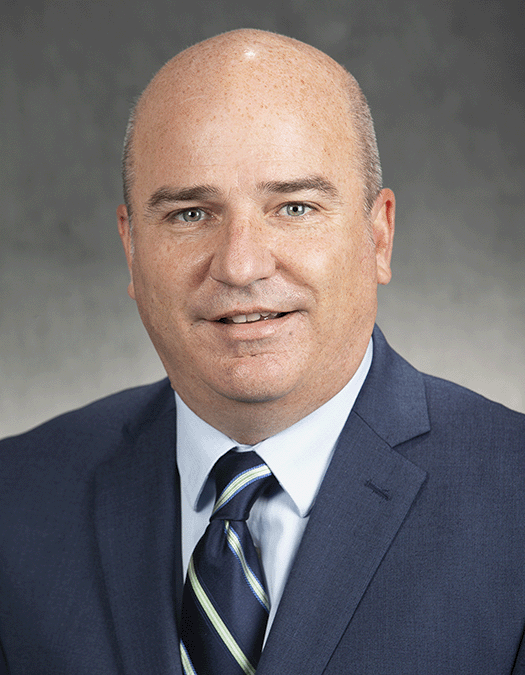
Rep. John Burkel
Sponsored bills
Maddy summaryHF 3718 amends Minnesota's veterinary medicine statutes by adding and updating key definitions. It creates a new definition for "accredited program of veterinary technology" (requiring AVMA-CVTEA accreditation) and expands "animal" to include fish and reptiles (removing poultry exclusions). The bill also adds definitions for terms like "consulting," "consent," "dispensing," "donor," "emergency stabilization," and "extra-label use" to clarify veterinary practice standards. These changes primarily affect licensed veterinarians, veterinary technicians, and veterinary practices by standardizing terminology in the state's regulatory framework. The bill does not impose new practice requirements but refines existing legal definitions.
Maddy summaryThis bill proposes a constitutional amendment to modify how Minnesota's permanent school fund is invested, managed, and distributed to school districts. The key change would require the fund to be managed as a perpetual resource that preserves its purchasing power over time while providing annual distributions to support schools without raising individual taxes. The amendment establishes a board of investment led by the governor, state auditor, secretary of state, and attorney general, and prohibits the use of state funds to underwrite municipal securities. If approved by voters in 2026, the new policy would take effect on July 1, 2027, with specific rules for calculating distributable amounts and handling investment gains and losses.
Maddy summaryThis bill modifies Minnesota's gambling laws by increasing the maximum cash prize for paddle tickets from $70 to $200 and raising the maximum ticket price from $2 to $5. It directly affects gambling organizations that sell paddle tickets, which are a type of lottery game. The changes are made to Minnesota Statutes 2024, section 349.211, subdivision 2b, which governs paddlewheel prizes.
Maddy summaryThis bill modifies prize and ticket limits for paddlewheel gambling in Minnesota. It directly affects organizations that operate paddlewheel games by changing the maximum cash prize to $70 and setting a merchandise prize limit at $200 fair market value. The legislation also increases the maximum ticket price from $2 to $5. These changes update Minnesota Statutes 349.211, subdivision 2b to reflect the new gambling regulations.
Maddy summaryThis bill (HF 3579) amends Minnesota statutes to allow grocery stores and processors to donate eggs past their "quality assurance date" to charitable food programs under specific conditions. It directly affects retailers with eggs nearing expiration and charitable organizations distributing food assistance. Key provisions require donated eggs to remain in original packaging, be previously graded, continuously refrigerated, distributed within 30 days of the quality assurance date, and labeled with a "Donated Eggs - Not for Resale" notice. The bill updates Minnesota Statutes sections 29.21 (defining quality assurance date) and 29.26 (retail egg handling rules) to create this donation pathway while maintaining safety standards.
Maddy summaryHF 1849 proposes a constitutional amendment to limit Minnesota's governor and lieutenant governor to two terms each. If approved by voters in 2026, the amendment would change the state constitution to state that no person may be elected more than twice to either office. The amendment requires a statewide vote at the 2026 general election with a specific ballot question asking voters to approve term limits beginning in 2030. This change would affect all future governors and lieutenant governors, but would not apply to terms served before 2030.
Maddy summaryThis bill modifies Minnesota's corporate farm law to clarify and expand the definitions of family farms and related agricultural entities. It directly affects nonprofit corporations, family trusts, and individuals involved in farming by updating how they are classified under state statutes. The key provision redefines terms like "family farm corporation" and "authorized farm corporation" to include specific ownership structures, such as trusts held by relatives within the third degree of kinship, while maintaining limits on land ownership and non-farming income. By amending the legal definitions, the legislation aims to ensure that these specific types of family-owned agricultural operations continue to qualify for existing exemptions and protections under the law.
Maddy summaryHF 3490 authorizes Minnesota to participate in a federal tax credit program by establishing rules for scholarship-granting organizations (SGOs). These SGOs must be 501(c)(3) nonprofits that spend at least 90% of funds on student scholarships, verify household income, prioritize returning students/siblings, and avoid targeting specific students. Organizations must report annually to the Minnesota Department of Education, which will post a public list of approved SGOs. The bill clarifies it does not grant schools additional control over nonpublic schools or their students.
Maddy summaryHF 1327 amends Minnesota's definition of "all-terrain vehicle" (ATV) by increasing the maximum allowable dry weight from 2,000 pounds to 3,000 pounds. The bill clarifies that ATVs must have three to six low-pressure or non-pneumatic tires and a width of 65 inches or less, while explicitly excluding electric-assisted bicycles, golf carts, mini-trucks, dune buggies, and vehicles designed for specific commercial uses like farming or logging. This change directly affects ATV operators, manufacturers, and law enforcement by expanding the weight threshold for vehicles classified as ATVs under state law. The policy adjustment updates regulatory definitions without altering enforcement requirements or creating new restrictions.