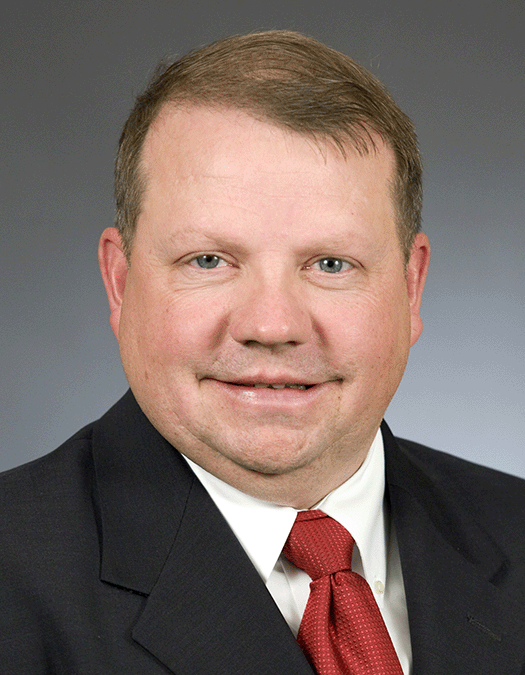
Photo of Ron Kresha
R Minnesota House · District 10A

Rep. Ron Kresha

Compare
Total votes
2,168
all sessions
Attendance
92%
188 missed
Near the chamber average
With party
97%
of cast votes
Near the chamber average
Bipartisan score
2%
crosses aisle rarely
Near the chamber average
Sponsored
625
bills & resolutions
Lower than 87% of chamber peers
Committees
3
assignments
625 bills and resolutions

Sponsored bills

Total
625
Primary
225
Co-sponsor
400
This page
625
matching current filters
Primary HF 4052
Signed into law · Minnesota House · Lead sponsor
Various provisions governing telephone company regulation, facilities and property, pricing plans, service classification, and reporting requirements.

Maddy summaryThis bill updates Minnesota telecommunications regulations by clarifying rules for telephone companies, including requirements for law enforcement access to call information, annual reporting, and customer pricing notices. It directly affects telephone service providers and their customers by establishing clearer obligations for how companies must handle service requests, billing information, and compliance with federal universal service programs for schools and libraries. The legislation also repeals several outdated statutes related to public payphones and other legacy regulations to simplify the legal framework governing telephone services in the state.

Signed into law Aug 1, 2026 0 co-sponsors
Co-sponsor SF 4282
Signed into law · Minnesota Senate · Co-sponsor
Various agency forecast adjustments

Maddy summaryThis bill adjusts funding forecasts for Minnesota's public school programs from prekindergarten through grade 12, updating the amounts the state expects to spend in 2026 and 2027. It directly affects school districts and the state education finance system by changing the projected allocations for general education aid, abatement aid, career and technical aid, and other specific funding categories. The bill amends existing state laws to reflect revised dollar amounts for each program, replacing previous estimates with new figures based on current financial projections. These changes ensure the state's education budget forecasts align with updated revenue and expenditure expectations for the upcoming fiscal years.

Signed into law May 27, 2026 1 co-sponsor
Co-sponsor HF 3900
Signed into law · Minnesota House · Co-sponsor
Permanent school fund investment, management, and distribution policy modified; and constitutional amendment proposed.

Maddy summaryThis bill proposes a constitutional amendment to modify how Minnesota's permanent school fund is invested, managed, and distributed to school districts. The key change would require the fund to be managed as a perpetual resource that preserves its purchasing power over time while providing annual distributions to support schools without raising individual taxes. The amendment establishes a board of investment led by the governor, state auditor, secretary of state, and attorney general, and prohibits the use of state funds to underwrite municipal securities. If approved by voters in 2026, the new policy would take effect on July 1, 2027, with specific rules for calculating distributable amounts and handling investment gains and losses.

Signed into law May 26, 2026 1 co-sponsor
Co-sponsor HF 3335
In committee · Minnesota House · Co-sponsor
Slavery or involuntary servitude as criminal punishment for a crime prohibited, and constitutional amendment proposed.

Maddy summaryHF 3335 proposes a constitutional amendment to prohibit slavery or involuntary servitude as a criminal punishment, removing the current exception in Minnesota's constitution that allows it for convicted criminals. The amendment would require voter approval at the 2026 general election, with the ballot question asking: "Shall the Minnesota Constitution be amended to prohibit slavery or involuntary servitude as criminal punishment for a crime?" If passed, it would ban forced labor as a penalty for any crime, affecting Minnesota's criminal sentencing laws. This change would eliminate a historical loophole in the state constitution that permits involuntary servitude as punishment for offenses.

In committee May 14, 2026 1 co-sponsor
Co-sponsor HF 3490
In committee · Minnesota House · Co-sponsor
Scholarship-granting organizations authorized.

Maddy summaryHF 3490 authorizes Minnesota to participate in a federal tax credit program by establishing rules for scholarship-granting organizations (SGOs). These SGOs must be 501(c)(3) nonprofits that spend at least 90% of funds on student scholarships, verify household income, prioritize returning students/siblings, and avoid targeting specific students. Organizations must report annually to the Minnesota Department of Education, which will post a public list of approved SGOs. The bill clarifies it does not grant schools additional control over nonpublic schools or their students.

In committee May 13, 2026 1 co-sponsor
Co-sponsor HF 5040
In committee · Minnesota House · Co-sponsor
Tax on certain individuals and organizations convicted of and benefiting from fraud established.

Maddy summaryThis bill creates a new 100% tax on money obtained through fraud by individuals or organizations, regardless of whether they have already paid fines or restitution. It applies to those convicted by a court, those identified by the state revenue commissioner as having committed fraud, and anyone paid to help facilitate such fraudulent activities. The revenue collected from this tax must be used exclusively to provide relief for state income or property taxes. The law takes effect retroactively for fraud cases determined after December 31, 2019.

In committee Apr 20, 2026 1 co-sponsor
Co-sponsor HF 5015
In committee · Minnesota House · Co-sponsor
School safety plans enhanced, student discipline provisions modified, anonymous reporting systems enabled, safe schools revenue increased, school building and cybersecurity grant program modified, reports required, and money appropriated.

Maddy summaryThis bill directs the Minnesota School Safety Center to create and distribute evidence-based model safety plans for K-12 schools, requiring districts to adopt similar plans by May 2028. It establishes strict criteria for what counts as "evidence-based," mandating that safety strategies be backed by strong research or well-designed studies before they are implemented. The legislation also enables anonymous threat reporting systems in schools and requires the safety center to consult with licensed mental health professionals when developing these plans. Additionally, the bill modifies grant programs for school buildings and cybersecurity while increasing funding for safe schools initiatives.

In committee Apr 16, 2026 1 co-sponsor
Co-sponsor HF 3493
In committee · Minnesota House · Co-sponsor
Safe schools revenue increased; safe schools revenue available to charter schools, cooperative units, nonpublic schools, and Tribal contract schools made; and money appropriated.

Maddy summaryHF 3493 increases Minnesota's safe schools revenue funding to $36 per adjusted pupil unit for the 2027 fiscal year and later. It expands eligibility to include charter schools, cooperative units, nonpublic schools, and Tribal contract schools - previously limited to traditional public school districts. The bill requires funds to be used for specific safety purposes like security enhancements, counseling services, drug prevention programs, and cybersecurity measures. This policy change directly affects all Minnesota schools receiving state education funding, providing new resources for school safety initiatives. The bill takes effect for fiscal year 2027.

In committee Apr 16, 2026 1 co-sponsor
Primary HF 3289
In committee · Minnesota House · Lead sponsor
Wetland replacement ratios modified.

Maddy summaryHF 3289 modifies Minnesota's wetland replacement requirements by changing the ratio for agricultural land. It specifies a 1:1 replacement ratio (one acre restored for each acre drained) for wetlands on agricultural land or in areas over 80% agricultural, down from the previous 2:1 ratio required for nonagricultural land. This directly affects developers, farmers, and landowners seeking permits to drain or fill wetlands in agricultural zones. The bill amends Minnesota Statutes 103G.222 and 103G.2243 to establish this new standard, clarifying that restored wetlands from previously drained areas may be used for replacement. The change aims to streamline requirements for agricultural land while maintaining wetland protection principles.

In committee Apr 16, 2026 0 co-sponsors
Co-sponsor HF 4962
In committee · Minnesota House · Co-sponsor
Definition of electronic voting system modified, and voting system rules and instructions permitted to be made available to and acknowledged by a voter using mobile voting technology.

Maddy summaryThis bill modifies Minnesota election laws to formally recognize mobile voting technology and allow voters to use it in jurisdictions that have authorized it. Under the new rules, eligible voters could request their ballots, instructions, and eligibility certificates be sent to them via a secure app on a mobile device, which they would then use to submit their votes. The legislation defines mobile voting technology as an encrypted application on a mobile device and sets minimum security requirements, including multifactor authentication and encryption for data transmission. Additionally, the bill updates the legal definition of an electronic voting system to include mobile voting technology and clarifies how voting rules and instructions must be made available to voters using this method.

In committee Apr 13, 2026 1 co-sponsor
Showing 1 to 10 of 625 bills
1 2 3 63 Next