

(1) Existing law, commonly referred to as the Density Bonus Law, requires a city or county to grant a density bonus, other incentives or concessions, and waivers or reductions of development standards, as specified, to an applicant for a housing development when the applicant seeks a density bonus for the housing development, as specified, if the applicant agrees to construct, among other things, a specified percentage of units for very low income, lower income, or senior citizen housing, and meets other requirements. This bill would, instead, require a city or county to grant a density bonus, other incentives or concessions, and waivers or reductions of development standards, as specified, to an applicant for a housing development when the applicant submits an application for a housing development that a city, county, or city and county determines meets specified criteria, including, among others, the housing development includes specified percentage of units for very low income, lower income, or senior citizen housing. (2) Existing law defines density bonus for the purposes of the Density Bonus Law to mean a density increase over the otherwise base density, as specified. Existing law specifies the base density calculation standards and requires base density to be determined using dwelling units per acre, except as otherwise provided. For the purpose of calculating a density bonus, existing law requires the residential units to be on contiguous sites that are the subject of one development application, as specified. Existing law also requires the density bonus to be permitted in geographic areas of the housing development other than the areas where the units for the lower income households are located. This bill would allow an applicant who provides a base density study, as defined, to elect to receive a density bonus in the form of a percentage increase in maximum floor area ratio, as specified. The bill would create an additional exception to the requirement that base density be determined using dwelling units per acre for applicants who elect to provide a base density study. This bill would revise and recast the provisions related to permitting of a density bonus relative to the geographic area to instead require a density bonus, incentive, or concession, or waiver or reduction, on sites that are the subject of the same housing development, as specified. (3) Existing law requires a city or county to adopt procedures and timelines for processing a density bonus application and to notify the applicant for a density bonus whether the application is complete in a manner consistent with specified timelines. If the local government notifies the applicant that the application is deemed complete, this bill would require the city or county to provide the applicant with a determination that the project is eligible for a density bonus. (4) Existing law authorizes an applicant for a density bonus to submit to a city or county a proposal for the specific incentives or concessions that the applicant requests and requires the city or county to grant the concession or incentive requested by the applicant unless the city or county makes a certain written finding, based upon substantial evidence. Existing law specifies the number of incentives or concessions an applicant is eligible to receive based on certain criteria. This bill would make revisions to certain of those calculations related to incentives or concessions. (5) The California Environmental Quality Act (CEQA) requires a lead agency, as defined, to prepare, or cause to be prepared, and certify the completion of an environmental impact report on a project that it proposes to carry out or approve that may have a significant effect on the environment or to adopt a negative declaration if it finds that the project will not have that effect. CEQA also requires a lead agency to prepare a mitigated negative declaration for a project that may have a significant effect on the environment if revisions in the project would avoid or mitigate that effect and there is no substantial evidence that the project, as revised, would have a significant effect on the environment. Existing law specifies that the granting of a density bonus or incentive or concessions shall not require or be interpreted to require a general plan amendment, local coastal plan amendment, zoning change, or other discretionary approval. Existing law also specifies that the granting of an incentive or concessions shall not require or be interpreted to require a study. This bill would specify that the granting of a waiver or reduction of development standards shall not require or be interpreted to require a general plan amendment, local coastal plan amendment, zoning change, study, or other discretionary approval. The bill would also specify that the granting of a density bonus, incentive or concession, or waiver or reduction of development standards shall not be discretionary. The bill would specify that the granting of a density bonus, incentive or concession, or waiver or reduction of development standards shall not require or be interpreted to require environmental review under CEQA. (6) The bill would include findings that changes proposed by this bill address a matter of statewide concern rather than a municipal affair and, therefore, apply to all cities, including charter cities. (7) This bill would incorporate additional changes to Section 65915 of the Government Code proposed by AB 2480, SB 1383, or both, to be operative only if this bill and AB 2480, SB 1383, or both, are enacted and this bill is enacted last. (8) By imposing new requirements on local governments, the bill would impose a state-mandated local program. The California Constitution requires the state to reimburse local agencies and school districts for certain costs mandated by the state. Statutory provisions establish procedures for making that reimbursement. This bill would provide that no reimbursement is required by this act for a specified reason.
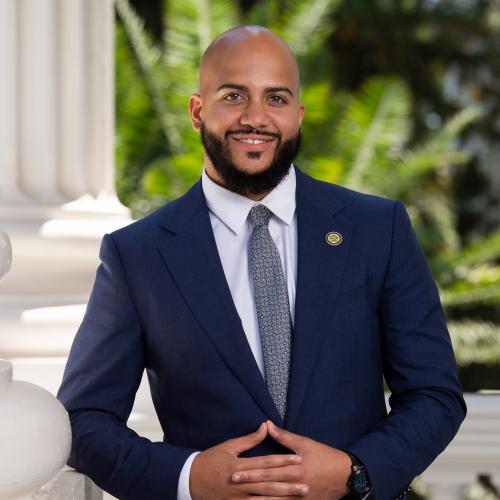
Rep. Isaac Bryan
Sponsored bills
Under existing law, a candidate for the United States House of Representatives or local elective office may purchase space in the county voter information guide to make a candidate statement. A candidate for United States Senate may purchase space for a candidate statement in the state voter information guide. A candidate for state elective office may also purchase space to make a candidate statement in the state voter information guide, but only if the candidate accepts certain voluntary campaign expenditure limits. Existing law prohibits these candidate statements from making any reference to the candidate's opponents. This bill would limit a candidate statement to a recitation of the candidate's own education, professional experience, public service, community involvement, and qualifications. The bill would prohibit a candidate statement from including, in addition to references to other candidates, a link or other reference to external content other than the candidate's campaign website; content that is vulgar or profane, or that threatens or incites violence; false statements or misleading claims; or any other content that is unrelated to the candidate's qualifications. The candidate would be required to submit a declaration with the candidate statement that attests that the statement is true and correct. Because a person who willfully makes a false statement in that declaration would be guilty of the crime of perjury, this bill expands the scope of that crime and thereby creates a state-mandated local program. The bill would require the Secretary of State and county elections officials to omit from the voter information guide any portion of a candidate statement that does not comply with the bill, except false statements and misleading claims, and it would require them to print the remainder of the statement if it can stand independently and does not mislead voters. The bill would make a fee paid by a candidate for the printing or inclusion of a candidate statement nonrefundable if any part of the statement is printed in the voter information guide, but the fee would be refunded if the statement is omitted. By increasing the duties of county elections officials, this bill would create a state-mandated local program. Existing law provides for the public examination of state and county voter information guides. During the 20-day examination period for the state guide, an elector may seek a writ of mandate or an injunction requiring any or all of the materials to be amended or deleted. During the 10-day examination period for the county guide, a voter of the relevant jurisdiction in which an election is being held, or the relevant local elections official themselves, may seek a writ of mandate or an injunction requiring any or all of the materials to be amended or deleted. A court will issue such a writ of mandate or injunction only upon clear and convincing proof that the material in question is false, misleading, or inconsistent with law, and that issuance of the writ or injunction will not substantially interfere with the printing or distribution of official election materials as provided by law. This bill would similarly allow any registered voter to seek a writ of mandate or an injunction requiring any or all of the material in a candidate statement in the state or a county voter information guide to be amended or deleted, as specified. This bill would require that, as in current law, the writ of mandate or an injunction only be issued upon clear and convincing proof that the material in question is false, misleading, or inconsistent with the requirements of the bill, and that issuance of the writ or injunction will not substantially interfere with the printing or distribution of official election materials as provided by law. This bill would additionally allow a county elections official to bring such an action for a writ or injunction challenging a candidate statement in the county voter information guide over which they have jurisdiction. The California Constitution requires the state to reimburse local agencies and school districts for certain costs mandated by the state. Statutory provisions establish procedures for making that reimbursement. This bill would provide that with regard to certain mandates no reimbursement is required by this act for a specified reason. With regard to any other mandates, this bill would provide that, if the Commission on State Mandates determines that the bill contains costs mandated by the state, reimbursement for those costs shall be made pursuant to the statutory provisions noted above.
This measure would call on Congress to enact legislation that restores and strengthens the full protections of the Voting Rights Act of 1965, and it would call on the President to sign the legislation.
Existing law establishes the Division of Labor Standards Enforcement within the Department of Industrial Relations. Existing law authorizes the division, which is headed by the Labor Commissioner, to enforce the Labor Code and all labor laws of the state, the enforcement of which is not specifically vested in any other officer, board, or commission. This bill would, with certain exceptions, prohibit an employer from using a workplace surveillance tool that uses artificial intelligence to, among other things, collect neural data or recognize an individual's emotional state. The bill would define an employer to include a governmental entity, including, among other entities, charter cities and the University of California. This bill would authorize the Labor Commissioner or a public prosecutor to enforce the bill's provisions. The bill would subject an employer who violates the bill's provisions to a civil penalty of up to $500 for each violation. The bill would define various terms for purposes of its provisions. This bill would exempt from its provisions an employer's use of a workplace surveillance tool in specified operations where the use of a workplace surveillance tool is reasonable necessary to comply with a federal statute, federal regulation, or binding federal contract relating to the development of aircraft for use in the national airspace or the development of products or services for national security, military, space, or defense purposes. The bill would include findings that changes proposed by this bill address a matter of statewide concern rather than a municipal affair and, therefore, apply to all cities, including charter cities.
Existing law designates specific days as holidays in this state. Existing law adopts state holidays as judicial holidays, with certain exceptions, including Admission Day and Columbus Day. Existing law designates holidays on which community colleges and public schools are authorized to close pursuant to a memorandum of understanding between the governing board and represented employees, including "Native American Day" on the 4th Friday in September. This bill would add "Eid al-Fitr" and "Eid al-Adha" to the list of state holidays. The bill would exclude "Eid al-Fitr" and "Eid al-Adha" from designation as judicial holidays. The bill would authorize community colleges and public schools to close on "Eid al-Fitr" and "Eid al-Adha," as specified. Existing law entitles state employees, with specified exceptions, to be given time off with pay for specified holidays. Existing law, in addition, authorizes state employees to elect to use 8 hours of vacation, annual leave, compensating time off, or personal holiday credit corresponding with specified dates. This bill would, similarly, permit the employee to elect to receive the holiday credit for the holidays of "Eid al-Fitr" or "Eid al-Adha," as specified. The bill would, for those holidays whose dates vary annually, instead authorize the above-described election to be made on the date designated by their group. The bill would make findings and declarations related to the purpose of the Eid holidays. The bill would make its provisions severable. This bill would incorporate additional changes to Section 135 of the Code of Civil Procedure proposed by AB 2294 to be operative only if this bill and AB 2294 are enacted and this bill is enacted last. The bill also would incorporate additional changes to Sections 45203, 79020, and 88203 of the Education Code proposed by SB 1394 to be operative only if this bill and SB 1394 are enacted and this bill is enacted last. The bill further would incorporate additional changes to Section 6700 of the Government Code proposed by AB 2294 and SB 1394 to be operative only if this bill and either or both of those bills are enacted and this bill is enacted last. The bill further would incorporate additional changes to Sections 19853 and 19853.1 of the Government Code proposed by SB 1394 and AB 1841 to be operative only if this bill and either or both of those bills are enacted and this bill is enacted last.
Existing law requires each law enforcement agency, on or before January 1, 2021, to maintain a policy that provides a minimum standard on the use of force. Existing law requires that the policy include, among other things, training standards and requirements relating to demonstrated knowledge and understanding of the law enforcement agency's use of force policy by officers, investigators, and supervisors. Existing law prohibits a law enforcement agency from authorizing the use of a carotid restraint or choke hold by any peace officer employed by that agency. This bill would, until January 1, 2030, prohibit a law enforcement agency, including a federal law enforcement agency, from using a wearable electroshock device within the State of California. The bill would also prohibit a law enforcement agency from using state funds to purchase a wearable electroshock device. The bill would require a law enforcement agency to update their use of force policies to prohibit the use of a wearable electroshock device. By increasing the duties on local law enforcement, the bill would impose a state-mandated local program. The bill would require the Division of Law Enforcement within the Department of Justice to conduct a study on the safety and community impacts of wearable electroshock devices and provide recommendations for appropriate standards and safeguards for their use, and would require the department to report to the Legislature on the findings and recommendations of the study on or before January 1, 2029. The California Constitution requires the state to reimburse local agencies and school districts for certain costs mandated by the state. Statutory provisions establish procedures for making that reimbursement. This bill would provide that, if the Commission on State Mandates determines that the bill contains costs mandated by the state, reimbursement for those costs shall be made pursuant to the statutory provisions noted above.
Existing law, the Protecting Our Kids from Social Media Addiction Act, prohibits an operator of an addictive internet-based service or application from providing an addictive feed, as defined, to a user unless the operator does not have actual knowledge that the user is a minor, as specified, or the operator has obtained verifiable parental consent to provide an addictive feed to the user who is a minor. Existing law, the Digital Age Assurance Act, beginning January 1, 2027, requires a person who owns, maintains, or controls a software application, as defined, to request age bracket data sent by a real-time secure application programming interface or operating system with respect to a particular user from an operating system provider or a covered application store when the application is downloaded and launched. This bill would prohibit a covered platform, as defined, from providing an addictive feature, as defined, to a user who is under 16 years of age and would require a covered platform to implement reasonable measures to ensure that users under 16 years of age are not offered or provided any addictive feature on the covered platform. The bill would also authorize the Attorney General to adopt regulations to implement and enforce the bill in order to further the purpose of protecting minors online, including by altering the scope of "covered platform" if the Attorney General determines that doing so is necessary to ensure that "covered platform" applies to internet websites, online services, online applications, or mobile applications that make addictive features, as defined, available to users under 16 years of age. This bill would impose a civil penalty upon a noncompliant platform and would require its provisions to be enforced by a civil action brought only by the Attorney General or a local public prosecutor, as specified. This bill would also establish the e-Safety Advisory Commission within the Department of Justice as an independent advisory body that is only for administrative purposes to advise state government on certain matters related to online safety and would require the commission to, on or before January 1 of each year, report to the Legislature and the Governor on, among other things, its activities under the bill.
Existing law requires the State Department of Social Services, in collaboration with the State Department of Education, to implement a reimbursement system plan that establishes reasonable standards and assigned reimbursement rates for subsidized childcare and development services, and to develop and conduct an alternative methodology for ratesetting, as specified. Existing law requires the Governor and the Legislature to, by no later than July 1, 2025, establish reimbursement rates based on the alternative methodology, as specified. Existing law requires the department to provide quarterly updates from October 1, 2024, to July 1, 2027, inclusive, on the implementation of the new reimbursement rates set under the alternative methodology. If the new reimbursement rates do not take effect on July 1, 2025, existing law also requires the department to provide the Legislature with a timeline for transitioning from the rates that are in effect on July 1, 2025, to the new established rates. This bill would instead, under those circumstances, require the department to provide the Chairperson of the Joint Legislative Budget Committee with the department's anticipated timeline for the above-described rate transition. The bill would also require the quarterly reports described above to continue until July 1, 2028. Existing law states the intent of the Legislature that the reimbursement rates established under the alternative methodology satisfy certain parameters, including, among others, that the rates vary based on geography, type of care setting, regulatory requirements applicable to each type of care setting, time categories, and child age. This bill would impose various requirements on the department, in consultation with the State Department of Education, when establishing new reimbursement rates using a single-rate structure informed by the alternative methodology, to the extent those requirements are consistent with the approved Child Care and Development Fund state plan. Among other things, the bill would require the department to vary rates based on geographic regions and specific age groupings and to include in the rates an enhanced rate for nonstandard hours of care and enhanced inclusion rates for children with special needs. The bill would authorize the department to implement these provisions by means of all-county letters, childcare bulletins, or similar written instructions. This bill would incorporate additional changes to Section 10227.6 of the Welfare and Institutions Code proposed by AB 190 or SB 190 to be operative only if this bill and AB 190 or SB 190 are enacted and this bill is enacted last. This bill would declare that it is to take effect immediately as an urgency statute.
The Budget Act of 2026 appropriates, for the 2026–27 fiscal year, $1,000,000,000 from the General Fund to the State Department of Education to administer the California Community Schools Partnership Program to distribute funding to local educational agencies, as defined, in accordance with a specified formula, to support a network of their eligible schoolsites to implement new, and provide ongoing support for existing, community schools, as provided. Existing law authorizes a local educational agency who receives funds under these provisions to retain up to 10% of the total funds awarded for its eligible schoolsites each fiscal year to be used for specified activities, including, among other things, administering community schools established at eligible schoolsites. This bill, to be known as the It Takes a Village Act of 2026, would (1) require any retained funds described above to be used consistent with a specified community schools framework, as provided, and (2) authorize a local educational agency that retains those funds to also use those funds to serve as a network lead for multiple schoolsites located in a Promise Neighborhood, as provided. By expanding the purposes for which previously appropriated moneys may be expended, the bill would make an appropriation. This bill would incorporate additional changes to Section 8903 of the Education Code proposed by AB 133 or SB 133 to be operative only if this bill and either AB 133 or SB 133 are enacted and this bill is enacted last.
Existing law provides that every executive or ministerial officer, employee, or appointee of the State of California, or any county or city therein, or any political subdivision thereof, who knowingly asks, receives, or agrees to receive any emolument, gratuity, or reward, or any promise thereof excepting such as may be authorized by law for doing an official act, is guilty of a misdemeanor. Existing law exempts from that offense certain employment by a peace officer while off duty, as specified. Existing law also provides that a peace officer shall not be prohibited from engaging in other employment while off duty, as specified. This bill would, notwithstanding those provisions, prohibit certain peace officers from engaging in any form of secondary employment, including contract based or as an individual contractor, that involves engaging in arresting, detaining, transporting, or deporting individuals pursuant to federal or out-of-state immigration laws. The bill would provide that failure to comply with this provision may constitute, for certain purposes, an act of serious misconduct and that it is grounds for decertification as a peace officer. The bill would require certain peace officers to report to their employing law enforcement agency any conditional offer of secondary employment relating to immigration enforcement. The bill would require the law enforcement agency to maintain specified records related to secondary employment. By imposing additional duties on local law enforcement agencies, this bill would impose a state-mandated local program. The bill would also explicitly state that these records related to secondary employment of certain peace officers are public records for the purposes of the California Public Records Act. The California Constitution requires the state to reimburse local agencies and school districts for certain costs mandated by the state. Statutory provisions establish procedures for making that reimbursement. This bill would provide that, if the Commission on State Mandates determines that the bill contains costs mandated by the state, reimbursement for those costs shall be made pursuant to the statutory provisions noted above.