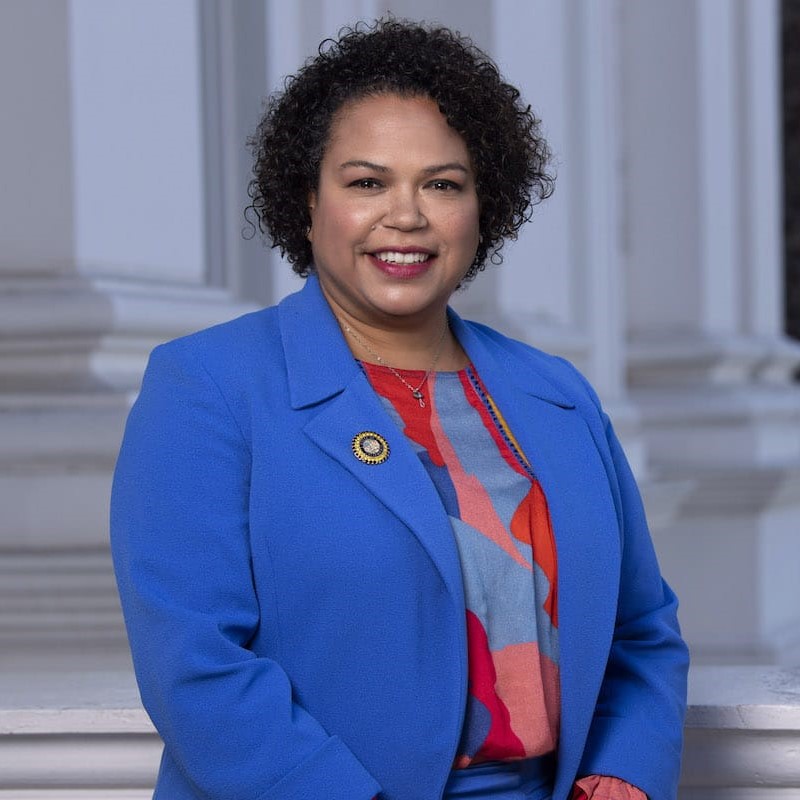
Photo of Mia Bonta
D California House · District 18 On the 2026 ballot

Rep. Mia Bonta

Compare
Total votes
12,577
all sessions
Attendance
81%
2,245 missed
Near the chamber average
With party
99%
of cast votes
Near the chamber average
Bipartisan score
0%
crosses aisle rarely
Near the chamber average
Sponsored
1,139
bills & resolutions
Near the chamber average
Committees
14
assignments
1,139 bills and resolutions

Sponsored bills

Total
1,139
Primary
116
Co-sponsor
1,023
This page
1,139
matching current filters
Primary AB 2434
Passed · California House · Lead sponsor
Inmates: visitation.

Existing law requires the Department of Corrections and Rehabilitation, when amending or adopting regulations that may impact the visitation of inmates, to recognize and consider the value of visiting as a means to improve prison safety, the important role of inmate visitation in maintaining connection with family and community, and the role of inmate visitation in preparing for successful release. This bill would require each facility, as defined, to establish at least 3 days of visitation per week. The bill would require a facility, if it will not be open for visitation, to provide notice to the impacted population as soon as possible. The bill would authorize a facility to deny contact visits only for specified reasons, including, among others, possession of contraband or pending or sustained rules violations that result in a restricted housing unit term. The bill would require facility staff to take specified actions with regard to correctable issues with a visitation, including, among other things, allowing the visitor a reasonable opportunity to correct the issue and return to visiting up to one hour before the end of the visiting period. The bill would prohibit denial of visitation if a visitor has traveled more than 170 miles to attend a visit and has not visited within 30 days, unless there has been a finding of a credible and documented security threat. The bill would prohibit a facility from searching visitors without their voluntary, informed, and written consent. The bill would authorize a facility to respond to refusal of that search only with denial of contact visiting for that day, and would require the facility to offer a noncontact visit on the same day, if space is available. The bill would authorize other restrictions and procedures for searches of visitors, as specified.

Passed Aug 30, 2026 0 co-sponsors
Co-sponsor AB 2540
Passed · California House · Co-sponsor
Public health: public postsecondary education: student health centers: abortion by medication techniques.

Existing law establishes the California Community Colleges, under the administration of the Board of Governors of the California Community Colleges, the California State University, under the administration of the Trustees of the California State University, and the University of California, under the administration of the Regents of the University of California, as the 3 segments of public postsecondary education in the state. Existing law requires, on and after January 1, 2023, a student health center on a California State University or University of California campus to offer abortion by medication techniques, as specified. Existing law establishes the College Student Health Center Sexual and Reproductive Health Preparation Fund to be administered by the Commission on the Status of Women and Girls and continuously appropriates the moneys in that fund to the commission for specified activities related to providing abortion by medication techniques at student health centers. This bill would require a student health center on a California State University or University of California campus, on or before January 1, 2028, to promote awareness of the services for abortion by medication techniques that the student health center offers, provide information on those services to students, and post the availability of those services on its internet website. This bill would require a community college that has a student health center, upon appropriation by the Legislature, to, on and after January 1, 2029, offer access to abortion by medication techniques, promote awareness of those services, provide information on those services to students, and post the availability of those services on its internet website. The bill would require the commission to submit a report to the Legislature, on or before January 1, 2030, that includes, but is not limited to, specified information relating to abortion by medication techniques at or through community college student health centers. The bill would require the commission, in consultation with the office of the Chancellor of the California Community Colleges, to develop a standardized reporting framework that minimizes administrative burden and protects student privacy. The bill would authorize funds appropriated for these provisions to be used for implementation readiness activities and ongoing operational costs, as specified.

Passed Aug 30, 2026 1 co-sponsor
Co-sponsor AB 2760
Passed · California House · Co-sponsor
Law enforcement: wearable electroshock devices.

Existing law requires each law enforcement agency, on or before January 1, 2021, to maintain a policy that provides a minimum standard on the use of force. Existing law requires that the policy include, among other things, training standards and requirements relating to demonstrated knowledge and understanding of the law enforcement agency's use of force policy by officers, investigators, and supervisors. Existing law prohibits a law enforcement agency from authorizing the use of a carotid restraint or choke hold by any peace officer employed by that agency. This bill would, until January 1, 2030, prohibit a law enforcement agency, including a federal law enforcement agency, from using a wearable electroshock device within the State of California. The bill would also prohibit a law enforcement agency from using state funds to purchase a wearable electroshock device. The bill would require a law enforcement agency to update their use of force policies to prohibit the use of a wearable electroshock device. By increasing the duties on local law enforcement, the bill would impose a state-mandated local program. The bill would require the Division of Law Enforcement within the Department of Justice to conduct a study on the safety and community impacts of wearable electroshock devices and provide recommendations for appropriate standards and safeguards for their use, and would require the department to report to the Legislature on the findings and recommendations of the study on or before January 1, 2029. The California Constitution requires the state to reimburse local agencies and school districts for certain costs mandated by the state. Statutory provisions establish procedures for making that reimbursement. This bill would provide that, if the Commission on State Mandates determines that the bill contains costs mandated by the state, reimbursement for those costs shall be made pursuant to the statutory provisions noted above.

Passed Aug 30, 2026 1 co-sponsor
Co-sponsor AB 2074
Passed · California House · Co-sponsor
Regional transit hub districts: downtown housing developments.

The Planning and Zoning Law generally regulates local government zoning and approval of certain types of housing development projects. The law authorizes a development proponent to submit an application for a development that is subject to a prescribed ministerial approval process if the development complies with certain procedural requirements and satisfies specified objective planning standards. The law also requires a housing development project within a specified distance of a transit-oriented development stop to be an allowed use as a transit-oriented housing development on any site zoned for residential, mixed, or commercial development, if the development complies with specified requirements, as applicable. This bill would, by July 1, 2027, require major transit cities to designate at least one regional transit hub district, as specified, and prescribe requirements for those districts, including requiring that a district make a downtown housing development an allowable use, as specified. The bill would define "downtown housing development" as a housing development project within a regional hub district that meets certain conditions, including that it meets specified labor standards. The bill would prescribe requirements for the developments, including that the developments are eligible for streamlined ministerial approval, as specified. The bill would require the California Housing Finance Agency to conduct a housing construction loan and financing study that includes specified components and deliver that study to the Legislature and specified committees by March 1, 2028, as specified. By requiring certain cities to designate regional transit hub districts and requiring streamlined ministerial approval of certain housing developments, the bill would impose a state-mandated local program. The Planning and Zoning law requires each planning agency to prepare and the legislative body of each county and city to adopt a comprehensive, long-term general plan for the physical development of the county or city that includes certain mandatory elements, including a housing element. The law requires the Department of Housing and Community Development to notify the city, county , or city and county and authorizes the department to notify the Attorney General that the city, county, or city and county is in violation of state law if the department finds that the housing element or an amendment to the housing element does not substantially comply with these provisions or that any local government has taken an action in violation of specified laws. This bill would add a violation of the provisions described above to that list of specified laws. The bill would include findings that changes proposed by this bill address a matter of statewide concern rather than a municipal affair and, therefore, apply to all cities, including charter cities. The California Constitution requires the state to reimburse local agencies and school districts for certain costs mandated by the state. Statutory provisions establish procedures for making that reimbursement. This bill would provide that with regard to certain mandates no reimbursement is required by this act for a specified reason. With regard to any other mandates, this bill would provide that, if the Commission on State Mandates determines that the bill contains costs so mandated by the state, reimbursement for those costs shall be made pursuant to the statutory provisions noted above. The California Constitution requires the state to reimburse local agencies and school districts for certain costs mandated by the state. Statutory provisions establish procedures for making that reimbursement. This bill would provide that no reimbursement is required by this act for a specified reason.

Passed Aug 30, 2026 1 co-sponsor
Co-sponsor SB 1218
Passed · California Senate · Co-sponsor
Vehicle immobilization: illegal dumping violation penalties.

Existing law authorizes a peace officer, as defined, or a regularly employed and salaried employee who is engaged in directing traffic or enforcing parking laws and regulations, as specified, to immobilize a vehicle with a device made for that purpose, if the vehicle is found upon a highway or public lands within the officer or employee's jurisdiction, and the vehicle has been issued 5 or more notices of parking violations that are delinquent because the owner or person in control of the vehicle has not responded within the prescribed time period, or the registered owner has been issued 5 or more notices for failure to pay or failure to appear in court for traffic violations, as specified. Existing law allows a vehicle to be immobilized until the owner or person in control of the vehicle presents the immobilizing law enforcement agency with specified information, including evidence that all outstanding parking penalties have been paid. Existing law makes it unlawful and punishable as an infraction for a person to dump or cause to be dumped waste matter upon a public or private highway or road, upon private property without the consent of the owner, or in or upon a public park or other public property, as specified. Existing law also makes it unlawful and punishable as a misdemeanor for a person to place, deposit, or dump, or cause to be placed, deposited, or dumped, waste matter in commercial quantities, as specified. This bill would similarly authorize the immobilization of a vehicle with a device made for that purpose if the registered owner of the vehicle has been issued a certain number of notices of illegal dumping violation that are delinquent, or is known to have been issued a certain number notices for failure to pay or failure to appear in court for an illegal dumping violation, as specified.

Passed Aug 30, 2026 1 co-sponsor
Co-sponsor AB 1709
Passed · California House · Co-sponsor
Covered platforms: age restriction: e-Safety Advisory Commission.

Existing law, the Protecting Our Kids from Social Media Addiction Act, prohibits an operator of an addictive internet-based service or application from providing an addictive feed, as defined, to a user unless the operator does not have actual knowledge that the user is a minor, as specified, or the operator has obtained verifiable parental consent to provide an addictive feed to the user who is a minor. Existing law, the Digital Age Assurance Act, beginning January 1, 2027, requires a person who owns, maintains, or controls a software application, as defined, to request age bracket data sent by a real-time secure application programming interface or operating system with respect to a particular user from an operating system provider or a covered application store when the application is downloaded and launched. This bill would prohibit a covered platform, as defined, from providing an addictive feature, as defined, to a user who is under 16 years of age and would require a covered platform to implement reasonable measures to ensure that users under 16 years of age are not offered or provided any addictive feature on the covered platform. The bill would also authorize the Attorney General to adopt regulations to implement and enforce the bill in order to further the purpose of protecting minors online, including by altering the scope of "covered platform" if the Attorney General determines that doing so is necessary to ensure that "covered platform" applies to internet websites, online services, online applications, or mobile applications that make addictive features, as defined, available to users under 16 years of age. This bill would impose a civil penalty upon a noncompliant platform and would require its provisions to be enforced by a civil action brought only by the Attorney General or a local public prosecutor, as specified. This bill would also establish the e-Safety Advisory Commission within the Department of Justice as an independent advisory body that is only for administrative purposes to advise state government on certain matters related to online safety and would require the commission to, on or before January 1 of each year, report to the Legislature and the Governor on, among other things, its activities under the bill.

Passed Aug 30, 2026 1 co-sponsor
Co-sponsor AB 1981
Passed · California House · Co-sponsor
Subsidized childcare: reimbursement rates: reporting.

Existing law requires the State Department of Social Services, in collaboration with the State Department of Education, to implement a reimbursement system plan that establishes reasonable standards and assigned reimbursement rates for subsidized childcare and development services, and to develop and conduct an alternative methodology for ratesetting, as specified. Existing law requires the Governor and the Legislature to, by no later than July 1, 2025, establish reimbursement rates based on the alternative methodology, as specified. Existing law requires the department to provide quarterly updates from October 1, 2024, to July 1, 2027, inclusive, on the implementation of the new reimbursement rates set under the alternative methodology. If the new reimbursement rates do not take effect on July 1, 2025, existing law also requires the department to provide the Legislature with a timeline for transitioning from the rates that are in effect on July 1, 2025, to the new established rates. This bill would instead, under those circumstances, require the department to provide the Chairperson of the Joint Legislative Budget Committee with the department's anticipated timeline for the above-described rate transition. The bill would also require the quarterly reports described above to continue until July 1, 2028. Existing law states the intent of the Legislature that the reimbursement rates established under the alternative methodology satisfy certain parameters, including, among others, that the rates vary based on geography, type of care setting, regulatory requirements applicable to each type of care setting, time categories, and child age. This bill would impose various requirements on the department, in consultation with the State Department of Education, when establishing new reimbursement rates using a single-rate structure informed by the alternative methodology, to the extent those requirements are consistent with the approved Child Care and Development Fund state plan. Among other things, the bill would require the department to vary rates based on geographic regions and specific age groupings and to include in the rates an enhanced rate for nonstandard hours of care and enhanced inclusion rates for children with special needs. The bill would authorize the department to implement these provisions by means of all-county letters, childcare bulletins, or similar written instructions. This bill would incorporate additional changes to Section 10227.6 of the Welfare and Institutions Code proposed by AB 190 or SB 190 to be operative only if this bill and AB 190 or SB 190 are enacted and this bill is enacted last. This bill would declare that it is to take effect immediately as an urgency statute.

Passed Aug 30, 2026 1 co-sponsor
Co-sponsor AB 1776
Passed · California House · Co-sponsor
Cartwright Act: violations.

Existing law, commonly known as the Cartwright Act, identifies certain acts as unlawful restraints of trade and unlawful trusts and prescribes provisions for its enforcement. Chapter 338 of the Statutes of 2025 provides that in a complaint for any violation of the Cartwright Act, it is sufficient to contain factual allegations demonstrating that the existence of a contract, combination in the form of a trust, or conspiracy to restrain trade or commerce is plausible. Chapter 338 of the Statutes of 2025 also provides that a complaint for any violation of the Cartwright Act is not required to allege facts tending to exclude the possibility of independent action. Existing case law, In re Cipro Cases I & II (2015) 61 Cal.4th 116, establishes a rule of reason analysis for certain claims under the Cartwright Act, which, among other things, determines whether an act was made for the purpose of avoiding competition and whether the anticompetitive effects of the agreement outweigh any procompetitive justifications. This bill would prohibit any person from monopolizing or monopsonizing any part of trade or commerce, as provided. The bill would require courts to use the analytical framework and guidance provided in In re Cipro Cases I & II. The bill would require a plaintiff bringing an action under its provisions to allege, and prove at trial, substantial market power through either direct or indirect evidence. The bill would exempt a small business, as defined, from these provisions. The bill would provide that its provisions do not prevent, limit, or prohibit certain conduct and legal instruments, including exclusive franchises granted and supervised by a local, state, or federal governmental agency. This bill would require any action brought pursuant to these provisions to be initiated only by the Attorney General or a district attorney, and would, with certain exceptions, preclude an alleged violation under its provisions from serving as a predicate violation under the Unfair Competition Law. The bill would require an action brought pursuant to these provisions to be filed as a "complex case" pursuant to provisions of law requiring the assessment of additional court fees, as specified. The bill would also make related findings and declarations. The bill would require courts to liberally interpret California's antitrust laws to best promote free and fair competition, as provided. Because the bill would expand the scope of activities prohibited by the Cartwright Act, the violation of which is punishable as a crime, the bill would impose a state-mandated local program. The California Constitution requires the state to reimburse local agencies and school districts for certain costs mandated by the state. Statutory provisions establish procedures for making that reimbursement. This bill would provide that no reimbursement is required by this act for a specified reason.

Passed Aug 30, 2026 1 co-sponsor
Primary AB 1969
Passed · California House · Lead sponsor
California Community Schools Partnership Program: Promise Neighborhoods.

The Budget Act of 2026 appropriates, for the 2026–27 fiscal year, $1,000,000,000 from the General Fund to the State Department of Education to administer the California Community Schools Partnership Program to distribute funding to local educational agencies, as defined, in accordance with a specified formula, to support a network of their eligible schoolsites to implement new, and provide ongoing support for existing, community schools, as provided. Existing law authorizes a local educational agency who receives funds under these provisions to retain up to 10% of the total funds awarded for its eligible schoolsites each fiscal year to be used for specified activities, including, among other things, administering community schools established at eligible schoolsites. This bill, to be known as the It Takes a Village Act of 2026, would (1) require any retained funds described above to be used consistent with a specified community schools framework, as provided, and (2) authorize a local educational agency that retains those funds to also use those funds to serve as a network lead for multiple schoolsites located in a Promise Neighborhood, as provided. By expanding the purposes for which previously appropriated moneys may be expended, the bill would make an appropriation. This bill would incorporate additional changes to Section 8903 of the Education Code proposed by AB 133 or SB 133 to be operative only if this bill and either AB 133 or SB 133 are enacted and this bill is enacted last.

Passed Aug 30, 2026 0 co-sponsors
Showing 1 to 10 of 1,139 bills
1 2 3 114 Next