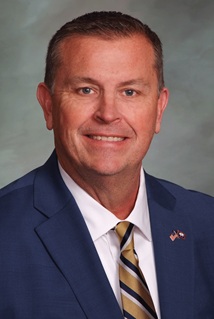
Photo of Justin Fornstrom
R Wyoming House · District 10 On the 2026 ballot

Rep. Justin Fornstrom

Contact Email
Compare
Total votes
519
all sessions
Attendance
99%
3 missed
Near the chamber average
With party
68%
of cast votes
Near the chamber average
Bipartisan score
18%
some cross-party votes
Near the chamber average
Sponsored
15
bills & resolutions
Near the chamber average
Committees
3
assignments
15 bills and resolutions

Sponsored bills

Total
15
Primary
0
Co-sponsor
15
This page
15
matching current filters
Co-sponsor SF 113
Signed into law · Wyoming Senate · Co-sponsor
2026 election hand count comparison.

Maddy summaryWyoming's SF 113 requires county clerks to conduct hand counts of election ballots for the 2026 primary and general elections. Specifically, counties must physically examine approximately 5% of ballots for one federal race, one statewide race (selected by the state secretary of state), and all legislative races on the ballot. The hand count results must be compared to electronic tabulation results within nine days of the county canvass, with any discrepancies reported to the secretary of state. This bill directly affects county election officials who will implement the hand count audits. The law takes effect immediately upon becoming law, with reports due by May 1, 2027.

Signed into law Mar 8, 2026 1 co-sponsor
Co-sponsor HB 96
Signed into law · Wyoming House · Co-sponsor
Carrying of concealed weapons-age requirement.

Maddy summaryWyoming's HB 96 lowers the minimum age to obtain a concealed carry permit from 21 to 18 years. It directly affects 18- to 20-year-olds who previously could not legally carry concealed weapons under state law. The bill amends permit eligibility requirements in statute and adds legal immunity for officials issuing or denying permits. The law takes effect July 1, 2026.

Signed into law Mar 8, 2026 1 co-sponsor
Co-sponsor SF 50
Signed into law · Wyoming Senate · Co-sponsor
State engineer-surface and ground water study.

Maddy summaryThis bill requires Wyoming's state engineer to conduct groundwater studies every decade in counties with designated groundwater control areas. The studies must assess water usage, determine necessary controls to replenish underground water systems, and may include mapping or test wells. Results must be publicly shared and reported to a legislative committee within 15 days of completion. The state engineer's office is allocated $250,000 specifically for this study, which must be finished by June 30, 2028.

Signed into law Mar 6, 2026 1 co-sponsor
Co-sponsor SF 100
died · Wyoming Senate · Co-sponsor
Wyoming business council-evaluation and reform-2.

Maddy summaryThis bill creates a 13-member Wyoming Business Council Strategic Advisory Task Force to evaluate the state's Wyoming Business Council (WBC). The task force, including legislative members, business representatives (from agriculture, manufacturing, tourism, oil/gas, and local economic development), and local officials, must assess the WBC's programs, duties, and operations - including those not specified in law - and compare them to economic development models in other states. It will develop recommendations for strategic direction, propose changes to the WBC's structure or functions, and suggest improvements for communication with state leadership. The task force must meet at least three times and submit findings by a specified deadline. (Note: This is a procedural evaluation bill, not a policy change.)

died Mar 4, 2026 1 co-sponsor
Co-sponsor SF 109
died · Wyoming Senate · Co-sponsor
Cowboy state agricultural trust fund.

Maddy summarySF 109 creates a permanent "Cowboy State Agricultural Trust Fund" in Wyoming, funded through state investments and eligible contributions. The fund's earnings will provide grants to support agricultural programs, including University of Wyoming research, workforce development at community colleges, K-12 agricultural education, value-added projects, and technology adoption in farming. Recipients must match each dollar from the fund with at least one dollar in non-state funds and report on grant usage annually. The bill establishes a committee to manage grant applications, oversight, and reporting requirements. This legislation directly affects Wyoming agricultural educators, students, producers, and institutions through new funding mechanisms.

died Mar 4, 2026 1 co-sponsor
Co-sponsor SF 92
died · Wyoming Senate · Co-sponsor
Wyoming False Claims Act.

Maddy summarySF 92 creates Wyoming's False Claims Act, allowing the state to sue individuals or entities that knowingly submit false claims for payment. It imposes penalties of three times the state's damages plus $5,500-$11,000 per false claim, affecting contractors, grantees, and state employees who submit inaccurate claims or fail to repay overpayments. The law includes reduced penalties if the person reports violations within 30 days and fully cooperates with investigations. It defines key terms like "knowingly" and "false claim" to clarify when penalties apply.

died Mar 3, 2026 1 co-sponsor
Co-sponsor HB 140
died · Wyoming House · Co-sponsor
Construction inspections-qualified third parties.

Maddy summaryWyoming's HB 140 allows building owners or contractors to hire licensed architects, engineers, or ICC-certified third-party inspectors (not involved in the project's design or construction) to perform most building permit inspections, rather than relying solely on local building departments. Owners must notify the local authority in writing before inspections (via email or online systems), provide the inspector's details, and share inspection reports electronically within deadlines. Third-party inspectors must carry $1 million in liability insurance and cannot conduct final inspections required for certificate of occupancy, which remains the local authority's responsibility. This bill directly affects construction project owners, contractors, and local building departments in Wyoming.

died Feb 23, 2026 1 co-sponsor
Co-sponsor HB 150
died · Wyoming House · Co-sponsor
Wyoming business council-evaluation and reform.

Maddy summaryHB 150 creates a 13-member Wyoming Business Council Strategic Advisory Task Force to evaluate the state's existing Wyoming Business Council (WBC). The task force, including legislative members, business representatives from agriculture, manufacturing, oil/gas, tourism, and local government, will review the WBC's programs, duties, and operations - including those not specified in the Wyoming Economic Development Act - and compare them to other states. It must recommend changes to retain, modify, privatize, or eliminate WBC functions, develop a strategic direction for the council, and improve communication of its work to state leadership. The bill does not change the WBC's current operations but mandates this review process to inform potential future reforms.

died Feb 23, 2026 1 co-sponsor
Co-sponsor HJ 7
Introduced · Wyoming House · Co-sponsor
Social studies content standards-political ideologies.

Maddy summaryHJ 7 is a non-binding resolution requesting the Wyoming State Board of Education to amend social studies content standards to include teaching about the negative consequences of communism, fascism, and socialism in the 20th and 21st centuries. It specifically asks for curriculum that covers documented historical abuses (such as human rights violations and loss of freedoms) under these ideologies and compares them with U.S. principles like democracy and individual rights. The resolution does not mandate changes but urges the Board to consider adding these teaching benchmarks during their standard review process. If adopted, this would affect social studies curriculum in Wyoming public schools, altering how these political ideologies are taught to students.

Introduced Feb 14, 2026 1 co-sponsor
Co-sponsor HB 163
Introduced · Wyoming House · Co-sponsor
Amendments to beef checkoff program.

Maddy summaryHB 163 limits the state's annual costs that can be charged against Wyoming's Beef Council to 3% of fees collected by the council that aren't already required by state or federal law. This directly affects the Beef Council (which collects industry fees) and state agencies like the Department of Administration and Information that manage these funds. The bill's key provision sets a hard cap on administrative fees, ensuring the council retains more of its collected revenue. The law will take effect on July 1, 2026, and does not alter how the council spends its funds.

Introduced Feb 14, 2026 1 co-sponsor
Showing 1 to 10 of 15 bills