Maddy summaryAB 500 bans corporal punishment in all public and private schools, defining it as intentional physical pain used for discipline (e.g., paddling or slapping). The bill prohibits school staff from using such punishment on students but allows reasonable force for safety under new school policies. Schools must adopt policies clarifying when force is permitted, excluding individualized education programs and athletic training. This directly affects all public and private schools and their staff in the state.

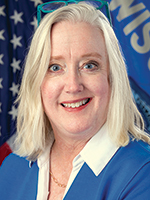
Rep. Ann Roe
Sponsored bills
Maddy summaryAB 1012 establishes a family and medical leave insurance program that would allow eligible workers to take up to 14 weeks of leave per year to care for a newborn, newly adopted child, or family member with a serious health condition, or to address certain family military needs. The bill would require employers with 50 or more employees to provide this leave, funded through a new family and medical leave insurance trust fund. It defines "family member" broadly to include spouses, domestic partners, parents, children, siblings, and other close relatives or people in close association with the employee. The legislation also sets specific limits on leave availability, including a maximum of 6 weeks for certain family situations and 8-14 weeks for combined reasons within a 12-month period.
Maddy summaryAJR 126 is a ceremonial resolution honoring the late Representative Rudolph L. "Rudy" Silbaugh (1930-2025), who served in the Wisconsin State Assembly from 1991 to 1997. The resolution formally recognizes his 25 years of public service - including his work as a Stoughton alderman, his legislative committee roles, and his advocacy for seniors - and extends condolences to his family. It contains no policy changes or funding provisions, as it is solely a commemorative gesture by the Wisconsin Legislature. This procedural resolution directly affects no constituents or policies, serving only to memorialize Representative Silbaugh's legacy.
Maddy summaryAB 80 would allow social workers, marriage and family therapists, and professional counselors licensed in this state to practice in other states that join the Social Work Licensure Compact without needing separate state licenses. The bill amends existing statutes to align state definitions and requirements with the compact framework, ensuring professionals certified under Chapter 457 can work across participating states. It directly affects licensed social work professionals seeking to practice in multiple states and changes how their credentials are recognized in statutes related to child welfare, mental health, and professional practice. The compact aims to streamline licensure for these professionals while maintaining state-specific standards.
Maddy summaryAB 943 creates a new law (Section 941.236) prohibiting people from carrying firearms within 100 feet of polling places during voting hours (one hour before opening to one hour after closing). It directly affects voters, election workers, and anyone near polling locations during elections. The law applies to all individuals except law enforcement officers, qualified out-of-state officers, former officers, property owners on their own land, and security personnel acting in their official duties. Violating this provision is a serious misdemeanor charge.
Maddy summaryThis bill would create a tuition exemption for nonresident students attending University of Wisconsin System schools if they meet specific residency and immigration status requirements. To qualify, a student must have lived in Wisconsin for 12 consecutive months before registering for classes and must have approved deferred action status under the federal Deferred Action for Childhood Arrivals program. The exemption applies to students enrolling in the semester or session following the bill's effective date. This legislation is designed to provide financial relief to certain immigrant students by allowing them to pay in-state tuition rates despite not being Wisconsin residents. The bill was introduced in March 2026 and referred to the Committee on Colleges and Universities for review.
Maddy summaryAB 1060 allocates $450,000 annually for two fiscal years (2025-26 and 2026-27) to fund falls prevention awareness and initiatives in Wisconsin. The bill directs the Department of Health Services to award this grant specifically to the Wisconsin Institute for Healthy Aging. This funding supports statewide programs aimed at reducing fall-related injuries, primarily affecting older adults in the state. The bill makes a concrete budget adjustment to enable this grant without altering existing health service programs.
Maddy summaryAB 790 creates a dedicated "Water Fund for Our Future" with an initial $250 million transfer from the general fund. The fund establishes a rapid response account to cover clean water-related costs during natural disasters or public health emergencies, including remediation and assistance for affected individuals. A new joint committee oversees fund spending, reviewing requests for funding (excluding non-clean-water uses) and recommending approvals to the finance committee. All funds must be used exclusively for clean water activities, with specific rules for disbursement and oversight.
Maddy summaryThis bill requires motorboats with enclosed living spaces to be equipped with carbon monoxide detection systems and warning stickers to protect occupants from dangerous gas exposure. It mandates that the state provide free safety information and stickers when registering cabin motorboats, while also requiring dealers to ensure new boats meet these safety standards before sale. The legislation establishes specific penalties for operating or selling non-compliant boats, with fines up to $500 for first offenses and up to $300 for repeat violations. These rules apply to boats sold, registered, or operated on the bill's effective date.
Maddy summaryThis bill creates a new category called "very large customer" for electric utilities and gives the state commission authority to define who qualifies for this class. It requires electric utilities to file rate applications every other year for these customers and mandates that the commission review whether the rates charged are fair and not discriminatory. The commission will also develop specific rules to ensure utilities properly justify how rates cover the costs of serving these large customers. If rates are found to be unreasonable or unfairly discriminatory, the commission can adjust them or modify service terms accordingly.