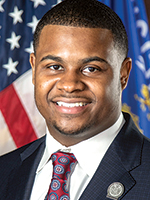
Photo of Kalan Haywood
D Wisconsin House · District 16 On the 2026 ballot

Rep. Kalan Haywood

Compare
Total votes
561
all sessions
Attendance
96%
22 missed
Near the chamber average
With party
98%
of cast votes
Near the chamber average
Bipartisan score
1%
crosses aisle rarely
Near the chamber average
Sponsored
387
bills & resolutions
Near the chamber average
Committees
6
assignments
387 bills and resolutions

Sponsored bills

Total
387
Primary
387
Co-sponsor
0
This page
387
matching current filters
Primary AB 500
Failed · Wisconsin House · Lead sponsor
Relating to: prohibiting corporal punishment in public and private schools.

Maddy summaryAB 500 bans corporal punishment in all public and private schools, defining it as intentional physical pain used for discipline (e.g., paddling or slapping). The bill prohibits school staff from using such punishment on students but allows reasonable force for safety under new school policies. Schools must adopt policies clarifying when force is permitted, excluding individualized education programs and athletic training. This directly affects all public and private schools and their staff in the state.

Failed Jul 2, 2026 0 co-sponsors
Primary AB 1012
Failed · Wisconsin House · Lead sponsor
Relating to: the establishment of a family and medical leave insurance program; family leave to care for a family member and for the active duty of a family member; the employers that must allow an employee to take family or medical leave; allowing a local government to adopt ordinances requiring employers to provide leave benefits; providing an exemption from emergency rule procedures; providing an exemption from rule-making procedures; granting rule-making authority; making an appropriation; and providing a penalty. (FE)

Maddy summaryAB 1012 establishes a family and medical leave insurance program that would allow eligible workers to take up to 14 weeks of leave per year to care for a newborn, newly adopted child, or family member with a serious health condition, or to address certain family military needs. The bill would require employers with 50 or more employees to provide this leave, funded through a new family and medical leave insurance trust fund. It defines "family member" broadly to include spouses, domestic partners, parents, children, siblings, and other close relatives or people in close association with the employee. The legislation also sets specific limits on leave availability, including a maximum of 6 weeks for certain family situations and 8-14 weeks for combined reasons within a 12-month period.

Failed Jun 16, 2026 0 co-sponsors
Primary AB 790
Failed · Wisconsin House · Lead sponsor
Relating to: creating the water fund for our future, granting rule-making authority, and making an appropriation. (FE)

Maddy summaryAB 790 creates a dedicated "Water Fund for Our Future" with an initial $250 million transfer from the general fund. The fund establishes a rapid response account to cover clean water-related costs during natural disasters or public health emergencies, including remediation and assistance for affected individuals. A new joint committee oversees fund spending, reviewing requests for funding (excluding non-clean-water uses) and recommending approvals to the finance committee. All funds must be used exclusively for clean water activities, with specific rules for disbursement and oversight.

Failed Apr 13, 2026 0 co-sponsors
Primary AB 1203
Failed · Wisconsin House · Lead sponsor
Relating to: net zero emissions, carbon-free and renewable energy standards, and creating an office of sustainability and clean energy, granting rule-making authority, making an appropriation, and providing a penalty. (FE)

Maddy summaryThis bill establishes a comprehensive clean energy framework requiring Wisconsin to achieve 100 percent clean electricity production and net-zero carbon emissions by 2050. It creates a new Office of Sustainability and Clean Energy within the Department of Administration to develop and update an economy-wide decarbonization roadmap using sector-based modeling. The legislation sets specific interim targets for carbon-free electricity, including 50 percent by 2030, 65 percent by 2035, 80 percent by 2040, 90 percent by 2045, and full carbon-free status by 2050. State agencies must consider purchasing renewable energy from providers with long-term contracts, though the requirements do not apply if generation is not technically feasible or cost-effective. The bill also provides funding for technology implementation and defines carbon-free resources to include hydroelectric power alongside other renewable sources.

Failed Apr 9, 2026 0 co-sponsors
Primary AB 601
Signed into law · Wisconsin House · Lead sponsor
Relating to: excluding certain event or sports wagers from the definition of “bet”.

Maddy summaryAB 601 amends the statute to exclude certain sports wagers from the legal definition of "bet." Specifically, it exempts wagers made by people physically in the state using mobile devices if the server is on tribal lands and the wager follows an Indian gaming compact entered before April 1, 1993. This directly affects tribal gaming operations that operate under pre-1993 compacts. The bill clarifies that such wagers - conducted via tribal servers under existing agreements - are not considered "bets" under state gambling laws. This is a technical definition change, not a new policy or tax.

Signed into law Apr 9, 2026 0 co-sponsors
Primary AB 1168
Failed · Wisconsin House · Lead sponsor
Relating to: medical debt abolition and making an appropriation. (FE)

Maddy summaryThis bill establishes a program to eliminate medical debt for eligible Wisconsin residents by creating a $10 million annual appropriation for the Department of Health Services to purchase and cancel outstanding medical bills. To qualify, residents must either have household income at or below 400 percent of the federal poverty line or owe medical debt equal to at least 5 percent of their annual household income. The department will identify eligible individuals, negotiate with healthcare providers and debt collectors to buy their outstanding balances, and then formally abolish the debt while minimizing tax consequences for recipients. The program prioritizes purchasing debt from providers serving low-income populations and those in areas disproportionately affected by medical debt, with annual reporting required to track the number of debts eliminated and demographic information of affected residents.

Failed Apr 8, 2026 0 co-sponsors
Primary AB 916
Failed · Wisconsin House · Lead sponsor
Relating to: a home repair program and making an appropriation. (FE)

Maddy summaryAB 916 creates a state-funded home repair program to address habitability issues and improve energy efficiency in affordable housing. It provides grants of up to $25,000 per unit to eligible homeowners (income ≤100% of area median income who own or occupy their homes) and interest-free loans of up to $25,000 to eligible landlords (owning ≤5 properties/15 units of affordable housing). The program prioritizes repairs for homes with health/safety hazards, energy efficiency upgrades, and accessibility improvements for individuals with disabilities or young children. Properties must be between 10 and 40 years old to qualify, and funds are administered by the state authority or contracted counties/nonprofits with strict reporting requirements.

Failed Apr 7, 2026 0 co-sponsors
Primary AB 1105
Failed · Wisconsin House · Lead sponsor
Relating to: notice to employees of full-service pharmacies and major grocery stores of permanent business closings and providing a penalty. (FE)

Maddy summaryThis bill requires employers operating full-service pharmacies or major grocery stores to provide at least 60 days advance written notice to employees before permanently closing their business. The law defines a full-service pharmacy as one that dispenses prescriptions with an on-site pharmacist and a major grocery store as a licensed food establishment selling fresh produce and staples that occupies at least 15,000 square feet. If an employer fails to give timely notice, affected employees may recover up to 60 days of pay and the value of lost benefits through a claims process administered by the state department. The bill also requires employers to notify local workforce development boards and municipal officials, and provides for attorney fees if employees successfully pursue legal action against non-compliant employers.

Failed Mar 25, 2026 0 co-sponsors
Primary AB 1120
Failed · Wisconsin House · Lead sponsor
Relating to: repealing the prohibition against local governments enacting or enforcing an eviction moratorium on a landlord. (FE)

Maddy summaryThis bill would remove a state law that currently prevents local governments from creating or enforcing eviction moratoriums, which are rules that temporarily stop landlords from evicting tenants. By repealing the specific statute that bans these local measures, the legislation would allow cities and counties to decide on their own whether to pause evictions within their jurisdictions. The change directly affects local governments, landlords, and tenants by potentially expanding the ability of communities to implement temporary eviction protections. This is a procedural change that alters existing legal restrictions rather than creating new substantive requirements for housing or eviction processes.

Failed Mar 25, 2026 0 co-sponsors
Primary AB 1061
Failed · Wisconsin House · Lead sponsor
Relating to: legalizing the possession of cannabis; medical cannabis; expunging or adjusting past convictions for marijuana-related crimes; regulating the production, processing, transportation, testing, and sale of cannabis; granting rule-making authority; providing an exemption from emergency rule procedures; making an appropriation; and providing a penalty. (FE)

Maddy summaryAB 1061 legalizes recreational cannabis possession and establishes a regulatory framework for cannabis production, sales, and medical use in Wisconsin. It directly affects individuals with past marijuana-related convictions (by creating a review unit to expunge these records), cannabis businesses (through new licensing and regulations), and state agencies (by creating a Division of Cannabis Regulation under the Department of Agriculture). Key provisions include allocating $30 million annually for regulatory operations, establishing medical cannabis registry fees, creating a $5 million fund for conviction reviews, and repealing outdated marijuana criminal penalties. The bill also introduces new taxes on cannabis sales to fund these programs and public health research.

Failed Mar 24, 2026 0 co-sponsors
Showing 1 to 10 of 387 bills
1 2 3 39 Next