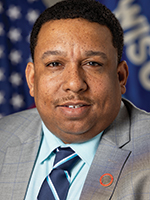
Photo of Russell Goodwin
D Wisconsin House · District 12 On the 2026 ballot

Rep. Russell Goodwin

Compare
Total votes
224
all sessions
Attendance
91%
21 missed
Near the chamber average
With party
94%
of cast votes
Lower than 95% of chamber peers
Bipartisan score
3%
crosses aisle rarely
Higher than 93% of chamber peers
Sponsored
317
bills & resolutions
Near the chamber average
Committees
2
assignments
317 bills and resolutions

Sponsored bills

Total
317
Primary
317
Co-sponsor
0
This page
317
matching current filters
Primary AB 554
Vetoed · Wisconsin House · Lead sponsor
Relating to: the sale, service, and labeling of food products containing lab-grown animal cells and providing a penalty. (FE)

Maddy summaryAB 554 requires clear labeling for food products containing lab-grown meat, directly affecting food manufacturers, restaurants, and state institutions. It mandates that "lab-grown meat" appear in prominent, contrasting text on labels (at least as large as other text), with full ingredient lists and separate labeling for multi-component products. The bill prohibits serving lab-grown meat as a meat substitute in public eateries without customer order or in state institutions (like prisons or hospitals) without specific health authorization. Violations carry fines of $100-$500 for first offenses and up to $1,000 for repeat violations. The law takes effect January 1, 2027.

Vetoed May 13, 2026 0 co-sponsors
Primary AB 847
Failed · Wisconsin House · Lead sponsor
Relating to: grants for alternatives to prosecution and incarceration programs for persons with mental illness and making an appropriation. (FE)

Maddy summaryAB 847 creates a state grant program providing $1.6 million annually to counties and tribes for mental health diversion programs. These programs offer alternatives to prosecution and incarceration for low-to-medium risk individuals with mental illness who interact with the criminal justice system, including deferred prosecution and restorative justice services. Eligible programs must provide holistic treatment (mental health care, housing, employment support), avoid including violent offenders, and collaborate with courts, prosecutors, and mental health providers. Counties receiving grants must submit annual reports on program impact, including effects on jail populations and participant outcomes, and comply with state audits. The bill aims to reduce incarceration costs, improve public safety, and address mental health needs through evidence-based approaches.

Failed Apr 14, 2026 0 co-sponsors
Primary AB 1060
Failed · Wisconsin House · Lead sponsor
Relating to: grants for falls prevention awareness and initiatives and making an appropriation. (FE)

Maddy summaryAB 1060 allocates $450,000 annually for two fiscal years (2025-26 and 2026-27) to fund falls prevention awareness and initiatives in Wisconsin. The bill directs the Department of Health Services to award this grant specifically to the Wisconsin Institute for Healthy Aging. This funding supports statewide programs aimed at reducing fall-related injuries, primarily affecting older adults in the state. The bill makes a concrete budget adjustment to enable this grant without altering existing health service programs.

Failed Apr 13, 2026 0 co-sponsors
Primary AB 790
Failed · Wisconsin House · Lead sponsor
Relating to: creating the water fund for our future, granting rule-making authority, and making an appropriation. (FE)

Maddy summaryAB 790 creates a dedicated "Water Fund for Our Future" with an initial $250 million transfer from the general fund. The fund establishes a rapid response account to cover clean water-related costs during natural disasters or public health emergencies, including remediation and assistance for affected individuals. A new joint committee oversees fund spending, reviewing requests for funding (excluding non-clean-water uses) and recommending approvals to the finance committee. All funds must be used exclusively for clean water activities, with specific rules for disbursement and oversight.

Failed Apr 13, 2026 0 co-sponsors
Primary AB 1162
Failed · Wisconsin House · Lead sponsor
Relating to: a very large customer class for electric utilities and granting rule-making authority. (FE)

Maddy summaryThis bill creates a new category called "very large customer" for electric utilities and gives the state commission authority to define who qualifies for this class. It requires electric utilities to file rate applications every other year for these customers and mandates that the commission review whether the rates charged are fair and not discriminatory. The commission will also develop specific rules to ensure utilities properly justify how rates cover the costs of serving these large customers. If rates are found to be unreasonable or unfairly discriminatory, the commission can adjust them or modify service terms accordingly.

Failed Apr 9, 2026 0 co-sponsors
Primary AB 1124
Failed · Wisconsin House · Lead sponsor
Relating to: creating a Mississippi River erosion control revolving loan program, extending the time limit for emergency rule procedures, providing an exemption from emergency rule procedures, granting rule-making authority, and making an appropriation. (FE)

Maddy summaryThis bill establishes a revolving loan program to help municipalities and homeowners on the Mississippi River shorelines address erosion threats to their properties. It authorizes the Department of Natural Resources to administer loans funded by a $2 million appropriation, with rules to set eligibility criteria and income limits for borrowers. The legislation also grants the department authority to create emergency rules without the usual requirement to prove an immediate public safety emergency, extending how long such temporary rules can remain in effect. Additionally, it increases the department's staffing by half a full-time equivalent position to manage the new loan program.

Failed Apr 9, 2026 0 co-sponsors
Primary AB 854
Failed · Wisconsin House · Lead sponsor
Relating to: violence prevention grants and making an appropriation. (FE)

Maddy summaryAB 854 creates a grant program funded by taxes on vapor products to support violence prevention efforts. It directs $30,000 for fiscal year 2025-26 and $120,000 for 2026-27 toward local health departments or tribal health centers. These entities can use the funds to run violence prevention programs or award grants to community organizations, but they cannot distribute money to law enforcement agencies or any groups working with them. The bill specifies that applications for these grants must be submitted by June 30 each year.

Failed Apr 9, 2026 0 co-sponsors
Primary AB 964
Signed into law · Wisconsin House · Lead sponsor
Relating to: Internet crimes against children administrative subpoenas for the crime of sexual extortion when the crime victim is a child. (FE)

Maddy summaryAB 964 clarifies that online sexual extortion targeting children falls under existing law by specifying it as a violation of Section 942.095 when the victim is a child (as defined in Section 948.01). This bill directly affects law enforcement agencies investigating internet crimes against children, enabling them to issue administrative subpoenas to internet companies for relevant data without a court order. The key provision streamlines the process for obtaining evidence from online platforms in cases where children are victims of sexual extortion. It does not create new penalties but ensures these cases are explicitly covered under current statutes for investigative efficiency.

Signed into law Apr 9, 2026 0 co-sponsors
Primary AB 759
Signed into law · Wisconsin House · Lead sponsor
Relating to: eligibility to receive occupational credentials for recipients of deferred action under the Deferred Action for Childhood Arrivals program. (FE)

Maddy summaryAB 759 allows individuals with deferred action under the federal DACA program to obtain state occupational licenses (like nursing or cosmetology credentials) if they have valid federal work permits. It requires state licensing agencies to verify DACA recipients' federal work authorization through official systems before issuing licenses. Licenses issued under this law expire when the federal work permit expires, and recipients must renew both simultaneously. The bill explicitly states it does not grant eligibility for public benefits beyond occupational credentials.

Signed into law Apr 9, 2026 0 co-sponsors
Primary AB 194
Signed into law · Wisconsin House · Lead sponsor
Relating to: modifications to housing programs under the Wisconsin Housing and Economic Development Authority. (FE)

Maddy summaryAB 194 modifies Wisconsin's housing programs under the Wisconsin Housing and Economic Development Authority. It redefines "developer" to include tribal housing authorities (Section 3) and clarifies "residential housing" to include tax-exempt reservation or trust lands (Section 4). The bill reduces maximum loan limits for housing projects from 33% to 20% of development costs (Section 10) and from 25% to 10% (Section 11). It also requires local governments to submit cost-reduction analyses showing how zoning or fee changes lowered housing costs (Section 7), directly affecting developers, tribal entities, and local governments administering housing programs.

Signed into law Apr 9, 2026 0 co-sponsors
Showing 1 to 10 of 317 bills
1 2 3 32 Next