Maddy summarySB 772 declares specific, previously identified claims against West Virginia state agencies (including Education, Health, Corrections, and Highways) as "moral obligations" requiring payment. The bill directs the state Auditor to issue warrants for payments totaling over $150,000 from designated funds (like General Revenue or State Road Fund) to named claimants, such as individuals ($240 to $30,000) and businesses (e.g., FEI Systems Inc. at $34,403.81). It does not create new policy but formalizes payment for claims already validated by the Legislative Claims Commission. The bill affects the listed claimants and requires state funds to settle these specific, pre-determined obligations.

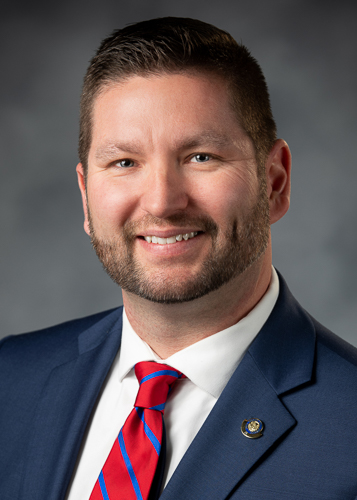
Sen. Jason Barrett
Sponsored bills
Maddy summarySB 724 removes the requirement that home confinement officers must be certified as law-enforcement officers to join West Virginia's Emergency Medical Services (EMS) Retirement System. The bill also extends the deadline for eligible home confinement officers to elect participation in the retirement system. This change directly affects home confinement officers working in the state's justice system, allowing them to access retirement benefits without prior law-enforcement certification. The bill amends specific sections of the West Virginia Code (§16-5V-2 and §16-5V-6f) to update eligibility rules and election procedures.
Maddy summarySB 749 authorizes four West Virginia counties - Ohio, Harrison, Monongalia, and Jefferson - to levy a special sales tax on businesses within designated economic development districts. The bill specifically approves taxes for the Fort Henry District (500 acres in Ohio County), Charles Pointe District (437 acres in Harrison County), University Town Centre District (1,450 acres in Monongalia County), and a Jefferson County district (unspecified acreage). Each district’s tax authority expires in 2053 or 2054, unless terminated earlier under existing law. The bill ensures these taxes won’t reduce state general revenue by requiring individual legislative approval for each district’s tax authorization. This directly affects businesses operating within these defined areas, with tax revenue funding local economic development initiatives.
Maddy summaryThis bill (SB 1038) increases salaries by 15% for three specific positions at the Unemployment Compensation Board of Review: Chief Administrative Law Judge, Administrative Law Judge 1, and Administrative Law Judge 2. The adjustment applies to salary levels effective when the bill takes effect and is separate from other 2026 budget salary changes. The stated purpose is to help ensure unemployment compensation hearings occur in a timely manner. The funding for this increase is exempt from standard budget constraints, and the law explicitly states it creates no legal liability for implementation.
Maddy summarySB 977 creates a partial disability benefit for West Virginia emergency medical services (EMS) members who develop work-related injuries or illnesses that prevent them from performing all duties but do not cause total disability. It adds a provision allowing these members to receive 45% of their average monthly compensation (based on the previous 12 months) instead of the 90% offered for total disability. To qualify as partially disabled, a member must have a medical condition lasting at least 12 months that prevents them from performing EMS duties, though they may still work other jobs. If partially disabled, the benefit continues until age 60, at which point they transition to the standard retirement benefit under the Emergency Medical Services Retirement System.
Maddy summarySB 1060 amends West Virginia law to define "WV certified thoroughbred" horses and adjust eligibility for restricted races. It requires thoroughbreds to be registered with the West Virginia Thoroughbred Breeders Association and either foaled in West Virginia, sired by a WV sire, or registered as a yearling in WV. The bill increases the $1 million funding cap for restricted races held by racetracks that did not participate in the West Virginia Development Fund for four consecutive years before December 31, 1992. These changes directly affect West Virginia racetracks and thoroughbred horses seeking eligibility for restricted races under updated funding rules.
Maddy summarySB 575 clarifies that county prosecuting attorneys must personally attend all refusal review hearings for drivers who refused chemical tests during traffic stops. This directly affects drivers facing license suspension for refusing tests and county prosecutors, who now have a clear duty to represent the state at these hearings. The bill amends existing law to specify that county attorneys - not other legal representatives - must handle all proceedings to protect the state’s interests. It does not change the hearing process or criteria for determining refusal but ensures prosecutors are present to present evidence. This aims to streamline the review of license suspensions under West Virginia’s DUI laws.
Maddy summarySB 28 allows members of the West Virginia State Police Retirement System to convert accrued annual or sick leave into additional retirement credit. It specifically affects current and future State Police retirees, with different rules based on membership start dates: members joining before July 1, 2015, receive two days of retirement credit for each day of accrued leave, while those joining on or after that date receive one day of credit per day of leave. The bill clarifies that each leave day equals eight hours and establishes how remainders (e.g., less than 10 workdays) are handled, ensuring the conversion aligns with existing retirement service calculations.
Maddy summarySenate Bill 781 adds $15 million to the Governor’s Office Civil Contingent Fund (Fund 0105) for fiscal year 2026, using an unappropriated surplus balance from the State General Revenue Fund. This supplemental appropriation directly affects the Governor’s Office, providing funds for unforeseen expenses or emergencies. The bill’s key mechanism is reallocating existing unspent surplus funds - identified in the Governor’s budget documents - into the contingency fund without creating new taxes or spending. It does not change existing laws or create new policy, only modifying the budget allocation for the fiscal year ending June 30, 2026.
Maddy summaryThis Senate resolution formally recognizes the dedicated public service of Honorable Michael Andrew Woelfel, a former West Virginia State Senator. The bill honors his career as a prosecutor, juvenile court referee, university professor, and legislator who served three consecutive terms in the Senate. It expresses the Senate's appreciation for his contributions to West Virginia citizens and directs the Clerk to send a copy of the resolution to Woelfel. This is a commemorative measure with no policy changes or budgetary impact.