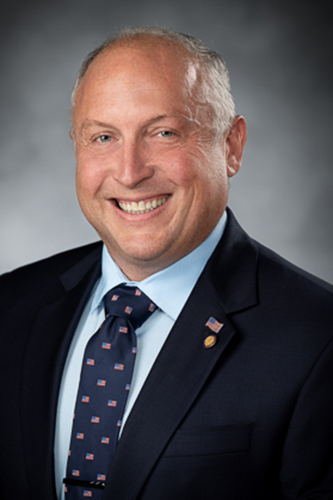
Photo of Bill Flanigan
R West Virginia House · District 4

Rep. Bill Flanigan

Compare
Total votes
1,396
all sessions
Attendance
93%
94 missed
Near the chamber average
With party
91%
of cast votes
Lower than 92% of chamber peers
Bipartisan score
4%
crosses aisle rarely
Higher than 91% of chamber peers
Sponsored
162
bills & resolutions
Near the chamber average
Committees
2
assignments
162 bills and resolutions

Sponsored bills

Total
162
Primary
29
Co-sponsor
133
This page
162
matching current filters
Co-sponsor HB 5182
Signed into law · West Virginia House · Co-sponsor
Relating generally to authorizing security personnel employed by the State Treasurer to carry concealed weapons while performing his or her official duties

Maddy summaryHB 5182 authorizes security personnel employed by West Virginia's State Treasurer to carry concealed firearms while performing official duties. To qualify, staff must obtain the Treasurer's written approval, hold a valid concealed handgun license, pass firearms training equivalent to police academy standards, and maintain annual requalification. The State Treasurer may reimburse staff for training costs, and the state assumes liability for security personnel acting in good faith during official duties. This bill directly affects the Treasurer's security team and establishes specific safety requirements for firearm use.

Signed into law Jun 29, 2026 1 co-sponsor
Co-sponsor HB 5444
Signed into law · West Virginia House · Co-sponsor
Relating to increasing the amount of fees to be paid by parolees for supervision.

Maddy summaryHB 5444 increases the maximum monthly fee parolees in West Virginia must pay for supervision from $40 to $50, based on their ability to pay. The Division of Corrections and Rehabilitation must consider factors like income, assets, debts, and necessary expenses (such as child care or medical costs) when setting individual fees. All collected fees will go into a special fund to cover parole supervision costs, with any excess funds to be reallocated by the legislature. This change directly affects parolees under state supervision, including those paroled by other states or the federal government.

Signed into law Jun 29, 2026 1 co-sponsor
Co-sponsor HB 5406
Signed into law · West Virginia House · Co-sponsor
Relating to driving under the influence

Maddy summaryHB 5406 updates West Virginia's DUI laws by shifting authority for chemical testing oversight from the Bureau of Public Health to the West Virginia State Police Forensic Laboratory. It eliminates outdated references to urine testing, removes propoxyphene from drug testing requirements, and permits trained phlebotomists to collect blood samples for analysis. The bill also corrects blood alcohol concentration thresholds for juvenile drivers and clarifies that refusing only a blood test - without refusing a breath test - will not automatically trigger license revocation. These changes streamline DUI testing procedures for law enforcement and ensure current medical standards are reflected in the law.

Signed into law Jun 29, 2026 1 co-sponsor
Co-sponsor HB 5401
Signed into law · West Virginia House · Co-sponsor
Relating to voting in West Virginia elections while residing overseas

Maddy summaryHB 5401 expands absentee voting eligibility in West Virginia to citizens temporarily residing overseas. To qualify, voters must have been residents of West Virginia before leaving, hold a U.S. passport, not have established permanent residency abroad, and intend to return. They must also be registered or eligible to vote in another U.S. jurisdiction. The bill updates both mail-in and electronic absentee ballot rules to include this group, aligning with federal voting protections for overseas citizens.

Signed into law Jun 29, 2026 1 co-sponsor
Co-sponsor HB 5457
Signed into law · West Virginia House · Co-sponsor
To allow partial credits for times of disability service in the CPRB for Troopers.

Maddy summaryHB 5457 allows West Virginia State Police troopers who receive disability benefits to count half of their disability service time toward retirement eligibility. The bill amends retirement system rules to provide one-half service credit for periods when troopers are on disability leave under existing provisions. This change directly affects active troopers and retirees who have periods of disability service but do not qualify for full retirement credit. It ensures these service periods contribute to retirement benefits without requiring full-time employment. The policy applies specifically to disability service under §15-2A-9 or §15-2A-10 of the West Virginia Code.

Signed into law Jun 29, 2026 1 co-sponsor
Primary HB 5382
Signed into law · West Virginia House · Lead sponsor
Relating to the Neighborhood Investment Program.

Maddy summaryHB 5382 extends the expiration date of West Virginia's Neighborhood Investment Program from July 1, 2026, to July 1, 2031. This program provides tax credits to taxpayers who contribute to certified neighborhood development projects. Contributions made before July 1, 2031, will still qualify for the credit, but no new credits will be available for contributions after that date. The bill ensures continued support for community investment projects through 2031 while clarifying the program's termination timeline.

Signed into law Jun 29, 2026 0 co-sponsors
Co-sponsor HB 4577
Signed into law · West Virginia House · Co-sponsor
Relating to driver’s licenses

Maddy summaryHB 4577 creates a reciprocity agreement with the Republic of Ireland for driver licenses, allowing Irish license holders to drive in West Virginia without retaking tests if their license meets comparable standards. The bill requires that foreign license standards (specifically for Ireland) align with West Virginia's, and mandates that drivers operating under this agreement comply with the state's mandatory motor vehicle liability insurance and financial responsibility laws. This agreement applies only to Ireland and does not alter the standard driver's license examination process for new applicants in West Virginia.

Signed into law Jun 29, 2026 1 co-sponsor
Primary HB 4756
Signed into law · West Virginia House · Lead sponsor
To provide automatic treble damages anytime a non-English speaking commercial truck driver causes an accident in WV

Maddy summaryHB 4756 requires commercial truck drivers in West Virginia who cannot comprehend English to pay triple the standard compensation for all accident-related damages and medical expenses if they cause an accident. It directly affects non-English-speaking commercial truck drivers and their employing companies. The bill’s key provision replaces standard damages with automatic "treble damages" (triple the usual amount) for qualifying accidents, without requiring separate legal proceedings. This policy change specifically targets language barriers in commercial driving incidents, mandating higher financial accountability for drivers unable to understand English during operations.

Signed into law Jun 29, 2026 0 co-sponsors
Co-sponsor HB 4799
Signed into law · West Virginia House · Co-sponsor
To establish the cold case task force for the State of West Virginia

Maddy summaryHB 4799 establishes a statewide cold case task force within the West Virginia State Police to investigate unsolved criminal cases. The task force, led by an executive board of the State Police Superintendent, police chiefs, and sheriffs' association presidents, will coordinate with other law enforcement agencies while respecting ongoing investigations. It creates a dedicated "cold case task force fund" for operations and requires the West Virginia Fusion Center to share relevant data from existing cold case databases. The bill focuses on structural mechanisms for investigation rather than new policy changes, directly affecting state and local law enforcement agencies collaborating on cold cases.

Signed into law Jun 29, 2026 1 co-sponsor
Co-sponsor HB 4801
Signed into law · West Virginia House · Co-sponsor
Defining Permissible expenditures for municipalities and counties

Maddy summaryHB 4801 amends West Virginia law to allow municipalities and counties to use hotel occupancy tax revenue for two new purposes: demolishing unsafe or unsanitary structures and planning for reuse or improvement of publicly owned property. This bill adds these specific activities to the list of permissible expenditures while maintaining the existing requirement that at least 50% of the tax revenue must fund tourism promotion. Local governments can still allocate funds to convention visitor bureaus or hotels (up to 75% of eligible tax revenue) for tourism-related expenses like advertising and marketing, subject to budget approval. The law directly affects counties and municipalities collecting hotel occupancy taxes, providing clearer guidelines for how these funds can be spent on community infrastructure and tourism development.

Signed into law Jun 29, 2026 1 co-sponsor
Showing 1 to 10 of 162 bills
1 2 3 17 Next