

Maddy summaryHB 5048 ensures foster children in temporary care facilities continue their education through virtual learning while awaiting residential placement. It requires that virtual instruction occur in the county where the child was last enrolled (or the current county if unavailable, or the nearest capable county), and mandates that virtual learning begins within three days of placement in temporary care. Foster care agencies responsible for the child must receive IT training to support this transition. Once placed with a foster family, all educational records and virtual learning details are transferred to the new county and foster family. The bill directly affects foster children in temporary care and the agencies managing their placement.
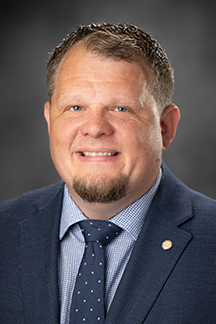
Rep. Ryan Browning
Sponsored bills
Maddy summaryHB 5065 amends West Virginia's hotel occupancy tax law to clarify collection requirements for online booking platforms (marketplace facilitators) like Airbnb or Booking.com. It requires these platforms to: (1) separately state the tax on all bills, (2) use geofencing for accurate tax calculation, (3) provide a nine-digit postal code to ensure taxes reach the correct local government (county or municipality), and (4) maintain detailed records of each transaction. The bill directly affects marketplace facilitators that meet sales thresholds ($100,000 revenue or 200+ transactions annually) and hotels using these platforms. It also prohibits businesses from claiming they will absorb the tax, ensuring the tax remains visible to consumers.
Maddy summaryHB 4483 changes the renewal period for funeral director licenses in West Virginia from every two years to every five years. This directly affects licensed funeral directors, who will now renew their licenses less frequently. The bill also updates apprenticeship requirements, including limiting the duration of apprenticeships to one year for funeral service licensees and one year for funeral directors, and clarifies the board's rule-making authority. The primary policy change extends the license renewal cycle to five years while maintaining existing educational and experiential standards for licensure.
Maddy summaryHB 4592 requires West Virginia colleges and universities to create standardized safety mapping data for campus buildings and grounds, directly affecting all public institutions of higher education. The bill mandates that maps include detailed floor plans, hazard locations, emergency equipment, and accurate aerial imagery, all formatted to integrate with public safety software without additional costs. These maps must be verified on-site, stored within the U.S., and shared permanently at no cost with local police, fire, EMS, and the state emergency management division. The requirement becomes effective September 1, 2026, with counties eligible to receive up to $4,500 per school for implementation.
Maddy summaryHB 4474 extends the expiration date of West Virginia's Alzheimer's Disease and Other Dementia Advisory Council, which was scheduled to sunset. The bill prevents the council from automatically dissolving by renewing its operational period. The council, composed of 15 voting members (including people with dementia, caregivers, healthcare providers, and researchers) and 5 nonvoting government representatives, examines dementia care needs, reviews state services, and assesses healthcare capacity. It does not create new policies but ensures the council can continue its work on dementia-related issues. This procedural bill affects only the council's continued operation, not direct service recipients.
Maddy summaryHB 4005, "Skills to Work," creates a state-funded Youth Apprenticeship Program for West Virginia students aged 16 or older in 11th or 12th grade. It allows these students to earn high school credit and job skills certifications through structured apprenticeships in fields like manufacturing, healthcare, and office technology, requiring 135 classroom hours and 400 on-the-job training hours per program. The bill mandates schools to partner with employers to develop approved apprenticeships, with standards including progressive wages, performance evaluations, and school approval. It also clarifies that apprenticeships cannot include hazardous occupations prohibited for minors under federal and state child labor laws. The program must be fully implemented across all school systems by the 2025-2026 school year.
Maddy summaryHB 4418, titled "The Tax Efficiency Act of 2026," would allow West Virginia municipalities to pay and manage their business and occupation or privilege taxes through a statewide electronic data processing system. This change directly affects all cities and towns in West Virginia that impose such taxes on local businesses. The bill amends existing tax code to establish this electronic system as an official method for tax collection and administration, replacing manual or paper-based processes. The key provision enables streamlined, centralized processing to reduce administrative costs and improve accuracy for both local governments and businesses.
Maddy summaryHB 4999 expands legal protections for both athletic officials (like referees) and participants (players) in West Virginia by making assault or battery against them a misdemeanor. It increases penalties: assault fines of $250-$500 with up to six months in jail, and battery fines of $500-$1,000 with up to one year in jail. The bill also allows school boards to ban convicted offenders from all school sports events for at least one year, with violating this ban treated as trespassing. However, it explicitly exempts normal sports actions - such as hard fouls within game rules - from prosecution.
Maddy summaryThis bill establishes the Recharge West Virginia Program, which provides financial reimbursement to private employers in the state for costs associated with training their employees in new skills. The program is administered by the Division of Economic Development and targets companies that wish to upskill their workforce through specialized technical training, leadership development, or registered apprenticeships. To qualify for reimbursement, employers must demonstrate that their employees complete industry-recognized credentials and achieve a wage increase of at least 25% above their previous earnings, with individual reimbursements capped at $10,000 per employee and $100,000 annually per employer. The legislation defines eligible employees as those who have lived and worked full-time in West Virginia for the past six months, while excluding public bodies and foreign nonprofit corporations from participating. Employers must submit detailed applications including training plans, job descriptions, and wage projections to the Division of Economic Development, which will establish specific procedures and standards for evaluating reimbursement requests.
Maddy summaryHB 4415 amends West Virginia law to explicitly include federal correctional facilities in existing statutes prohibiting the smuggling of prohibited items into correctional settings. The bill makes it a misdemeanor to deliver items like food, clothing, or money without permission (fines up to $500, jail up to 12 months) and a felony to transport weapons, drugs, escape tools, or telecommunications devices (fines $1,000-$5,000, prison 1-10 years). It directly affects individuals attempting to smuggle contraband into federal prisons located within West Virginia, such as visitors, family members, or others delivering unauthorized items. The law updates prior penalties for smuggling into state facilities to apply uniformly to federal correctional institutions.