Maddy summaryThis bill is a House resolution that formally recognizes Representative Virginia "Jenny" Graham for her public service in the Washington State House of Representatives. It highlights her eight-year tenure, her advocacy for public safety, and her work on community safety and veterans' issues. The resolution does not create new laws or policies but serves as an official acknowledgment of her contributions and legacy.

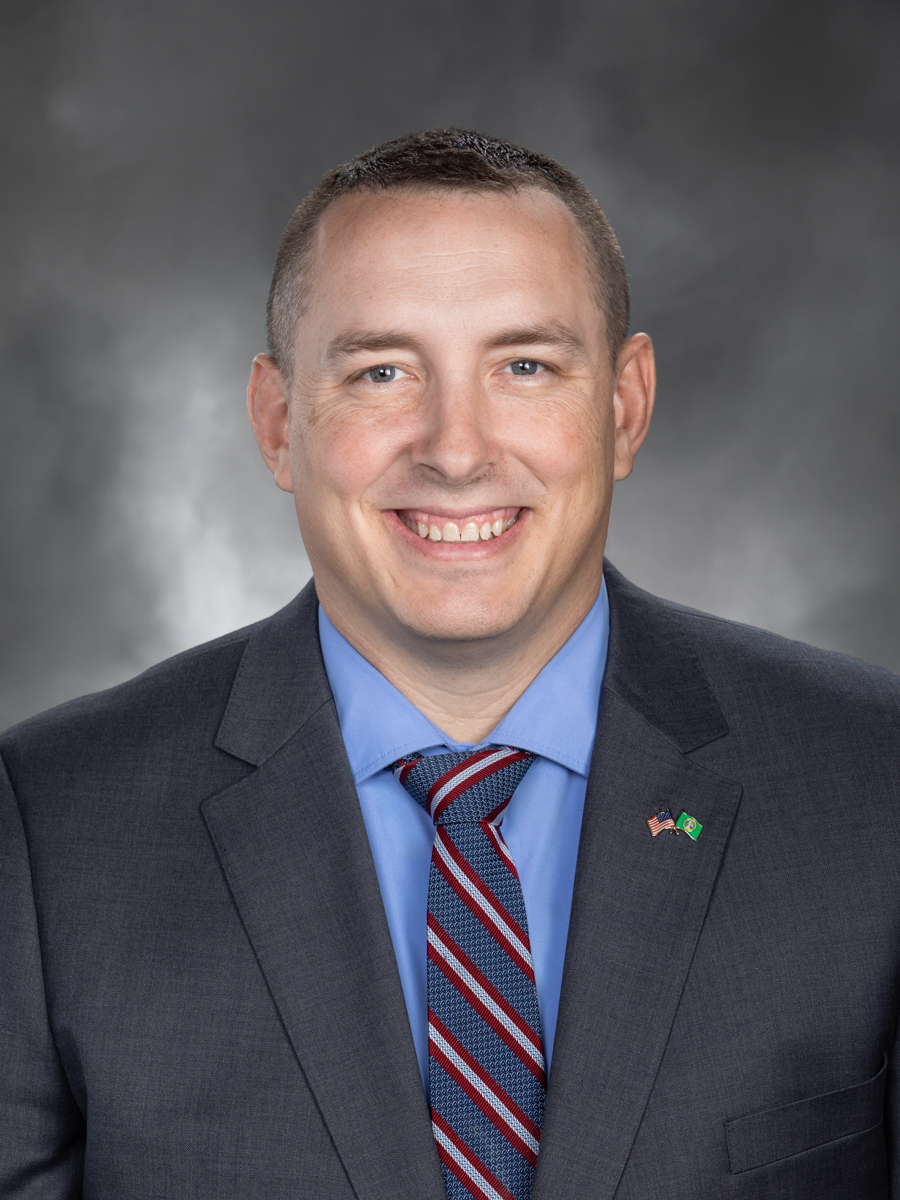
Rep. Josh Penner
Sponsored bills
Maddy summaryThis bill is a House resolution that formally honors John Michael Sattgast for his 35 years of dedicated service as a communications professional for the House Republican Caucus in the Washington State Legislature. It recognizes his work producing over 4,000 radio stories and coordinating media coverage for state representatives, as well as his leadership roles with the National Conference of State Legislatures. The resolution acknowledges his contributions to sharing legislative history and public information, noting his receipt of the 2023 Legislative Staff Achievement Award. This measure serves as a commemorative tribute rather than establishing new policy or affecting government operations.
Maddy summaryThis bill formally acknowledges the service of Representative Steve Tharinger to his district and the Washington state legislature. It recognizes his long career in public service, including his time as a Clallam County Commissioner, his work on the House Capital Budget Committee, and his advocacy for environmental protection and healthcare. The resolution serves as a commemorative tribute to his contributions and personal qualities rather than establishing new laws or policies.
Maddy summaryHB 2319 renames three state facilities currently referred to as "schools" in statutes to "residential habilitation centers" to better reflect their actual purpose of providing habilitative support (like daily living skills training and medical services) rather than education. Specifically, Fircrest School, Rainier School, and Yakima Valley School become Fircrest Residential Habilitation Center, Rainier Residential Habilitation Center, and Yakima Valley Residential Habilitation Center, respectively, while Lakeland Village retains its existing name. The bill clarifies that these name changes are purely administrative - no services, operations, or funding access will be altered. It also updates related statutes to use the new facility names consistently across state law.
Maddy summaryHB 2203 creates a new offense for drivers who operate vehicles on public roadways closed due to emergencies (e.g., barricades, emergency vehicles), with two penalty levels: a serious misdemeanor for general violations, or a felony if the act causes injury to first responders or involves minors/vulnerable adults. Convicted individuals face license suspension (60-90 days) and must reimburse public agencies for emergency response costs, capped at $25,000 per incident. The bill directly affects drivers who ignore emergency closures, particularly those with minors in the vehicle or who endanger first responders. It establishes clear penalties and financial accountability for reckless interference during emergency operations.
Maddy summaryHouse Bill 1833 establishes the Spark Act Grant Program in Washington state, designed to support startups, research institutions, and companies developing innovative artificial intelligence (AI) technologies. The Department of Commerce will administer these grants, which will be funded through a dedicated account receiving legislative appropriations, private donations, and federal funds. Grants will be awarded annually, prioritizing applicants committed to ethical AI use, risk analysis, small businesses, and projects with statewide impact such as wildfire tracking, cybersecurity, or healthcare advancements. Eligible applicants must propose technology that will be shared with and provide a benefit to the state, with the program's progress and impact reported biennially.
Maddy summaryThis House resolution commemorates the 250th anniversary of the United States founding on July 4, 2026, specifically focusing on Washington State's role in that history. The bill formally recognizes the significance of the Declaration of Independence and encourages citizens, organizations, and businesses in Washington to participate in commemorative events celebrating American heritage and federalist principles. It does not create new laws or funding but serves as a symbolic acknowledgment of the nation's founding ideals and Washington's contributions to the country's development.
Maddy summaryHB 2742 creates an annual sales and use tax holiday in Washington for qualifying items priced at $500 or less per item. It exempts these items from both sales tax (under RCW 82.08) and use tax (under RCW 82.12) during a four-day period each year, specifically from 12:00 a.m. on the Friday after Thanksgiving through 11:59 p.m. on the Monday after Thanksgiving. The tax holiday directly affects all Washington residents purchasing qualifying items during this window, providing temporary financial relief on everyday goods like clothing, school supplies, or electronics. The Department of Revenue must establish administrative rules and provide taxpayer guidance to implement the holiday, consistent with existing tax agreements.
Maddy summaryThis House Resolution (HR 4701) is a symbolic measure passed by the Washington State House of Representatives to honor Black History Month in 2026, marking the 100th anniversary of the national observance. It recognizes the historical contributions of Black Americans to Washington state and the nation through decades of cultural, scientific, and civil rights advancements. The resolution encourages year-round celebration of Black history in schools, communities, and institutions, emphasizing that "Black history is American history" and "Black culture is American culture." As a non-binding resolution, it does not create new laws or directly affect specific groups.
Maddy summaryThis resolution (HR 4692) acknowledges the 84th anniversary of Executive Order 9066, which led to the forced relocation and internment of over 120,000 Japanese Americans during WWII, including 12,000 from Washington State. It recognizes Japanese American veterans, incarcerees, and civil rights activists from Washington, and urges reflection on the principle "with liberty and justice for all," without creating new policies or requiring government action.