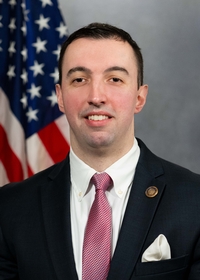
Photo of Brandon Markosek
D Pennsylvania House · District 25 On the 2026 ballot

Rep. Brandon Markosek

Compare
Total votes
4,295
all sessions
Attendance
100%
of floor votes
Near the chamber average
With party
98%
of cast votes
Higher than 91% of chamber peers
Bipartisan score
1%
crosses aisle rarely
Lower than 87% of chamber peers
Sponsored
195
bills & resolutions
Near the chamber average
Committees
1
assignment
195 bills and resolutions

Sponsored bills

Total
195
Primary
48
Co-sponsor
147
This page
195
matching current filters
Co-sponsor HB 2734
In committee · Pennsylvania House · Co-sponsor
An Act amending the act of May 17, 1921 (P.L.682, No.284), known as The Insurance Company Law of 1921, in casualty insurance, providing for coverage for treatments to slow the progression of Alzheimer's disease and related dementias.

Maddy summaryPennsylvania House Bill 2734 requires health insurance companies to cover FDA-approved diagnostic tests and treatments that slow the progression of Alzheimer's disease and related dementias. The mandate applies to insurers offering individual or group health policies in the state, with a compliance deadline of January 1, 2028, unless federal law preempts the requirement. The bill explicitly prohibits insurers from using step therapy for these specific treatments, meaning patients cannot be forced to try other medications first before receiving coverage for approved Alzheimer's therapies.

In committee Aug 18, 2026 1 co-sponsor
Co-sponsor HB 2124
In committee · Pennsylvania House · Co-sponsor
An Act amending Title 20 (Decedents, Estates and Fiduciaries) of the Pennsylvania Consolidated Statutes, providing for uniform real property transfer on death.

Maddy summaryHB 2124 establishes a "transfer on death deed" process in Pennsylvania, allowing property owners to directly transfer real estate to named beneficiaries upon their death without probate. The bill enables owners to create a legally binding deed (requiring only county recording before death) that automatically transfers property to designated beneficiaries, with no need for beneficiary acceptance or payment during the owner's lifetime. Owners retain full control to revoke or modify the deed anytime before death, using the same legal capacity required for making a will. This applies to all Pennsylvania property owners seeking to simplify post-death property transfers for homes, land, or other real estate, avoiding court involvement in estate administration.

In committee Aug 13, 2026 1 co-sponsor
Primary HB 482
Signed into law · Pennsylvania House · Lead sponsor
An Act authorizing the Commonwealth of Pennsylvania to join the Interstate Compact; providing for the form of the compact; and imposing additional powers and duties on the Governor, the Secretary of the Commonwealth and the Compact.

Maddy summaryHB 482 authorizes Pennsylvania to join the Interstate Occupational Therapy Licensure Compact, enabling licensed occupational therapists and assistants from Pennsylvania to practice in other participating states without obtaining separate licenses. The bill establishes mechanisms for mutual recognition of licenses, sharing of disciplinary and investigative data between states, and accountability for practitioners providing services across state lines. It directly affects occupational therapists, assistants, and patients seeking services in multiple states, particularly supporting military spouses relocating and expanding telehealth access. Key provisions include requiring states to participate in a shared data system, defining terms like "Compact Privilege," and preserving each state’s regulatory authority over local practice standards. This is a procedural bill enabling Pennsylvania’s participation in an existing interstate framework, not creating new licensing requirements.

Signed into law Jul 20, 2026 0 co-sponsors
Co-sponsor HB 2190
In committee · Pennsylvania House · Co-sponsor
An Act amending the act of July 23, 1970 (P.L.563, No.195), known as the Public Employe Relations Act, in collective bargaining impasse, further providing for arbitration; and, in strikes, further providing for prohibited strikes.

Maddy summaryHB 2190 amends Pennsylvania's Public Employe Relations Act to change how collective bargaining impasses are resolved for specific public safety and court staff. It requires binding arbitration for disputes involving prison guards, mental hospital staff, peace officers, and court employees when mediation fails - meaning the arbitrator's decision becomes final and enforceable. However, if an arbitration decision would require new legislation (e.g., changing pay rates or benefits), that part would only be advisory, not binding. The bill directly affects these public employee groups whose work is critical to security and court operations. This change streamlines dispute resolution while maintaining legislative oversight for policy changes.

In committee Jul 12, 2026 1 co-sponsor
Co-sponsor HB 2359
Passed · Pennsylvania House · Co-sponsor
An Act amending the act of March 4, 1971 (P.L.6, No.2), known as the Tax Reform Code of 1971, in computer data center equipment incentive program, further providing for definitions, for application for certification, for eligibility requirements relating to sales and use tax refund program, for notification, for eligibility requirements relating to sales and use tax exemption program and for notification and records.

Maddy summaryThis bill amends Pennsylvania's Right-to-Know Law to ban government agencies from signing nondisclosure agreements related to data centers. The law prohibits any contract that restricts the public from accessing information about the construction, development, or location of these facilities. If an agency signs such an agreement, the contract is considered void and unenforceable. The bill defines a data center as a facility used to process, store, or transmit data using computers and software.

Passed Jul 10, 2026 1 co-sponsor
Co-sponsor HB 2146
Passed · Pennsylvania House · Co-sponsor
An Act amending Title 65 (Public Officers) of the Pennsylvania Consolidated Statutes, in open meetings, further providing for notification of agency business required and exceptions.

Maddy summaryHB 2146 modifies Pennsylvania's open meetings law to clarify when government agencies can take action on unlisted agenda items. It creates specific exceptions for minor administrative approvals that arise unexpectedly, such as urgent legal filings, small purchases under $10,000 (based on current thresholds), grant applications with deadlines, or minor permit approvals. Agencies must obtain and publicly disclose a legal opinion confirming an item qualifies under these exceptions before acting. This directly affects state and local agencies holding public meetings, ensuring transparency while allowing limited flexibility for time-sensitive matters. The bill does not change core meeting notice requirements but adds defined exceptions for minor, non-financial actions.

Passed Jul 9, 2026 1 co-sponsor
Co-sponsor HB 2490
In committee · Pennsylvania House · Co-sponsor
An Act amending Title 67 (Public Welfare) of the Pennsylvania Consolidated Statutes, in miscellaneous provisions, providing for waiver of subrogation.

Maddy summaryThis bill prohibits Pennsylvania county agencies and municipal governments from including clauses in service contracts that waive their right to seek reimbursement from insurance companies for liability claims. It directly affects government entities that hire external service providers regulated under state child and family services rules. By declaring such waiver clauses unenforceable, the legislation ensures that insurance carriers retain the ability to recover costs from the government if a service provider causes a liability issue. The changes apply to any service contracts entered into or renewed after the law takes effect 60 days from its passage.

In committee Jul 1, 2026 1 co-sponsor
Co-sponsor HB 2549
In committee · Pennsylvania House · Co-sponsor
An Act amending Title 75 (Vehicles) of the Pennsylvania Consolidated Statutes, in registration of vehicles, providing for contributions for the deaf and hard of hearing, for contributions for the Shriners Hospitals for Children, for contributions to Fire Company Grant Program and for contributions to Emergency Medical Services Grant Program.

Maddy summaryThis bill allows Pennsylvania residents to voluntarily donate $5 when they renew their driver's licenses or vehicle registrations online. The funds collected will go exclusively to the Office for the Deaf and Hard of Hearing to help provide communication access services for those individuals. The donation is optional and will be added to the regular renewal fee, with annual reports required to track how much money is raised and how it is spent.

In committee Jul 1, 2026 1 co-sponsor
Primary HB 1700
In committee · Pennsylvania House · Lead sponsor
An Act amending Title 75 (Vehicles) of the Pennsylvania Consolidated Statutes, in licensing of drivers, providing for communication barrier designation; and imposing penalties.

Maddy summaryHB 1700 would amend Pennsylvania's vehicle laws to allow driver's licenses to include a "communication impairment designation" for individuals with conditions affecting speech or hearing, such as hearing loss or speech disorders. This designation would help drivers communicate more effectively with law enforcement during traffic stops by indicating they may need alternative communication methods. The bill also specifies penalties for violations related to this designation, such as failing to accommodate it during stops. It directly affects drivers with communication disabilities and law enforcement officers interacting with them.

In committee Jun 29, 2026 0 co-sponsors
Co-sponsor HB 2226
In committee · Pennsylvania House · Co-sponsor
An Act amending Title 40 (Insurance) of the Pennsylvania Consolidated Statutes, providing for prescription drug cost credits in health insurance; and imposing penalties.

Maddy summaryHB 2226 amends Pennsylvania's Unfair Trade Practices and Consumer Protection Law to explicitly prohibit pyramid schemes and similar deceptive promotional plans. The bill adds a new definition clarifying that schemes where participants pay to join and earn compensation primarily by recruiting others (rather than through product sales) are illegal, including "chain-letter plans," "pyramid clubs," and "pyramid promotional schemes." This change directly affects businesses operating such schemes and protects consumers from being misled by these fraudulent programs. The amendment specifically bans practices like requiring participants to pay for "opportunities" to recruit others, while excluding minimal initial payments of $25 or less.

In committee Jun 24, 2026 1 co-sponsor
Showing 1 to 10 of 195 bills
1 2 3 20 Next