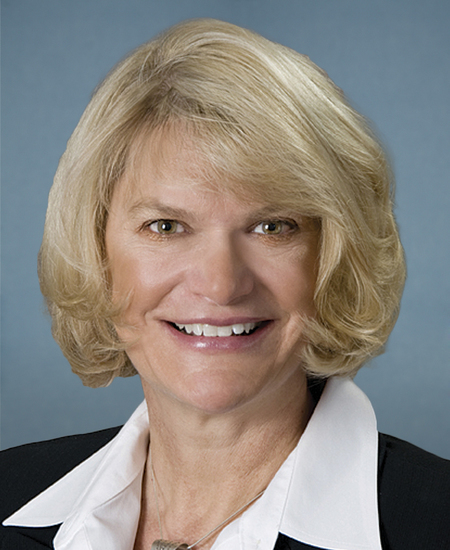
Maddy summaryThis bill redesignates Wyoming's National Historic Trails Interpretive Center in Casper as the "Barbara L. Cubin National Historic Trails Interpretive Center." It directly affects the center's official name and all federal references to it. The bill updates all federal documents, maps, and records to use the new name, while preserving the center's existing purpose and operations. It is a ceremonial naming bill with no substantive policy changes.

Sponsored bills
Maddy summaryThis resolution formally honors the life, service, and legacy of Jon Llewellyn Kyl, a former U.S. Senator from Arizona who passed away at age 84. It details his career highlights, including his time in the House of Representatives, his long tenure in the Senate, and his work on issues such as water policy, national security, and crime victims' rights. The bill directs the Secretary of the Senate to share this tribute with the House of Representatives and Kyl's family, while also ordering the Senate to adjourn for the day as a mark of respect.
Maddy summaryThis Senate resolution designates the week of September 27 through October 3, 2026, as "Religious Education Week" to recognize the role of religious instruction in civic and moral development. The bill highlights historical perspectives and legal precedents that support the right to religious education, including the use of sectarian schools and released time programs for public school students. It calls on all states, territories, and the District of Columbia to accommodate individuals who wish to leave public school attendance to attend religious classes.
Maddy summaryThe Connected Vehicle Security Act of 2026 restricts the importation, sale, and use of connected vehicles and related technology from China, Russia, Iran, and North Korea to protect national security. Starting in 2027, the bill generally bans these vehicles if they originate from or are controlled by these countries, with separate restrictions on software and hardware taking effect in 2030. The Secretary of Commerce is authorized to issue specific exemptions for items that do not pose a security risk and must publish a list of approved products. The law also requires companies to submit declarations confirming their vehicles comply with the rules and imposes heavy fines for violations.
Maddy summaryThe Terrorism Risk Insurance Program Reauthorization Act of 2026 extends the federal terrorism insurance program through 2034, ensuring continued government support for insurance companies facing large losses from terrorist attacks. The bill also updates the schedule for recouping federal funds, shifting the timeline for when insurers must repay taxpayer money to later dates ranging from 2029 to 2036. These changes directly affect insurance carriers and policyholders by maintaining the program's availability for a longer period and adjusting the financial obligations tied to it.
Maddy summaryThis Senate resolution formally honors the life and legacy of Dolly Parton, who passed away on August 25, 2026, at the age of 80. The bill recognizes her significant contributions to American music, as well as her extensive philanthropy in areas such as childhood literacy, education, healthcare, disaster relief, and wildlife conservation. It specifically highlights her establishment of Dollywood, The Dollywood Foundation, and the Imagination Library program, which provided free books to millions of children. The resolution also acknowledges her financial support for medical research and her efforts to aid families affected by natural disasters in Tennessee and North Carolina.
Maddy summaryThe MORE American Fuel Act of 2026 amends the Atomic Energy Act to allow companies to begin constructing uranium enrichment facilities before the Nuclear Regulatory Commission issues an operating license, provided the application has been officially accepted and all federal laws are followed. This change shifts the licensing process from requiring approval before construction starts to a model where construction can proceed at the applicant's own financial risk while the regulatory review is still pending. To ensure local awareness, the bill mandates that applicants notify state governors, local government officials, and nearby tribal leaders at least 15 days before starting construction. The Nuclear Regulatory Commission is required to update its regulations within 180 days of the act's passage to reflect these new procedures, while retaining full authority to deny licenses if safety or operational standards are not met.
Maddy summaryThe FEAT Act allows individuals involved in specific Department of Interior administrative proceedings to move their cases to a federal district court instead of having them heard solely by internal agency tribunals. This change applies to parties who either seek approval for certain conduct or are appealing sanctions and penalties imposed by the Department. Under the new rules, these parties must file for removal within 60 days of starting the action, and the federal court will review the case from scratch rather than relying on the agency's initial decision.
Maddy summaryThe Cold Weather Diesel Reliability Act of 2025 requires the Environmental Protection Agency (EPA) to revise Clean Air Act regulations to address diesel vehicle challenges in extreme cold. It allows diesel vehicle manufacturers to temporarily disable engine power reductions or shutdowns caused by emissions system faults when temperatures are at or below freezing, but only until temperatures rise above freezing. The bill also grants a year-round exemption from diesel exhaust fluid (DEF) system requirements for vehicles primarily operating north of 59°N latitude or in regions with prolonged freezing conditions that make DEF use impractical. This exemption prevents engine derates or shutdowns due to DEF system issues, ensuring critical transportation and emergency services remain functional. The bill does not change overall emissions standards but provides targeted relief for safety and operational needs in cold weather regions.
Maddy summaryThis bill, the GOOD Act (Guidance Out Of Darkness Act), requires federal agencies to publish all their non-binding guidance documents - such as memos, bulletins, letters, and blog posts - on a single, publicly accessible government website. It applies to all federal agencies and mandates that existing guidance be posted within 180 days of the law's enactment, with new guidance published immediately upon issuance. Agencies must also maintain rescinded guidance documents online with clear labels indicating they are no longer in effect. The law does not apply to documents already exempt from public disclosure under the Freedom of Information Act (FOIA).