

Maddy summarySB 445 automatically adopts federal temporary waivers or modifications issued by the U.S. Department of Health and Human Services or Centers for Medicare & Medicaid Services under specific Social Security Act sections (1135 or 1812(f)) for North Carolina hospitals during declared emergencies. This means hospitals in disaster zones no longer need separate state approval to implement federal rule changes, directly affecting hospitals operating under such declarations. Key provisions include automatically waiving state hospital regulations to align with federal waivers and allowing temporary increases in bed capacity without additional state review. The bill streamlines emergency hospital operations by eliminating bureaucratic delays in applying federally authorized relief measures.
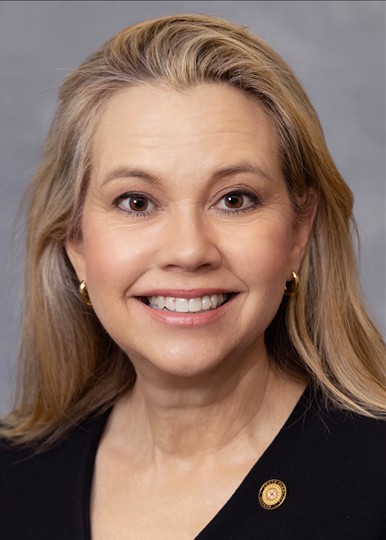
Sen. Amy Galey
Sponsored bills
Maddy summarySB 177 expands North Carolina's Medicaid Healthcare Access and Stabilization Program (HASP) to include qualifying freestanding psychiatric hospitals, allowing them to receive increased reimbursements for services. The bill creates a new assessment (a fee) on these hospitals, calculated as a percentage of their hospital costs, to fund the program. To implement this, the state must seek federal approval from CMS to include psychiatric hospitals in HASP. This change directly affects all Medicare-certified, state-licensed freestanding psychiatric hospitals in North Carolina, requiring them to pay the new assessment while gaining eligibility for enhanced Medicaid payments.
Maddy summarySB 857 updates the statutes governing the North Carolina Board of Funeral Service and amends various licensing programs within the Department of Insurance. The bill primarily reorganizes existing laws by recodifying sections to improve clarity and adds new definitions for terms such as alkaline hydrolysis, funeral chapels, and embalming facilities. These changes clarify what constitutes a funeral establishment versus a separate chapel or embalming site and specify how certain religious or private preparations are treated. The legislation affects funeral directors, embalmers, and related businesses by refining the rules they must follow regarding facility operations and terminology.
Maddy summarySB 474, the DAVE Act, creates a new Division of Accountability, Value, and Efficiency within North Carolina's State Auditor's office. It requires all state agencies to report by October 2025 on how they spend public funds and list vacant positions held for six months or longer, including reasons for vacancies. The Division will assess whether agencies or specific positions remain necessary, using AI tools to analyze spending effectiveness, duplication, and budget use. By December 2025, the Division must recommend to the legislature which agencies or positions should be eliminated based on this review.
Maddy summarySB 528 (Child Care Regulatory Reforms and Flexibilities) allows five years of documented work experience in a licensed North Carolina child care facility to count as equivalent to the North Carolina Early Childhood Credential for lead teachers and star ratings. It also increases the maximum group size for toddlers from 18 to 20 children in centers maintaining a 1/9 staff-to-child ratio, while adjusting nap-time supervision requirements. These changes directly affect licensed child care centers, administrators, lead teachers, and staff by providing alternative pathways to meet credentialing requirements and adjusting operational standards for group sizes. The bill aims to increase flexibility for providers while maintaining safety and quality standards under North Carolina’s child care regulations.
Maddy summaryThis bill, titled "Truth in Taxation," requires local taxing authorities in North Carolina to follow a specific process before raising property tax rates above a revenue-neutral level during years when a general reappraisal of real property occurs. To implement this change, the governing body must publish public notices in newspapers and online, send direct mail to taxpayers detailing the proposed tax increase, and hold a dedicated public hearing where a majority vote is required to approve the higher rate. If a local government fails to comply with these procedures and collects excess taxes, the bill mandates that they refund the overage to affected property owners. Additionally, the legislation increases the late reinstatement fee for expired real estate appraiser trainee registrations, licenses, and certificates to $12 per month, up from $10.
Maddy summaryThis bill modifies North Carolina's Cosmetic Art Act to create a new professional category called "hair designer" specifically for natural hair care services. It reduces the training hours required to become a licensed cosmetologist and removes the apprenticeship requirement for licensure. The legislation also formally defines "natural hair care" as services that involve tension on hair strands through twisting, wrapping, extending, or locking. These changes aim to deregulate certain hair care practices while establishing new licensing pathways for specialists in that field.
Maddy summaryThis bill adds a new member to the General Statutes Commission of North Carolina, representing the High Point University School of Law. The amendment changes the commission's composition to include 14 members instead of 13, ensuring one seat is filled by an appointment from the dean of that specific law school. Appointments for this new seat will occur in odd-numbered years, with the initial term scheduled to begin in September 2026 and end in August 2029. The legislation affects the structure of the body responsible for reviewing and updating the state's legal code.
Maddy summarySB 227 prohibits North Carolina public schools from teaching or promoting 12 specific "divisive concepts" defined in the bill, such as claims that one race is inherently superior or that individuals bear responsibility for past actions of their race. The bill directly affects K-12 students, teachers, and school employees by banning instruction on these concepts and restricting professional development that includes them. Key provisions include requiring schools to avoid "discriminatory practices" and preventing staff from being compelled to affirm divisive concepts. The bill does not ban all diversity initiatives but targets specific teachings it deems contrary to "equality and rights of all persons." This is a proposed bill (not yet law) currently under review in the North Carolina Senate.
Maddy summarySB 558 (North Carolina Senate Bill 558) requires public universities and community colleges to adopt diversity, equity, and inclusion policies that comply with state law while prohibiting the promotion of specific "divisive concepts." It defines 12 concepts as "divisive," including claims that one race or sex is inherently superior, individuals bear guilt for past actions of their race, or meritocracy is inherently racist. The bill mandates that institutions avoid teaching these concepts and bars community colleges from investigating protected speech (like satire) labeled as "microaggressions." It directly affects all public higher education employees, faculty, and students in North Carolina's university system and community colleges.