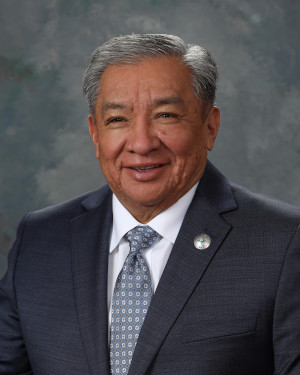
Photo of Benny Shendo
D New Mexico Senate · District 22

Sen. Benny Shendo

Compare
Total votes
346
all sessions
Attendance
87%
45 missed
Near the chamber average
With party
97%
of cast votes
Near the chamber average
Bipartisan score
1%
crosses aisle rarely
Near the chamber average
Sponsored
16
bills & resolutions
Higher than 93% of chamber peers
Committees
3
assignments
16 bills and resolutions

Sponsored bills

Total
16
Primary
16
Co-sponsor
0
This page
16
matching current filters
Primary SB 260
In committee · New Mexico Senate · Lead sponsor
WORKFORCE EDUCATION TAX CREDIT

Maddy summarySB 260 creates a tax credit allowing businesses to claim 75% of donations (up to $750,000 per company annually) to public colleges or school districts for workforce education programs, such as vocational training and job skills courses. The credit is capped at $5 million total per year across all businesses, requiring companies to apply for certification through the state's economic development department. Eligible donations must be direct monetary contributions to public institutions - not to affiliated entities - and the credit applies to taxable years starting January 1, 2026. This policy directly affects businesses donating to workforce training programs and public educational institutions receiving those funds.

In committee Mar 24, 2026 0 co-sponsors
Primary SB 66
In committee · New Mexico Senate · Lead sponsor
ABANDONED URANIUM MINE CLEANUP

Maddy summaryThis bill appropriates $50 million from the state general fund to clean up abandoned uranium mines and other contaminated sites across New Mexico where no responsible polluter exists to fund the work. It directly affects communities near these sites, particularly those impacted by historical uranium mining, by enabling the Department of Environment to conduct assessments and remediation. The funds will be used for cleanup actions during fiscal years 2027-2029, with any unspent balance reverting to the general fund by 2029. The legislation focuses solely on addressing existing contamination through state-funded cleanup, without altering liability or creating new regulatory requirements.

In committee Mar 24, 2026 0 co-sponsors
Primary SB 240
Signed into law · New Mexico Senate · Lead sponsor
CAPITAL OUTLAY PROJECTS

Maddy summarySB 240 authorizes New Mexico to issue bonds funded by severance taxes (taxes on oil, gas, and mineral extraction) to finance state capital projects like building construction, vehicle purchases, and equipment. It requires state agencies to certify their need for funds by the end of 2028 and to spend at least 5% of the bond proceeds within six months and 85% within three years of receiving the money. Unspent funds must be returned to the state treasury by 2030 or within six months of project completion, whichever comes first, preventing long-term budgeting of unused funds. This ensures timely project spending while holding agencies accountable for efficient use of bond proceeds.

Signed into law Mar 11, 2026 0 co-sponsors
Primary SM 27
Signed into law · New Mexico Senate · Lead sponsor
IMPACT OF RADIATION EXPOSURE

Maddy summaryThis Senate Memorial (SM 27) acknowledges New Mexico residents affected by radiation from the Trinity nuclear test and uranium mining, urging state agencies to help eligible individuals apply for federal compensation before December 31, 2027. It directly supports downwinders, uranium workers (post-1971), and their families who qualify for a one-time $100,000 federal payment under the expanded Radiation Exposure Compensation Act. The memorial directs state departments (Health, Aging, Veterans, Indian Affairs) to collaborate with tribal governments and community groups to provide outreach, education, and application assistance. As a non-binding memorial, it does not create new law but emphasizes state coordination to ensure affected residents access existing federal benefits.

Signed into law Feb 27, 2026 0 co-sponsors
Primary SB 2
Signed into law · New Mexico Senate · Lead sponsor
STATE HIGHWAY PROJECT BONDS

Maddy summarySB 2 increases funding for New Mexico's highway projects by raising fees on vehicle registrations and commercial truck taxes. It raises weight-distance tax rates for commercial trucks (affecting freight companies), increases standard passenger vehicle registration fees, and adds new annual fees for electric vehicles ($70-$90) and plug-in hybrids ($35-$45) starting in 2027. All new revenue from these changes goes directly to the State Road Fund to support highway improvements. The bill specifically targets commercial truck operators, all vehicle owners, and electric vehicle owners, with fee amounts varying by vehicle type and registration year.

Signed into law Feb 7, 2026 0 co-sponsors
Primary SB 19
Signed into law · New Mexico Senate · Lead sponsor
SCHOOL FINANCE UNIT VALUE RESET

Maddy summarySB 19 adjusts New Mexico's public school funding calculation for fiscal year 2026 by resetting the "unit value" used to determine state education funding. It requires the Secretary of Public Education to adjust this value by February 27, 2026, based on statewide unit counts after consulting with finance departments and legislative committees. This change directly affects all public schools in New Mexico by altering the formula for calculating their state funding allocation for that fiscal year. The bill is a temporary adjustment for FY2026, not a permanent change to the school finance system.

Signed into law Feb 2, 2026 0 co-sponsors
Primary SB 1
In committee · New Mexico Senate · Lead sponsor
GENERAL APPROPRIATIONS

Maddy summaryThis bill expands New Mexico's Rural Health Care Delivery Fund to provide grants to rural health care providers and facilities in high-need geographic areas with health professional shortages. It directly affects eligible rural providers (licensed in counties under 100,000 population or designated shortage areas) that serve Medicaid recipients and face operating losses for new or expanded services. Key provisions allow grants covering operating losses (not construction), require Medicaid provider status, mandate financial accountability through verified cost data, and prioritize services addressing critical community health needs. The bill appropriates $50 million from the general fund for fiscal year 2027 and subsequent years, with unspent funds not reverting to the general fund.

In committee Nov 10, 2025 0 co-sponsors
Primary SB 143
Passed · New Mexico Senate · Lead sponsor
CREATE UTILITY OVERSIGHT FUND

Maddy summarySB 143 creates a dedicated "utility oversight fund" in New Mexico's state treasury, funded by fees collected from utilities (like electric, gas, and water providers) operating within the state. The bill increases the annual inspection fee from 0.59% to 0.6% of utilities' New Mexico gross receipts and directs all related fees, late interest (15% annually), and penalties (2% for late payments) into this new fund, which cannot be used for other state purposes. The Public Regulation Commission will manage the fund, using it to support its oversight duties under the Public Utility Act, with disbursements requiring legislative appropriation.

Passed Jun 3, 2025 0 co-sponsors
Primary SJR 15
Passed · New Mexico Senate · Lead sponsor
APPOINTED STATE BOARD OF EDUCATION, CA

Maddy summaryThis constitutional amendment (SJR 15) proposes changing New Mexico's education governance structure. It would replace the current elected Public Education Commission with an appointed State Board of Education, which would appoint the Superintendent of Public Instruction to lead the public education department. The amendment keeps the elected commission as the authority for charter schools and retains its existing responsibilities. The proposed changes require voter approval at the next general election.

Passed Jun 3, 2025 0 co-sponsors
Primary SB 260
In committee · New Mexico Senate · Lead sponsor
CLEANUP OF CONTAMINATED SITES

Maddy summarySB 260 appropriates $50 million from the state general fund to New Mexico's Department of Environment for assessing and cleaning up abandoned or neglected contaminated sites, including former uranium mines, where no responsible party exists to pay for cleanup. The funding is available for use over fiscal years 2026 through 2028, with any unspent balance reverting to the general fund by the end of 2028. This bill directly affects state taxpayers through the funding mechanism and communities near contaminated sites by enabling cleanup actions that lack private funding. The key provision is the dedicated state funding to address environmental hazards at sites with no viable cleanup funding source.

In committee Jun 3, 2025 0 co-sponsors
Showing 1 to 10 of 16 bills