

0 co-sponsors
Total votes
957
all sessions
Attendance
100%
of floor votes
Near the chamber average
With party
100%
of cast votes
Higher than 76% of chamber peers
Bipartisan score
0%
crosses aisle rarely
Lower than 78% of chamber peers
Sponsored
653
bills & resolutions
Near the chamber average
Committees
4
assignments
653 bills and resolutions
Sponsored bills
Total
653
Primary
267
Co-sponsor
386
This page
653
matching current filters
Requires data center owners and operators to submit semi-annual water and energy usage reports to BPU.
Maddy summaryThis New Jersey bill (S 3379) requires data center owners and operators to submit semi-annual reports to the Board of Public Utilities (BPU) detailing water and energy usage. Existing data centers must begin reporting within three months of the law's enactment, while newer centers have six months. Reports must include basic facility information, usage data, and for centers receiving state funding, specific efficiency metrics like power usage effectiveness. The BPU will publish anonymized, aggregated data online but keep individual reports confidential.
Signed into law Aug 27, 2026
1 co-sponsor
Secures protections for patients and providers accessing and providing reproductive health care services; establishes right of residents to reproductive health care activity that is restricted in other states.*
Maddy summaryNew Jersey's S 2260 strengthens legal protections for patients and providers accessing or delivering reproductive and gender-affirming health care services within the state. The bill explicitly defines "legally protected health care activities" to include seeking, providing, or assisting with these services (such as abortion, contraception, or gender-affirming care), regardless of a patient's location. It prohibits obstruction, intimidation, or physical barriers at facilities offering these services and grants licensing boards authority to impose civil penalties for violations. This directly affects patients traveling to New Jersey for care (not available in their home states) and healthcare providers operating in these fields. The law codifies existing protections to prevent harassment or violence against these services, following increased threats and protests nationwide after the overturning of Roe v. Wade.
Signed into law Aug 20, 2026
1 co-sponsor
Requires Social Media Research Center to research and make recommendations concerning addictive social media behaviors.*
Maddy summaryS 3412 would require certain social media platforms in New Jersey to display a black box warning about mental health risks to users, similar to health warnings on tobacco products. The bill targets platforms primarily designed for social connection (like Facebook or TikTok) that have users in New Jersey, excluding services focused on news, entertainment, or e-commerce. This requirement is based on findings that youth social media use exceeding three hours daily doubles risks of depression and anxiety, and platforms are aware of these harms. The warning must be displayed on platforms meeting the bill's definition of "covered social media platforms," affecting all users of those services in the state.
HealthcareSupports HealthcareBill mandates mental health warnings on social media to prevent depression risks, directly protecting mental health as part of healthcare policy.
TechnologySupports TechnologyRegulates social media platforms for youth mental health protection, aligning with consumer protection in digital rights
Signed into law Aug 11, 2026
1 co-sponsor
"New Jersey Kids Code Act"; adopts New Jersey Age-Appropriate Design Code and requires certain online service providers to implement certain measures concerning minors' use of online service.*
Maddy summaryNew Jersey Assembly Bill 4015, the "New Jersey Kids Code Act," requires major online services (like social media and games) that minors are likely to use to set default privacy settings to the highest protection level for children. It prohibits these services from showing targeted ads to minors, using manipulative design tricks to change privacy settings, collecting certain personal data without clear consent, or promoting restricted products to children. The bill also mandates annual public reports detailing how these platforms protect minors’ privacy, their data practices, safety tools for parents, and how much time children spend on their services. This law directly affects large online platforms operating in New Jersey, not small websites or services not used by minors.
Signed into law Aug 11, 2026
1 co-sponsor
Establishes Social Media Research Center at four-year public institution of higher education.
Maddy summaryThis bill establishes a Social Media Research Center at a New Jersey four-year public university selected by the Higher Education Secretary. The center will conduct research on social media's effects on youth mental health, develop online safety resources for public schools, and provide recommendations to state agencies. It will also administer grants for social media research using a peer-reviewed process modeled after the NIH, and require annual reports on its work. The bill directly affects New Jersey public universities (as hosts), public schools (through educational resources), and state agencies (by requiring data sharing).
EducationSupports EducationCreates research center to develop school safety resources and study youth mental health impacts, directly supporting student well-being in educational settings.
HealthcareSupports HealthcareBill directly researches social media's impact on youth mental health and develops safety resources, aligning with mental health service support indicators.
TechnologySupports TechnologyEstablishes social media research center to study youth mental health impacts and develop safety resources, funding peer-reviewed research on technology's societal effects.
Signed into law Aug 11, 2026
0 co-sponsors
Appropriates $77,406,208 from constitutionally dedicated CBT revenues and various Green Acres funds to DEP for local government open space acquisition and park development projects, and for certain administrative expenses.
Maddy summaryThis bill allocates approximately $77.4 million from dedicated tax revenues and Green Acres funds to the Department of Environmental Protection to support local government projects. The funding is divided between acquiring land for conservation and developing existing parks, with specific amounts designated for planning incentives, standard projects, and areas with high population density. Local municipalities and counties that meet certain population criteria are eligible to receive grants or loans to help them purchase or improve recreational spaces. Any remaining funds after the listed projects are funded may be used for additional approved initiatives with further committee approval.
Budget & TaxesSupports Budget & TaxesBill allocates $77.4M in dedicated revenues to fund park development and open space acquisition, directly increasing funding for public services.
EnvironmentSupports EnvironmentBill allocates $77.4M for open space acquisition and park development, directly conserving natural resources and protecting the environment.
Signed into law Jul 30, 2026
0 co-sponsors
Establishes "John R. Lewis Voter Empowerment Act of New Jersey." **
Maddy summaryThis bill, titled the "John R. Lewis Voter Empowerment Act of New Jersey," is a commemorative resolution naming a state initiative after civil rights leader John Lewis. It appropriates $2.5 million but does not establish new voting procedures or protections. The bill primarily includes recognition language affirming New Jersey’s commitment to voting rights for protected classes and defines terms like "covered entity" for future reference, though no specific implementation mechanisms are detailed. As it is pending technical review and lacks concrete policy changes, it functions as a symbolic gesture rather than a substantive legislative action.
Signed into law Jul 2, 2026
1 co-sponsor
Increases amount of child tax credit in taxable years 2026, 2027, and 2028.
Maddy summaryThis New Jersey bill temporarily increases the state child tax credit for residents with incomes up to $80,000 during the tax years 2026, 2027, and 2028. The legislation raises the credit amount by $250 for each income bracket, providing an additional $250 to families earning $30,000 or less and reducing the credit by $250 for those earning between $60,000 and $80,000. After these three years, the credit amounts will revert to their previous levels. The bill does not affect taxpayers with incomes above $80,000 or children over the age of six.
Signed into law Jun 30, 2026
1 co-sponsor
Makes FY2026 supplemental appropriations of $358,811,000; adds and amends various language provisions to FY2026 Appropriations Act.
Maddy summaryThis bill provides an additional $358.8 million in funding for New Jersey state agencies and local governments for fiscal year 2026. The money is allocated to various departments, including support for domestic violence housing, prison consolidation savings, school infrastructure, and mosquito control. Specific provisions also authorize a supplemental appropriation for the Cannabis Regulatory Fund and allow nonprofit organizations to host the state's AI supercomputer. Overall, the legislation amends the existing FY2026 Appropriations Act to distribute these funds across education, health, public safety, and other state services.
Budget & TaxesSupports Budget & TaxesBill provides $358.8M in supplemental appropriations to fund state agencies and local governments for essential services.
Criminal JusticeSupports Criminal JusticeBill allocates funds for prison consolidation savings and domestic violence housing, which supports corrections and victim safety within criminal justice.
EducationSupports EducationBill allocates $358.8M for state agencies including specific funding for school infrastructure, directly strengthening the education sector.
HousingSupports HousingBill allocates funds for domestic violence housing, which directly supports housing needs for vulnerable populations.
TechnologySupports TechnologyBill authorizes nonprofit organizations to host the state's AI supercomputer, directly advancing technology infrastructure and access.
Signed into law Jun 30, 2026
1 co-sponsor
Ask Maddy
·
AI policy assistant
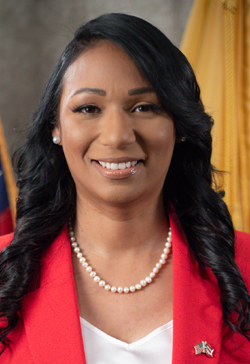
Ask Maddy about Carmen Morales
Scope: new-jersey
Hi! I can help you understand Carmen Morales's legislative record. What would you like to know?
Try one of these
i
Maddy answers using official bill text and legislative records. Always verify before sharing.
Sources cited inline