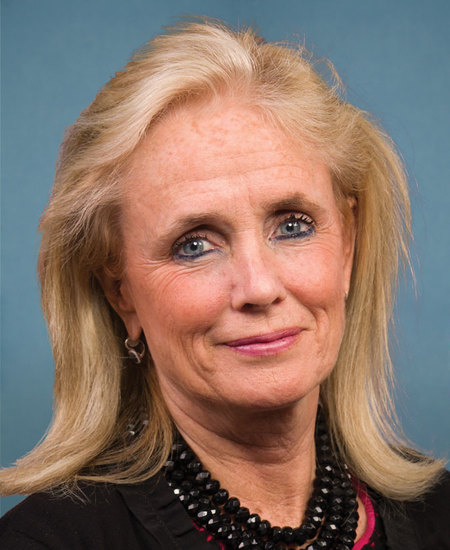
Photo of Debbie Dingell
D United States House · District 6 · Michigan On the 2026 ballot

Rep. Debbie Dingell

Compare
Total votes
2,837
all sessions
Attendance
97%
89 missed
Near the chamber average
With party
98%
of cast votes
Higher than 93% of chamber peers
Bipartisan score
1%
crosses aisle rarely
Lower than 94% of chamber peers
Sponsored
1,800
bills & resolutions
Higher than 93% of chamber peers
Committees
7
assignments
1,800 bills and resolutions

Sponsored bills

Total
1,800
Primary
191
Co-sponsor
1,609
This page
1,800
matching current filters
Primary HRES 1569
In committee · Montana House · Lead sponsor
Recognizing the importance of protecting continuous Medicaid coverage for individuals undergoing active cancer treatment.

Maddy summaryThis House resolution recognizes the critical need for continuous Medicaid coverage for individuals undergoing active cancer treatment and encourages states to simplify the process for maintaining eligibility. It urges state Medicaid programs to use existing claims and health data to automatically identify patients with cancer, thereby exempting them from community engagement requirements without requiring additional paperwork or repeated proof of their condition. The resolution also calls on the Centers for Medicare & Medicaid Services to provide technical assistance to states to implement these streamlined procedures and extend similar protections to other chronic illnesses.

In committee Sep 21, 2026 0 co-sponsors
Co-sponsor HR 9570
Passed · Montana House · Co-sponsor
To designate the facility of the United States Postal Service located at 117 West Lovett Street in Charlotte, Michigan, as the "Francis C. Flaherty Post Office Building".

Maddy summaryThis bill designates the United States Postal Service facility at 117 West Lovett Street in Charlotte, Michigan, as the "Francis C. Flaherty Post Office Building." It directly affects the specific postal location by officially changing its name in federal records and documents. The key provision ensures that all future legal and official references to this building will use the new name. This is a commemorative measure that honors an individual without altering operational policies or funding.

Passed Sep 17, 2026 1 co-sponsor
Co-sponsor HR 9191
Passed · Montana House · Co-sponsor
National Fossil Act of 2026

Maddy summaryThis bill designates the American mastodon as the national fossil mammal and the Tyrannosaurus rex as the national fossil dinosaur for the United States. It achieves this by amending Title 36 of the U.S. Code to officially recognize these specific species within the legal framework for national symbols. The changes update the relevant chapter heading to include "fossil" and add a new section to formally establish these designations.

Passed Sep 17, 2026 1 co-sponsor
Primary HCONRES 118
In committee · Montana House · Lead sponsor
Designating September 2026, as "Gynecologic Cancers Awareness Month".

Maddy summaryThis concurrent resolution designates September 2026 as Gynecologic Cancers Awareness Month to highlight conditions such as cervical, ovarian, and endometrial cancers. The bill cites statistics regarding annual diagnoses and deaths to emphasize the need for better public understanding of these diseases. It encourages individuals across the United States to learn about risk factors and supports efforts to promote prevention, research, and improved health outcomes for affected women.

In committee Sep 16, 2026 0 co-sponsors
Co-sponsor HR 10426
In committee · Montana House · Co-sponsor
Backlog Justice Act of 2026

Maddy summaryThe Backlog Justice Act of 2026 aims to reduce the backlog of untested sexual assault evidence kits by requiring the Attorney General to create a public database tracking inventory levels and laboratory processing times across state and local jurisdictions. To address staffing shortages, the bill authorizes the FBI to develop training programs for forensic analysts and DNA technical leaders, allowing states and localities to hire individuals who have completed this federal training. Additionally, it funds a program for the FBI to collaborate with state and local providers on validating new DNA processing technologies and sharing related protocols. The legislation also provides increased grant funding to states that implement electronic tracking systems allowing sexual assault survivors to monitor the status of their evidence kits from collection through final disposition.

In committee Sep 16, 2026 1 co-sponsor
Co-sponsor HR 10158
In committee · Montana House · Co-sponsor
Automotive National and Economic Security Act of 2026

Maddy summaryThe Automotive National and Economic Security Act of 2026 directs the Secretary of Commerce to conduct a study on commercial partnerships between U.S. automotive manufacturers and entities controlled by foreign adversaries. The bill defines these covered activities to include ownership interests, joint ventures, technology sharing agreements, and investments involving critical hardware or software for vehicles and automated driving systems. The study must assess potential impacts on national security, economic competitiveness, and intellectual property protection, including any involvement of state-directed investment vehicles from adversary nations. Within two years of enactment, the Secretary is required to submit a report to Congress and publish an unclassified summary online while protecting confidential business information and trade secrets.

In committee Sep 16, 2026 1 co-sponsor
Co-sponsor HR 6152
In committee · Montana House · Co-sponsor
Foreign Robocall Elimination Act

Maddy summaryHR 6152, the Foreign Robocall Elimination Act, establishes an interagency task force to address foreign robocalls entering the United States. The task force, composed of the FCC, FTC, DOJ, and private sector representatives, will study the origins, impacts, and potential solutions to foreign robocalls and must submit a report to Congress within 360 days. The bill also modifies existing law to require FCC notices about robocall mitigation every three years instead of annually, and introduces a bond requirement for providers using the Robocall Mitigation Database. This legislation affects telecommunications providers, federal agencies, and all U.S. telephone users who receive unwanted calls. The bill aims to improve coordination between U.S. agencies and foreign countries in combating illegal robocalls through concrete policy changes.

In committee Sep 16, 2026 1 co-sponsor
Co-sponsor HR 6130
In committee · Montana House · Co-sponsor
ASAP Act

Maddy summaryThis bill would require Medicare to cover early detection screening tests for Alzheimer's disease and related dementias starting January 1, 2028. It defines eligible tests as FDA-cleared genomic blood tests, blood product analyses, or equivalent medical imaging methods (like protein expression or whole genome sequencing) that detect pre-symptomatic or early-stage conditions. Medicare beneficiaries would receive this coverage without cost-sharing for these specific screenings. The bill amends Medicare coverage rules to explicitly include these tests under Section 1861(nnn) of the Social Security Act.

In committee Sep 16, 2026 1 co-sponsor
Co-sponsor HR 5967
In committee · Montana House · Co-sponsor
Strategic Task Force on Scam Prevention Act

Maddy summaryHR 5967 establishes a federal task force led by the FTC and DOJ to combat scams. The task force, including agencies like the FBI, SEC, and Social Security Administration, will develop a national strategy using existing tools such as the Consumer Sentinel Network and Internet Crime Complaint Center. Key actions include public education, coordination with industry (like banks and social media platforms), and enforcement using current laws against fraud and money laundering. The task force must report to Congress within one year and dissolve after 10 years.

In committee Sep 16, 2026 1 co-sponsor
Co-sponsor HR 2004
Passed · Montana House · Co-sponsor
Tyler’s Law

Maddy summaryHR 2004, titled "Tyler’s Law," requires the Secretary of Health and Human Services to study how often hospital emergency departments test for fentanyl during overdose cases (beyond standard drug tests), including associated costs, patient benefits/risks, and impacts on privacy and patient-physician relationships. The study must be completed within one year of the bill's enactment. Based on the study results, the Secretary must issue guidance within six months on whether emergency departments should routinely test for fentanyl, how to inform clinicians about test contents, and how such testing may affect future overdose risks and health outcomes. This bill directly affects hospital emergency departments and patients experiencing overdoses by shaping future testing protocols.

Passed Sep 16, 2026 1 co-sponsor
Showing 1 to 10 of 1,800 bills
1 2 3 … 180 Next