Maddy summaryHB 119 sought to establish the Montana Cattle Committee, a new entity composed of seven Montana cattle producers appointed by the governor. The committee would be responsible for planning and conducting research, promotion, and educational programs to benefit the state's cattle industry. To fund these activities, the bill proposed a cattle assessment to be collected from cattle sellers, which would first require approval through a referendum of those sellers. Funds from this assessment would be deposited into a dedicated cattle special revenue account for the committee's use.

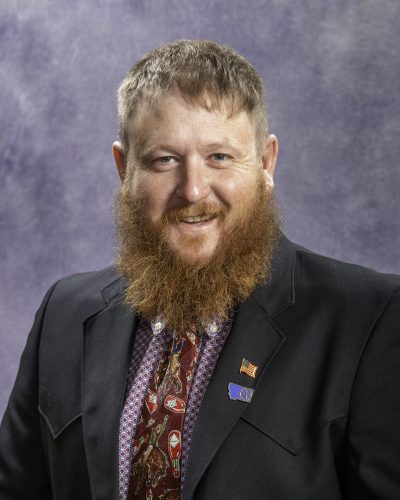
Rep. Brandon Ler
Sponsored bills
Maddy summaryHouse Bill 647 proposes to prohibit nonprofit organizations from leasing state lands or timber. The bill directly affects nonprofit organizations and the state entities responsible for managing state trust lands. It amends several existing state statutes to make it unlawful for any official or employee of a nonprofit organization to lease state lands or timber on behalf of their organization. This change would restrict the state board's authority to lease state trust lands for commercial or other purposes to nonprofits.
Maddy summaryHB 646 proposed to change the method of electing and appointing Supreme Court justices from statewide at-large elections to a district-based system. The bill would establish seven specific supreme court judicial districts across the state, with one justice to be selected from each district. It also included a transition plan, assigning current justices to specific districts for future re-election. This measure aimed to alter how voters elect and how candidates run for positions on the state's highest court.
Maddy summaryHB 389, titled "Provide for setbacks for wind turbine generators," aimed to establish specific minimum distances for the construction of new wind turbine generators in Montana. The bill would have required wind turbines to be set back at least 1,250 feet from property lines with a wind energy agreement, 3,000 feet from public roads, and 7,920 feet from property lines without a wind energy agreement. This legislation would have directly affected wind energy developers and landowners by regulating the placement of new wind energy infrastructure.
Maddy summaryHouse Bill 928 sought to revise the property tax calculation for agricultural land owned by specific nonprofit corporations. It proposed creating a new subcategory of Class three property for agricultural land acquired by nonprofits after the bill's effective date, excluding entities like churches, schools, and hospitals. For this particular land, its taxable value would have been determined by multiplying its productive capacity value by 10 times the standard agricultural land taxable percentage rate. This mechanism aimed to increase the taxable value of agricultural property held by certain nonprofits.
Maddy summaryHB 838 would revise election laws to allow candidates for Chief Justice and Justice of the Supreme Court to indicate a political party affiliation. These candidates could include their party affiliation on their nomination declaration, which would then appear on primary and general election ballots. The bill also permits these candidates to publicly announce their political affiliations and campaign endorsements. If a candidate does not indicate a party affiliation, the word "Nonpartisan" would appear next to their name on the ballot. This changes the current nonpartisan nature of these specific judicial races.
Maddy summaryHB 480 revises when a party in a legal proceeding is entitled to a jury trial. The bill grants any party the right to demand a trial by jury to determine issues of fact in proceedings that challenge the constitutionality or legality of a legislative act or a proposed or adopted ballot issue. This means that in disputes over the validity of laws or voter-approved measures, a jury can be called upon to decide factual disagreements. The bill amends Section 27-8-302, MCA, to incorporate this provision.
Maddy summaryHB 711 revises the process for selecting the presiding officer of the Districting and Apportionment Commission. This commission is responsible for drawing legislative district boundaries. If the initial four commissioners cannot agree on a fifth member, the Supreme Court makes the selection. Under this bill, the Supreme Court is prohibited from choosing an individual for this role who has made a campaign contribution to a major party candidate for state or federal office within the last 10 years.
Maddy summaryHB 676 proposes revisions to state laws governing land and water rights. It would eliminate the Water Court's duty to complete water rights adjudication by July 1, 2030, and repeals several related statutes. The bill also prohibits the Board of Land Commissioners from acquiring private water rights for state lands. Additionally, it requires the state to sell isolated land parcels with water rights to their current lessees, impacting water rights holders, the Water Court, and state land management.
Maddy summaryHB 554 changes how the Department of Fish, Wildlife, and Parks (FWP) manages wolves after they are removed from endangered species lists. It removes a previous requirement that mandated FWP to classify and regulate wolves as either game animals or furbearers. Under the amended law, the Fish and Wildlife Commission now has the discretion to declare wolves as game animals or furbearers, allowing for regulated hunting or trapping, but it is no longer a mandatory classification. The bill also retains provisions for controlling wolves to protect livestock, consistent with an approved wolf management plan.