Maddy summaryHB 3286 modifies Missouri's domestic violence protection order process to require courts to prohibit respondents from possessing firearms during active orders. It mandates that courts issue written firearm prohibitions, orally inform respondents, and immediately notify the Missouri Highway Patrol to update the National Instant Criminal Background Check System (NICS). This applies specifically to individuals subject to domestic violence protection orders, directly affecting respondents in such cases. The bill adds this firearm restriction as a standard provision within existing protection order mechanisms, without altering other elements like custody or child support.

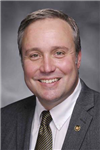
Rep. Jeff Hales
Sponsored bills
Maddy summaryHB 3519 requires businesses offering automatic renewals or continuous services to clearly explain renewal terms before consumers agree to them, directly affecting subscribers to services like streaming, software, or memberships. It mandates that businesses obtain explicit consumer consent before charging for renewals (including promotional periods), provide easy cancellation methods (such as toll-free numbers or email), and send clear, retainable cancellation instructions. Businesses must also notify consumers of material term changes and include cancellation details in initial agreements. Violations could result in $50,000 civil penalties per violation enforced by the attorney general.
Maddy summaryHJR 197 is a constitutional amendment establishing new rules for selecting members of certain Missouri districts. It requires city and county governing bodies to create six districts with near-equal populations, redraw them after each census, and set term lengths for board members. These changes would take effect following the 2026 election cycle. The amendment directly affects local governing bodies responsible for district planning, not voters or residents.
Maddy summaryHB 3521 requires the Department of Revenue to issue free nondriver's licenses to individuals who certify their homelessness and residency status using a department-provided form. These licenses contain standard identification details (name, photo, address) and are valid solely for identification purposes, not driving. The bill specifically waives the standard $6 fee for homeless applicants while maintaining all other license requirements, such as photo verification for non-homeless individuals. This policy directly affects unhoused residents seeking a reliable form of state-issued ID. The law aims to provide accessible identification for a population often excluded from standard licensing processes.
Maddy summaryHB 3520 requires the Department of Revenue to provide every resident with one free original nondriver's license and one free renewal or replacement nondriver's license every two years. This eliminates all fees for these identification cards, which are used for official identification but not for driving. The bill directly affects all individuals who obtain a nondriver's license, ensuring no cost for initial issuance or replacements within the two-year cycle. It mandates that the state cover all administrative and processing fees for these licenses, making them fully free for residents.
Maddy summaryHJR 198 proposes a constitutional amendment in Missouri that would prevent the state legislature (General Assembly) from amending or repealing any initiative measure approved by voters through a simple majority vote. This would require any change to such voter-approved initiatives to be put to another statewide referendum vote. The amendment would apply specifically to initiatives passed directly by voters, not to other legislative acts. It does not change current rules for how initiatives are created or how referendums work for other laws.
Maddy summaryHB 2843 increases the annual fee for repairing lateral sewer service lines (the pipes connecting homes to public systems) from $50 to $100 per residential property with six or fewer dwelling units. It also applies to condominiums with six or fewer units per building, requiring each unit to pay its share of the fee if served by its own individual sewer line. The fee requires voter approval via a local referendum before implementation, and collected funds must be used exclusively for repairing defective sewer lines in a dedicated account. This bill directly affects homeowners and condo owners in specific Missouri counties with populations between 210,000 and 300,000.
Maddy summaryHB 2063 requires Missouri's Secretary of State to provide all printed public materials in Spanish upon request. This applies to materials published and distributed by the Secretary of State's office, such as voter guides or forms. The bill adds a new section (28.950) to state law, mandating Spanish availability without requiring automatic translation of all materials. It directly affects Spanish-speaking residents and others who need these materials in a language they understand. The change is limited to printed materials and only when a specific request is made.
Maddy summaryHB 2066 would repeal Missouri's current law prohibiting same-sex marriage, specifically targeting Section 451.022 of the Revised Statutes of Missouri. This section currently bans marriage licenses for same-sex couples, invalidates such marriages, and prevents recognition of same-sex marriages even if valid elsewhere. If enacted, the bill would remove these restrictions, allowing same-sex couples to legally marry and have their marriages recognized under Missouri law. The change would directly affect same-sex couples seeking marriage licenses and county recorders responsible for issuing them.
Maddy summaryHB 2251 establishes Missouri's "Free School Meals Program," requiring participating public, charter, and private schools to provide all students with free breakfast and lunch daily. Schools must qualify by participating in the USDA National School Lunch Program and meeting specific student eligibility thresholds. The state reimburses schools for the difference between federal meal reimbursement rates and the actual federal funds received per meal, covering up to one free breakfast and one free lunch per student each day. This program applies only to schools already enrolled in USDA meal programs with identified student poverty rates meeting federal criteria. The Department of Elementary and Secondary Education administers the state aid payments and sets implementation rules.