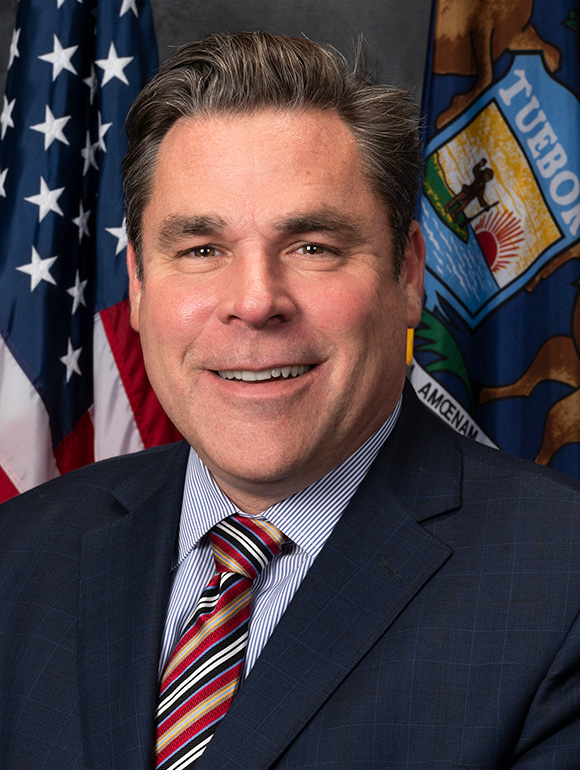
Photo of John Damoose
R Michigan Senate · District 37 On the 2026 ballot

Sen. John Damoose

Compare
Total votes
2,449
all sessions
Attendance
98%
51 missed
Near the chamber average
With party
92%
of cast votes
Lower than 82% of chamber peers
Bipartisan score
4%
crosses aisle rarely
Higher than 78% of chamber peers
Sponsored
529
bills & resolutions
Near the chamber average
Committees
4
assignments
529 bills and resolutions

Sponsored bills

Total
529
Primary
90
Co-sponsor
439
This page
529
matching current filters
Primary SB 71
Signed into law · Michigan Senate · Lead sponsor
Highways: bridges; Mackinac Bridge; designate as a key facility. Amends sec. 552c of 1931 PA 328 (MCL 750.552c).

Maddy summarySB 71 amends Michigan's penal code to specifically designate the portions of the Mackinac Bridge not open to the public as a "key facility." This means unauthorized entry to these restricted bridge areas would be prohibited, with violations punishable by up to four years in prison or a $2,500 fine. The law requires these areas to be clearly marked with signage meeting specific size and spacing standards (minimum 1-inch letters, 50 square inches per sign, spaced for visibility). The bill does not affect public access to bridge sections already open to pedestrians or restrict lawful public gatherings.

Signed into law Jul 29, 2026 0 co-sponsors
Co-sponsor SB 456
Signed into law · Michigan Senate · Co-sponsor
Law enforcement: reports; notification of the public through wireless devices of a missing senior or vulnerable adult; provide for. Amends title & sec. 5 of 2012 PA 176 (MCL 28.715).

Maddy summarySB 456 amends Michigan's "Mozelle senior or vulnerable adult medical alert act" to require law enforcement agencies to activate a text-message alert system for missing seniors or vulnerable adults. After filing a report under Section 3, agencies must notify the State Police to trigger a system that sends location-specific alerts via wireless devices through the existing emergency alert network. This directly affects vulnerable individuals and their families by enabling rapid public notification through texts, broadcasters, and newspapers. The bill mandates that alerts include descriptions and relevant details to aid in locating missing persons, while ensuring the system operates only after a completed report and per State Police policies.

Signed into law Jul 29, 2026 1 co-sponsor
Primary SB 1090
In committee · Michigan Senate · Lead sponsor
Courts: funding; trial court funding; provide for. Amends sec. 13, ch. II, secs. 1k & 5, ch. IX & secs. 1, 3, 3c & 3e, ch. XI of 1927 PA 175 (MCL 762.13 et seq.). TIE BAR WITH: SB 1089'26

Maddy summaryThis bill updates Michigan's criminal procedure code to clarify how courts assess and collect financial costs from defendants. It requires judges to determine if a defendant is financially unable to pay before ordering fines or court fees. If a defendant is not indigent, the court can impose specific minimum state costs and additional expenses related to the trial, such as personnel salaries and facility maintenance, but must waive these charges for those who qualify as indigent. The legislation also establishes a fee structure for probation supervision, charging $30 per month without electronic monitoring or $60 per month with it, while allowing courts to waive these fees for indigent individuals.

In committee Jul 2, 2026 0 co-sponsors
Co-sponsor SB 1089
In committee · Michigan Senate · Co-sponsor
Courts: funding; trial court funding; provide for. Amends secs. 880d, 8727 & 8827 of 1961 PA 236 (MCL 600.880d et seq.); adds secs. 1495, 1496 & 1497 & repeals secs. 8729 & 8829 of 1961 PA 236 (MCL 600.8729 & 600.8829). TIE BAR WITH: SB 1090'26

Maddy summaryThis bill establishes a standardized process for courts to determine whether individuals can afford court-related fees and fines. It requires judges to conduct a three-part financial assessment before imposing costs, which includes checking if a person receives public assistance, has income below a specific low-income threshold, or faces unique financial hardships. Under the new rules, people currently incarcerated are automatically considered indigent, and those found to be unable to pay will not be ordered to cover court costs or fees. Additionally, the legislation allows individuals to request a review of their financial status after sentencing if their circumstances have changed, potentially leading to the waiver of previously imposed charges.

In committee Jul 2, 2026 1 co-sponsor
Co-sponsor SB 1091
In committee · Michigan Senate · Co-sponsor
Courts: funding; trial court funding; provide for. Amends sec. 907 of 1949 PA 300 (MCL 257.907) & repeals sec. 908 of 1949 PA 300 (MCL 257.908). TIE BAR WITH: SB 1089'26

Maddy summaryThis bill amends the Michigan Vehicle Code to clarify how civil traffic infractions are handled in court, specifically preventing them from being treated as lesser included offenses of criminal charges. It establishes specific fine ranges for various violations, such as speeding and equipment failures, while also setting a maximum cost limit of $100 for court expenses. The legislation allows judges to order treatment or education programs for offenders and requires courts to publish schedules of fines that must account for indigent defendants. Additionally, it mandates that courts waive fines and costs if a driver repairs defective safety equipment before their court date.

In committee Jul 2, 2026 1 co-sponsor
Co-sponsor SCR 13
Passed · Michigan Senate · Co-sponsor
A concurrent resolution of tribute offered as a memorial for R. Robert Geake, former member of the Senate and House of Representatives.

Maddy summaryThis bill is a memorial resolution honoring the life and public service of R. Robert Geake, a former Michigan legislator who served in both the House of Representatives and the Senate. The text details his extensive career, including his legislative work on committees focused on education, mental health, and children's welfare, as well as his later roles as an investigator and chair of the Office of the Children's Ombudsman and the Legislative Retirement System Board. The resolution formally expresses the Legislature's tribute to his dedication and instructs that copies of the document be sent to his family.

Passed Jun 25, 2026 1 co-sponsor
Co-sponsor SB 1057
In committee · Michigan Senate · Co-sponsor
Occupations: individual licensing and registration; preliminary determination process for certain applicants seeking licensure or registration; modify. Amends secs. 202, 203 & 217 of 2016 PA 407 (MCL 339.5202 et seq.).

Maddy summaryThis bill modifies Michigan's skilled trades regulation act to create a preliminary determination process for individuals with criminal convictions who are seeking professional licenses. Under the new rules, applicants can submit a request to the department to get an early assessment of whether their past court judgments would likely lead to a license denial based on good moral character requirements. The department must provide this written decision within 60 days and cannot require the applicant to complete education or training before making this initial review. Additionally, the bill requires the department to publish an annual report detailing the number of license denials and the specific criminal offenses that led to those decisions.

In committee Jun 23, 2026 1 co-sponsor
Co-sponsor SB 1055
In committee · Michigan Senate · Co-sponsor
Health: licensing; preliminary determination process for certain applicants seeking licensure or registration; modify. Amends secs. 16174a & 16241 of 1978 PA 368 (MCL 333.16174a & 333.16241).

Maddy summaryThis bill modifies Michigan's Public Health Code to create a preliminary determination process for individuals seeking professional licensure or registration who have criminal court judgments. It allows applicants to request a written decision from the Department of Health and Human Services on whether their criminal history would likely result in a license denial based on good moral character requirements. The process requires applicants to submit a specific form, a nonrefundable fee, and details of their criminal proceedings, with the department required to provide a response within 60 days. Additionally, the bill clarifies that a negative preliminary determination does not bar a future license application and mandates that the department publish lists of disciplined individuals to inform the public and relevant agencies.

In committee Jun 23, 2026 1 co-sponsor
Co-sponsor SB 1056
In committee · Michigan Senate · Co-sponsor
Occupations: individual licensing and registration; preliminary determination process for certain applicants seeking licensure; modify. Amends secs. 202a & 411 of 1980 PA 299 (MCL 339.202a & 339.411).

Maddy summaryThis bill amends Michigan's occupational code to create a preliminary determination process for individuals seeking professional licenses who have criminal convictions. It allows applicants to request an early assessment from the department to see if their past court judgments would likely lead to a denial based on good moral character requirements. The legislation also modifies rules for relicensing, permitting individuals who let their licenses expire to renew without re-examination or additional training if they apply within three years and meet specific conditions. These changes aim to provide clearer guidance for applicants with criminal records and streamline the process for those who have lapsed in maintaining their professional credentials.

In committee Jun 23, 2026 1 co-sponsor
Co-sponsor SB 1016
In committee · Michigan Senate · Co-sponsor
State agencies (proposed): other; grants for community violence intervention services; provide for. Creates new act. TIE BAR WITH: SB 1015'26

Maddy summaryThis bill establishes a new grant program and fund to support community violence intervention and prevention efforts in Michigan. It directs state funding to eligible local governments and nonprofit organizations that meet specific criteria, such as having high homicide rates or a demonstrated need to address violence. The grants must be used for evidence-based strategies that utilize trauma-informed care, expand economic opportunities, and avoid contributing to mass incarceration. Furthermore, the legislation requires that at least 75% of any grant given to a local government be passed on to community-based or nonprofit groups, ensuring that law enforcement agencies do not receive these specific funds. The bill also mandates regular reporting on financial use and program outcomes to ensure accountability.

In committee Jun 23, 2026 1 co-sponsor
Showing 1 to 10 of 529 bills
1 2 3 53 Next