

Maddy summaryMichigan House Bill 6317 establishes a legal framework for community cat programs by defining free-roaming cats without visible identification as "community cats" and exempting them from state and local licensing, at-large, and feeding restrictions. The bill authorizes program sponsors to release these cats back into their original locations after they have been sterilized, vaccinated against rabies, and ear-tipped, a process that must be performed while the animal is anesthetized. Individuals who care for these cats are legally protected from being classified as owners or possessors, which prevents them from violating local pet ownership limits, though they remain subject to existing laws prohibiting animal cruelty and neglect. Sponsors and caretakers are required to maintain sterilization and vaccination records for at least three years and make reasonable efforts to arrange veterinary care for sick or injured animals.
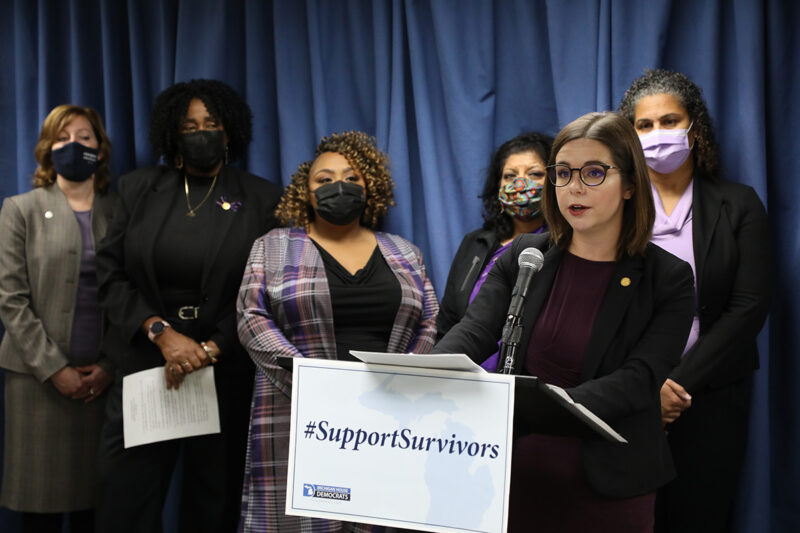
Rep. Laurie Pohutsky
Sponsored bills
Maddy summaryMichigan House Bill 6318 amends the state election law to explicitly prohibit denying or abridging any citizen's right to vote based on their sex. The bill adds a new section, 492c, to the Michigan Election Code to establish this specific protection. This provision directly affects all voters in the state by ensuring that gender cannot be used as a basis for restricting voting access.
Maddy summaryThis bill designates euchre as the official game of the state of Michigan. It creates a new act to formally establish this title in state law. The legislation does not impose any regulations or restrictions on how the game is played, but rather serves as a symbolic designation for the state.
Maddy summaryThis Michigan bill amends the state's vehicle code to clarify that traffic violations designated as civil infractions cannot be treated as lesser included offenses of criminal charges. It establishes specific fine ranges for various driving and vehicle equipment violations, including a new provision that requires courts to waive fines and costs if a driver cited for an illegible registration plate provides proof of having obtained and installed a compliant plate before their court date. The legislation also mandates a $40 justice system assessment for most civil infractions and allows judges to order additional educational or rehabilitation programs alongside monetary penalties.
Maddy summaryThis bill expands the powers and duties of Michigan's Office of the Legislative Corrections Ombudsman, which handles complaints from prisoners, their advocates, and legislators regarding conditions in state correctional facilities. Key changes require the ombudsman to notify complainants and affected prisoners when investigating or declining to investigate complaints, and mandate that the office consult with the Department of Corrections before issuing any report that criticizes the department or its staff. The legislation also establishes strict reporting requirements, forcing the ombudsman to publish detailed monthly and annual reports on complaint statistics and department responses, while adding protections to ensure that individuals cannot be penalized for filing complaints or cooperating with the ombudsman. Additionally, the bill clarifies that the ombudsman's authority operates alongside, rather than replacing, existing legal remedies and appeal processes for prisoners.
Maddy summaryHB 5920 expands the powers of Michigan's Office of the Legislative Corrections Ombudsman to better investigate issues within the Department of Corrections. The bill allows the ombudsman to launch investigations based on complaints from prisoners, legislators, or family members, as well as on their own initiative regarding safety and security concerns. Key provisions include granting the ombudsman access to medical and mortality records, the ability to hire qualified experts for inspections, and the authority to enter correctional facilities at any time, including during emergencies.
Maddy summaryThis bill requires K-5 teachers and literacy support staff in Michigan to complete specific professional training focused on reading and literacy instruction by the 2029-2030 school year. The legislation designates a single state-approved provider to deliver the training, which must cover evidence-based reading methods, assessment strategies, and a multitiered system of supports for addressing learning difficulties. School districts must report annual compliance data to the state department, which will publish public reports on implementation progress and recommend funding adjustments as needed. The training includes mandatory components on phonics, vocabulary, comprehension, and data-driven decision-making, with phased implementation beginning in the 2026-2027 school year.
Maddy summaryHB 5570 would allow single exit stairways in small multi-family buildings (up to 4 floors above ground or 3 floors with an occupiable roof) under strict safety conditions. It applies to buildings with no more than 4 units per floor and 4,000 square feet per floor. Required safety features include fire alarms, smoke detectors in common areas (like hallways and laundry rooms), and sprinklers meeting NFPA standards. This change would affect housing developers building qualifying new or renovated apartment buildings.
Maddy summaryHB 5571 allows single interior exit stairways in multi-family apartment buildings with 4-6 levels (or 3-5 levels with an occupiable roof), directly affecting developers and builders of such structures. The bill requires buildings to have no more than 4 units per level, limit floor area to 4,000 sq ft per level, and ensure exit access travel is ≤125 feet from any point. Key safety provisions include mandatory smoke detectors in common areas (like hallways and laundry rooms), manual fire alarms, automatic smoke detection systems, and sprinklers meeting NFPA standards. It also mandates that the building’s fire department must be accredited by the Commission on Fire Accreditation International and hold a Class 1-2 public protection rating. The bill is contingent on HB 5570 passing into law.
Maddy summaryHB 4072 requires hospitals and freestanding surgical outpatient facilities to offer patients any unused eye drops or eye ointments after ophthalmic surgical procedures or medical care. This applies when the facility-provided medication was administered to the patient and is required for their ongoing treatment upon discharge. The bill details labeling requirements if a pharmacist dispenses the drug, and assigns the responsibility for patient counseling on its use to the prescribing doctor. This allows patients to take home remaining eye medications for continued care.