

Maddy summarySB 2102 proposes a constitutional amendment to establish an independent Legislative and Congressional Redistricting and Apportionment Commission, which would take over the process of drawing state legislative and congressional district maps from the General Assembly. The bill requires that all House of Delegates districts be single-member units and sets specific standards for map drawing, including prohibitions against considering political party affiliation or the residence of incumbent officeholders when creating boundaries. If the commission fails to adopt a plan or if the legislature rejects the proposed maps, the Supreme Court of Maryland would gain original jurisdiction to establish the final district plans. The legislation also mandates public hearings and transparency requirements for the redistricting process, with the constitutional changes subject to voter approval in the November 2026 general election.
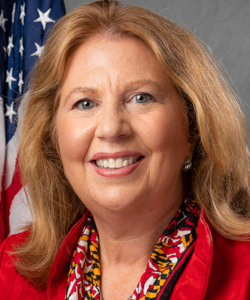
Sen. Mary Beth Carozza
Sponsored bills
Maddy summarySB 148 expands Maryland's income tax break for retired public safety employees to include 9-1-1 specialists. The bill modifies the tax code to allow retired 9-1-1 specialists - defined as those working at county emergency call centers handling emergency requests - to subtract up to $15,000 of their retirement income from taxable income, just like correctional officers and emergency medical personnel. This change applies to retirees aged 55+ who receive retirement income attributable to their work as 9-1-1 specialists. The law takes effect for tax years beginning after December 31, 2025.
Maddy summarySB 709 creates Maryland's Purple Star Colleges Program to recognize institutions of higher education that provide strong support for military-connected students. The bill updates the definition of "military-connected student" to include service members, veterans, and their spouses/dependents, and establishes specific requirements for colleges seeking designation. To qualify, colleges must designate a uniformed services liaison, maintain a dedicated webpage with transition resources, offer student-led transition programs, and provide staff training on military-connected student needs. Administered by the Maryland Higher Education Commission, this program complements the existing Purple Star Schools Program and directly affects colleges and military-connected students statewide.
Maddy summarySB 728 amends Maryland's Community College Promise Scholarship eligibility to include graduates of Delmar High School in Delmar, Delaware, who reside in Delmar, Maryland. The bill adds a new eligibility criterion requiring applicants to have graduated from Delmar High School (Delaware) and to be Maryland residents of Delmar. This change applies to students pursuing vocational certificates, certificates, associate's degrees, or registered apprenticeships at eligible Maryland community colleges. The amendment takes effect July 1, 2026, expanding existing scholarship access for this specific group without altering other program requirements.
Maddy summarySB 846 creates two new permit types for Worcester County: a temporary "to-go event permit" for Class B license holders (restaurants/hotels) and a "Class C per diem municipal to-go license" for counties to designate special event areas. It allows these businesses to sell beer, wine, and liquor in approved to-go cups for consumption within designated event zones during permitted events. The bill establishes a $20 daily fee for the temporary permit and requires municipalities to adopt regulations for event areas, hours, age verification, and cup specifications. This policy directly affects Worcester County restaurants, hotels with Class B licenses, and local municipalities managing special events.
Maddy summaryThis bill authorizes Wicomico County or its municipalities to grant a property tax credit against local property taxes for real estate owned by Salisbury Neighborhood Housing Services, Inc. (SNHS), specifically for properties SNHS intends to transfer to private owners within a near future. The credit applies only to properties used for development, rehabilitation, and transfer to private owners, excluding administrative or warehouse buildings owned by SNHS. SNHS must submit annual reports detailing all its property holdings and transactions in the jurisdiction granting the credit. The credit becomes effective for taxable years beginning after June 30, 2026.
Maddy summarySB 681 increases the number of members on Worcester County's Board of License Commissioners from three to five. The bill modifies Maryland law to require the Governor to appoint five residents of the county with business experience, serving four-year terms with staggered expiration dates. This change affects only Worcester County's local alcohol licensing board, not statewide regulations, and takes effect June 1, 2026. The bill does not alter licensing rules or processes - only the board's composition.
Maddy summarySB 242, the Modernizing Civil Relief for Service Members Act, allows active-duty service members and their spouses to practice in Maryland under an occupational or professional license issued by another state, without needing to meet all of Maryland’s usual licensing requirements. It also expands eligibility for veterans’ licensing benefits to include former service members who were discharged more than a certain period before applying for a license. The bill creates new provisions (Subtitle 14A) in Maryland law to streamline this process and updates definitions to clarify who qualifies under these rules. These changes directly affect military personnel, their families, and veterans seeking to work in licensed professions across Maryland.
Maddy summarySB 285 expands Maryland's existing scholarship program to include correctional officers. The bill amends state law to add "correctional officers" to the eligibility criteria for the Maryland Police Officers, Probation Agents, and Correctional Officers Scholarship Program, which previously covered only police officers and probation agents. It defines "correctional officer" per Maryland law and allows current or future correctional officers to apply for tuition assistance if they meet residency, enrollment, and service obligation requirements. The scholarship requires recipients to work in the field for at least five years within eight years of graduation or repay funds. This change directly affects correctional officers seeking higher education in Maryland.
Maddy summarySB 101 adds correctional officers to Maryland's existing loan repayment and scholarship programs for public safety workers. It expands the Maryland Loan Assistance Repayment Program (Subtitle 37) to allow correctional officers who work in state facilities for at least two years to get help repaying higher education loans. It also creates a new scholarship program (Subtitle 38) for students or current correctional officers pursuing relevant degrees, requiring a five-year service commitment after graduation. The bill directly affects correctional officers statewide by providing financial support for education and career advancement. The changes take effect July 1, 2026.